AI智能总结
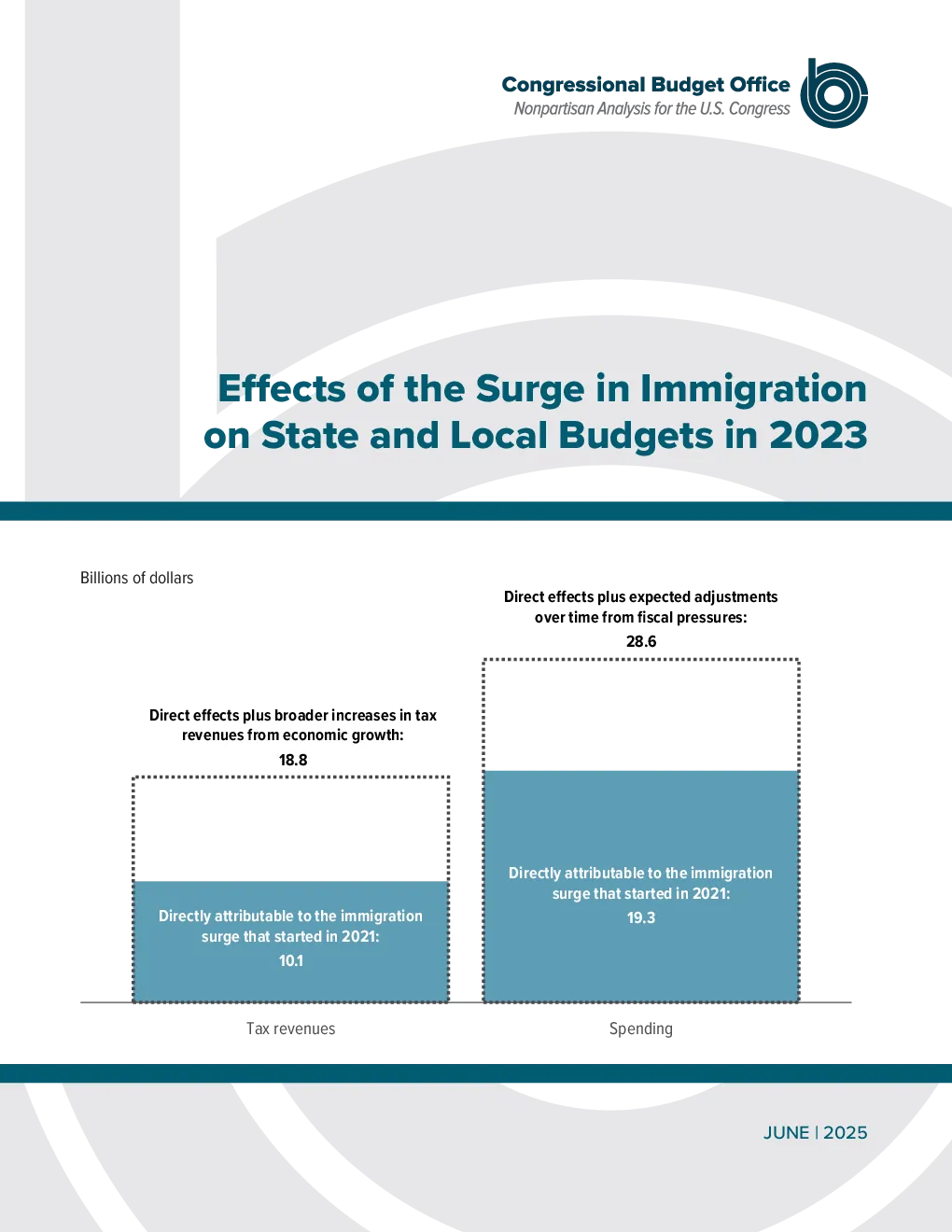
At a GlanceIn this report, the Congressional Budget Office estimates how the surge in immigration that began in2021 affected state and local budgets in 2023. In addition to estimating the direct effects of the surge,CBO calculated an alternative measure that includes the potential broader or longer-term effects andcosts that were borne without adding to spending—such as crowding in public schools and publictransportation systems. By either measure, the surge imposed a net cost.•Direct Effects.The surge led to a direct increase in revenues of $10.1 billion, primarily fromsales taxes, and a direct increase in spending of $19.3 billion, chiefly for public elementary andsecondary education, shelter and related services, and border security. The result was a directnet cost of $9.2 billion in 2023, amounting to 0.3 percent of state and local spending (net offederal grants-in-aid).•Potential Effects.In addition to those direct effects, CBO’s alternative measure accounts forexpected increases in property tax revenues, additional tax revenues from greater economic activity,and nonbudgetary costs associated with greater demand for government services. By that measure,the surge in immigration had the potential to increase revenues by $18.8 billion and spendingby $28.6 billion, resulting in a potential net cost to state and local governments of $9.8 billionin 2023. www.cbo.gov/publication/61256 ContentsSummaryThe Surge in ImmigrationCBO’s AnalysisEffects of the Surge in Immigration on State and Local Budgets in 2023The Surge Population in 2023How Immigration Affects State and Local BudgetsEffects of the Surge in Immigration on State and Local Tax RevenuesTaxation and ImmigrationSales TaxesProperty TaxesIncome TaxesOther TaxesIncreases in Tax Revenues From Overall Changes in the EconomyEffects of the Surge in Immigration on State and Local SpendingEducationShelter and Related ServicesBorder SecurityHealth Insurance and Income Security ProgramsIncarcerationGeneral Services Allocated Equally to AllSources of Uncertainty in CBO’s EstimatesNumber of Other Foreign Nationals in the Immigration SurgeCharacteristics of the Surge PopulationGeographic Distribution of the Surge PopulationEstimation MethodsImmigrants’ Behaviors and Governments’ ResponsesAppendix A: Methods Used to Estimate the Effects of the Immigration SurgeAppendix B: Comparison With Estimates From Other StudiesList of Tables and FiguresAbout This DocumentBox1.Categories of Immigrants 10111112141516161616161719333536 11224567788883 Notes About This ReportUnless this report indicates otherwise, all years referred to are calendar years.Numbers in the text, tables, and figure may not add up to totals because of rounding.In this report, the surge in immigration refers to the significant increase in the number of peopleentering the United States that began in 2021 and peaked in 2023 before slowing in 2024 and 2025.Estimates of net immigration in this report are based on demographic projections in CongressionalBudget Office,The Demographic Outlook: 2024 to 2054(January 2024),www.cbo.gov/publication/59697. Those estimates were updated in 2025; CBO used the 2024 projections in thisanalysis to maintain consistency with its previous analysis of the federal budgetary effects of the surgein immigration. See Congressional Budget Office,Effects of the Immigration Surge on the FederalBudget and the Economy(July 2024),www.cbo.gov/publication/60165. CBO does not produce10-year baseline projections for state and local budgets. Therefore, whereas that report projected theeffects of the surge over the 2024–2034 period, this report focuses on the effects in 2023. Effects of the Surge in Immigrationon State and Local Budgets in 2023SummaryThe number of people entering the United Statesincreased sharply starting in 2021 and peaked in2023 before slowing in 2024. That surge in immigrationimposed a fiscal burden on state and local governments.In this report, the Congressional Budget Office examinesthe fiscal impact of that surge in 2023. State and local taxrevenues grew, especially sales tax revenues, but the costsof providing services grew more. The largest increases incosts were for primary and secondary education, shelterand related services, and border security. Costs for incar-ceration and income security programs also increased.The Surge in ImmigrationMost immigrants in the surge were people whom CBOcategorizes asother foreign nationals—immigrants whowere not lawful permanent residents, were not eligibleto apply for lawful permanent residency on the basis oftheir current status, and were not admitted on a tempo-rary basis under the Immigration and Nationality Act(INA). Some of those immigrants received permission toenter or remain in the country (for example, through theuse of parole authority), and some did not.1Some hadnewly arrived, and some had been residing in the UnitedStates under a temporary status that expired.All told, the surge in immigration that started in2021 add