大宗商品周期与结构变化的特征
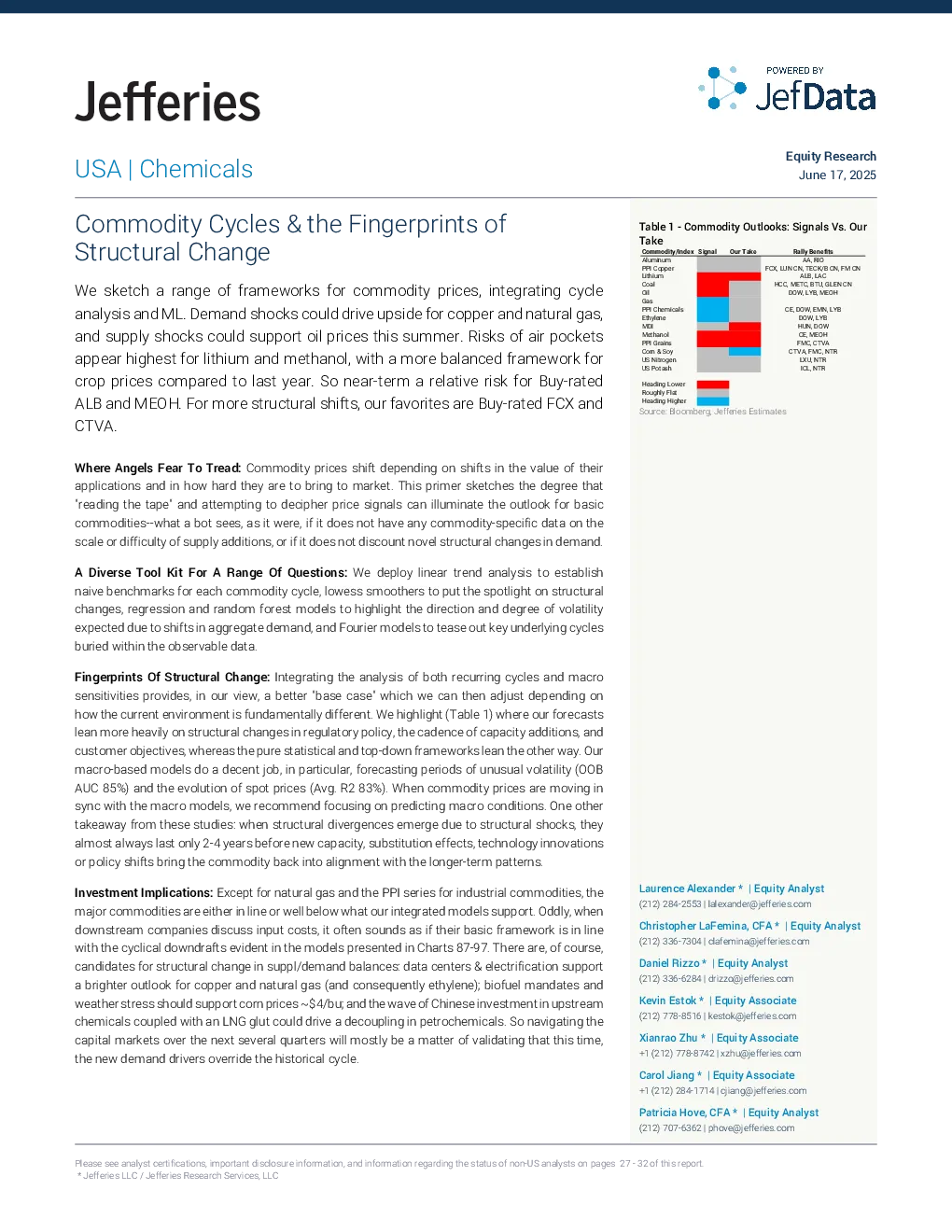
Equity ResearchJune 17, 2025 USA | Chemicals Commodity Cycles & the Fingerprints ofStructural Change We sketch a range of frameworks for commodity prices, integrating cycleanalysis and ML. Demand shocks could drive upside for copper and natural gas,and supply shocks could support oil prices this summer. Risks of air pocketsappear highest for lithium and methanol, with a more balanced framework forcrop prices compared to last year. So near-term a relative risk for Buy-ratedALB and MEOH. For more structural shifts, our favorites are Buy-rated FCX andCTVA. Where Angels Fear To Tread:Commodity prices shift depending on shifts in the value of theirapplications and in how hard they are to bring to market. This primer sketches the degree that"reading the tape" and attempting to decipher price signals can illuminate the outlook for basiccommodities--what a bot sees, as it were, if it does not have any commodity-specific data on thescale or difficulty of supply additions, or if it does not discount novel structural changes in demand. A Diverse Tool Kit For A Range Of Questions:We deploy linear trend analysis to establishnaive benchmarks for each commodity cycle, lowess smoothers to put the spotlight on structuralchanges, regression and random forest models to highlight the direction and degree of volatilityexpected due to shifts in aggregate demand, and Fourier models to tease out key underlying cyclesburied within the observable data. Fingerprints Of Structural Change:Integrating the analysis of both recurring cycles and macrosensitivities provides, in our view, a better "base case" which we can then adjust depending onhow the current environment is fundamentally different. We highlight (Table 1) where our forecastslean more heavily on structural changes in regulatory policy, the cadence of capacity additions, andcustomer objectives, whereas the pure statistical and top-down frameworks lean the other way. Ourmacro-based models do a decent job, in particular, forecasting periods of unusual volatility (OOBAUC 85%) and the evolution of spot prices (Avg. R2 83%). When commodity prices are moving insync with the macro models, we recommend focusing on predicting macro conditions. One othertakeaway from these studies: when structural divergences emerge due to structural shocks, theyalmost always last only 2-4 years before new capacity, substitution effects, technology innovationsor policy shifts bring the commodity back into alignment with the longer-term patterns. Laurence Alexander * | Equity Analyst(212) 284-2553 | lalexander@jefferies.com Investment Implications:Except for natural gas and the PPI series for industrial commodities, themajor commodities are either in line or well below what our integrated models support. Oddly, whendownstream companies discuss input costs, it often sounds as if their basic framework is in linewith the cyclical downdrafts evident in the models presented in Charts 87-97. There are, of course,candidates for structural change in suppl/demand balances: data centers & electrification supporta brighter outlook for copper and natural gas (and consequently ethylene); biofuel mandates andweather stress should support corn prices ~$4/bu; and the wave of Chinese investment in upstreamchemicals coupled with an LNG glut could drive a decoupling in petrochemicals. So navigating thecapital markets over the next several quarters will mostly be a matter of validating that this time,the new demand drivers override the historical cycle. Christopher LaFemina, CFA * | Equity Analyst(212) 336-7304 | clafemina@jefferies.com Daniel Rizzo * | Equity Analyst(212) 336-6284 | drizzo@jefferies.com Kevin Estok * | Equity Associate(212) 778-8516 | kestok@jefferies.com Xianrao Zhu * | Equity Associate+1 (212) 778-8742 | xzhu@jefferies.com Carol Jiang * | Equity Associate+1 (212) 284-1714 | cjiang@jefferies.com Patricia Hove, CFA * | Equity Analyst(212) 707-6362 | phove@jefferies.com Quick Takes & Key Conclusions In this report we focus on 20 commodities, and run a more comprehensive Fourier analysis on 11.Two overarching conclusions are that, in most cases, we have a significantly more upbeat take onthe commodity outlooks than the statistical analysis supports; and second, perhaps not surprisingly,in the near-term demand shocks are the dominant driver of commodity prices and in the medium-term predictable cyclical factors explain 55%-60% of the moves in crop prices and 65%-90% of themoves in oil prices, metals, industrial commodities and commodity chemicals. The two observationscan be reconciled, in our view, by both the large demand shock created by sustainability initiatives such as circularity and decarbonization, and the ripple effect on efforts to upgrade and expand electricitygeneration and distribution, and the unprecedented global inventory and subsequent restockingopportunity created by the unwinding of working capital distortions that built up during the QE period.Other key conclusions includ