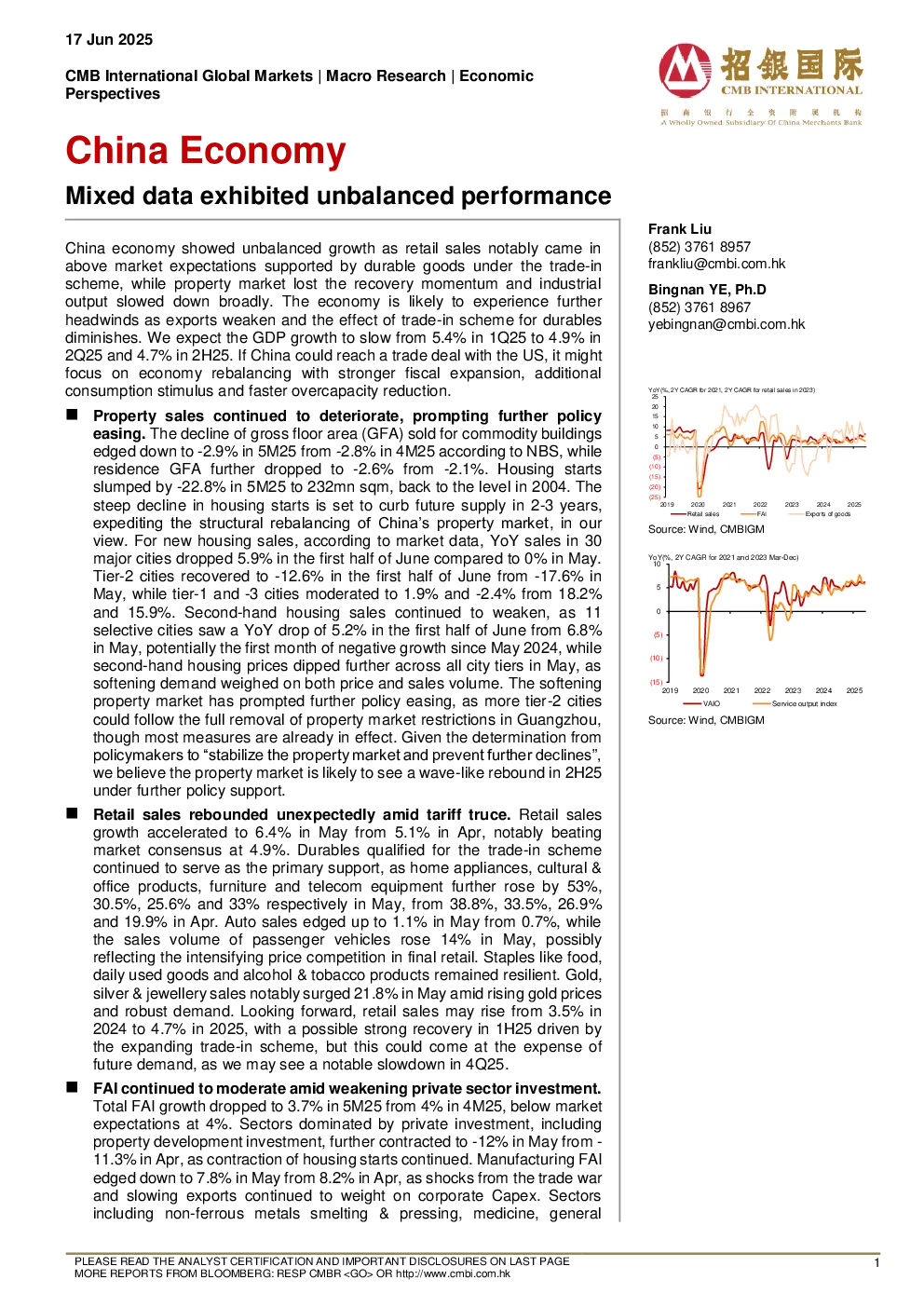
China Economy Mixed data exhibited unbalanced performance Frank Liu(852) 3761 8957frankliu@cmbi.com.hk China economy showed unbalanced growth as retail sales notably came inabovemarketexpectations supported by durable goods under thetrade-inscheme, while property market lost the recovery momentum and industrialoutput slowed down broadly. The economy is likely to experience furtherheadwinds as exports weaken and the effect of trade-in scheme for durablesdiminishes. We expect the GDP growth to slow from 5.4% in 1Q25 to 4.9% in2Q25 and 4.7% in 2H25. IfChinacould reach a trade deal with theUS,itmightfocuson economy rebalancing with stronger fiscal expansion,additionalconsumption stimulus and faster overcapacity reduction. Bingnan YE, Ph.D(852) 3761 8967yebingnan@cmbi.com.hk Property sales continued to deteriorate, prompting further policyeasing.The decline ofgross floor area(GFA) sold forcommoditybuildingsedged down to-2.9% in 5M25 from-2.8% in 4M25 according to NBS, whileresidence GFA furtherdropped to-2.6%from-2.1%.Housing startsslumpedby-22.8% in 5M25 to 232mnsqm, back to the level in2004.Thesteep decline in housing starts is set to curb future supply in 2-3 years,expediting the structural rebalancing of China’s property market, in ourview.For new housing sales,according to market data, YoY sales in30major citiesdropped 5.9% inthefirst half of June compared to 0% in May.Tier-2 cities recovered to-12.6% inthefirst half of June from-17.6% inMay, while tier-1 and-3 cities moderated to 1.9% and-2.4% from 18.2%and 15.9%. Second-hand housing sales continued to weaken, as 11selective citiessaw a YoYdropof5.2% inthefirst half of June from 6.8%in May, potentially the first month of negative growth since May 2024, whilesecond-hand housing prices dipped further across all city tiers in May, assoftening demand weighedon both price and sales volume.The softeningproperty market has prompted further policy easing, as more tier-2 citiescould follow the full removal of property market restrictions in Guangzhou,though most measures are alreadyin effect. Given the determination frompolicymakers to “stabilize the property market and prevent further declines”,we believethe property market is likely to see a wave-like rebound in 2H25under further policy support. Source:Wind, CMBIGM Source:Wind, CMBIGM Retail sales rebounded unexpectedly amid tariff truce.Retail salesgrowthaccelerated to 6.4% in May from 5.1% in Apr, notably beatingmarket consensus at 4.9%.Durables qualified for thetrade-in schemecontinued to serve as the primary support, as home appliances, cultural &officeproducts, furniture and telecom equipment further rose by 53%,30.5%, 25.6% and 33% respectively in May,from 38.8%, 33.5%, 26.9%and 19.9% in Apr. Auto sales edged up to 1.1% in May from 0.7%, whilethesales volume of passenger vehicles rose 14%in May,possiblyreflecting the intensifying price competitionin final retail.Staples like food,daily used goods and alcohol & tobacco productsremained resilient.Gold,silver & jewellerysales notably surged 21.8% in May amid rising gold pricesand robust demand. Looking forward, retail salesmayrise from 3.5% in2024 to 4.7% in 2025, withapossible strong recovery in 1H25 driven bythe expanding trade-in scheme, but this could come atthe expense offuture demand, as we may see a notable slowdown in 4Q25. FAIcontinued to moderate amid weakening private sector investment.TotalFAI growthdropped to 3.7% in 5M25 from 4% in 4M25,belowmarketexpectations at 4%.Sectors dominated by private investment, includingproperty development investment,furthercontracted to-12% in May from-11.3% in Apr,as contraction of housing starts continued.Manufacturing FAIedged down to 7.8% in May from 8.2% in Apr, as shocks fromthetrade warand slowing exports continued to weight on corporate Capex. Sectorsincludingnon-ferrous metals smelting&pressing,medicine,general equipment, electrical equipmentand other transportation equipmentsawnotable moderation.InfrastructureFAIremained resilient at 9.3% in May,thanks to the robust government bond issuance. Looking forward, FAIgrowth might mildly accelerate from 3.2% in 2024 to 3.7% in 2025 thankstothe narrower declines of property development investment.Manufacturing and infrastructure investment growth is likely to fall from9.2% and 9.2% in 2024 to 8.5% and 8.7% in 2025. Industrial output moderated broadly while service output recovered.VAIO growtheased to 5.8% in May from 6.1% in Apr,roughly in line withmarket consensus of5.7%.The broad-based slowdown in manufacturingcontinued, as textile, chemical products, other transport equipment, andelectricalequipment moderated,while autos and non-ferrous metalsmelting& pressing rebounded. Mining remained flat at 5.7% while publicutility edged down to 6.2% in May from 6.6%.Growth of service outputindexinched up to 6.2% in May from 6% in Apr. Looking forward, industrialoutput may decelerate as headwinds from trade intensifyand demandoverdraftkicks indue to trade-in