您的浏览器禁用了JavaScript(一种计算机语言,用以实现您与网页的交互),请解除该禁用,或者联系我们。 [未知机构]:摩根斯坦利-The Moments of TRUTHs - 发现报告

摩根斯坦利-The Moments of TRUTHs

2025-06-10 未知机构 喜马拉雅
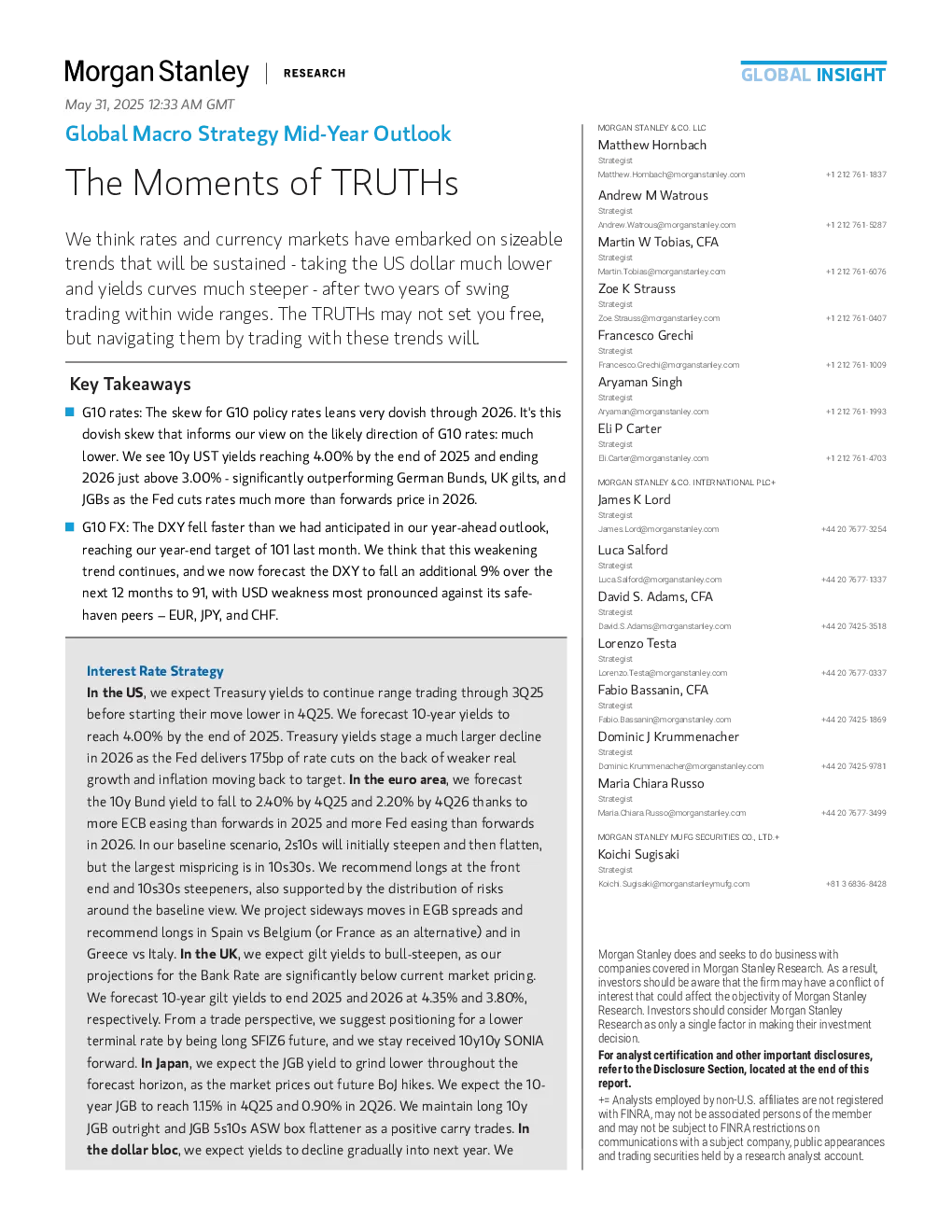
报告封面

Matthew HornbachStrategistMatthew.Hornbach@morganstanley.com+1 212 761-1837Andrew M WatrousStrategistAndrew.Watrous@morganstanley.com+1 212 761-5287Martin W Tobias, CFAStrategistMartin.Tobias@morganstanley.com+1 212 761-6076Zoe K StraussStrategistZoe.Strauss@morganstanley.com+1 212 761-0407Francesco GrechiStrategistFrancesco.Grechi@morganstanley.com+1 212 761-1009Aryaman SinghStrategistAryaman@morganstanley.com+1 212 761-1993Eli P CarterStrategistEli.Carter@morganstanley.com+1 212 761-4703Morgan Stanley & Co. International plc+James K LordStrategistJames.Lord@morganstanley.com+44 20 7677-3254Luca SalfordStrategistLuca.Salford@morganstanley.com+44 20 7677-1337David S. Adams, CFAStrategistDavid.S.Adams@morganstanley.com+44 20 7425-3518Lorenzo TestaStrategistLorenzo.Testa@morganstanley.com+44 20 7677-0337Fabio Bassanin, CFAStrategistFabio.Bassanin@morganstanley.com+44 20 7425-1869Dominic J KrummenacherStrategistDominic.Krummenacher@morganstanley.com+44 20 7425-9781Maria Chiara RussoStrategistMaria.Chiara.Russo@morganstanley.com+44 20 7677-3499Morgan Stanley MUFG Securities Co., Ltd.+Koichi SugisakiStrategistKoichi.Sugisaki@morganstanleymufg.com+81 3 6836-8428Morgan Stanley does and seeks to do business withcompanies covered in Morgan Stanley Research. As a result,investors should be aware that the firm may have a conflict ofinterest that could affect the objectivity of Morgan StanleyResearch. Investors should consider Morgan StanleyResearch as only a single factor in making their investmentdecision.For analyst certification and other important disclosures,refer to theDisclosure Section, located at the end of thisreport.+= Analysts employed by non-U.S. affiliates are not registeredwith FINRA, may not be associated persons of the memberand may not be subject to FINRA restrictions oncommunications with a subject company, public appearancesand trading securities held by a research analyst account. Hiromu UezatoStrategistHiromu.Uezato@morganstanleymufg.com forecast the Canadian 10-year yield at 2.80% by 2Q26. We see the 10-yearACGB yield at 4.30% by mid-2026 and 10-year NZGB yield at 4.25%.Currency & Foreign ExchangeWe forecastUSDto keep weakening, with the DXY falling roughly 9% to 91by mid-2026, thanks to a convergence in US rates and growth to peers, aswell as a further rise in risk premium due to increasing FX hedging flows andsafe-haven debates. These factors leadEUR/USDto rise to 1.25.GBP/USDrises to 1.45, aided by its high carry/vol, low trade tension risks, and indirectlinks to Europe.EUR/NOKis pushed to a high of 12.00 by weakness in oil. InEUR/SEK, a yield differential back-and-forth sees it rise then fall andultimately settle at 10.80. We expectEUR/CHFto trade in a range of0.93/0.94 as the pair is caught between franc demand and the SNB leaningagainst strength.AUD/USDrises to 0.69 by mid-2026, but does not benefitas much from increased FX hedging.NZD/USDreaches 0.65 as the RBNZreaches the end of its cutting cycle soon, while CAD underperforms in thedollar bloc from negative US growth spillovers, withUSD/CADfalling to1.34. We expectUSD/JPYto decline into 130 alongside the lower US terminalrate pricing.Inflation-Linked BondsIn the US, we think that breakevens stay elevated until 3Q25 in anticipationof inflationary impact of tariffs and the ongoing uncertainty around itsimplementation and it tightens around 2Q26, as tariff-induced inflationstarts to cool down. We introduce a z-score-based model for tactical tradingof 10-year breakevens.In Japan, given the relatively limited decline in USD/JPY outlook in the near term, we expect the BEIs to remain stable with solidinflation carry. After 4Q25 onwards, factors such as the slowdown in the USeconomy and rising expectations for Fed cuts, along with accelerated USD/JPY decline, will likely weigh on the BEIs.Short-Duration StrategyIn the US, we think UST liquidity conditions encountered some stresses inApril, but overall market functioning remained orderly. That said, the eventsthat transpired after Liberation Day have left a lasting mark on a few of theindicators we monitor to assess liquidity conditions.In Japan, we discuss howrisk-off sentiment in the wake of the April 2 “Liberation Day” was differentfrom past risk-off phase for XCCY basis. Unlike the past risk-off phase, USD’sdemand did not increase much and widening pressure on XCCY basis waslimited. We enter payer position on 1y1y SOFR/TONA basis from carryperspective. However, we close our recommendation for the 2s5s20s fly onSOFR/TONA basis as risk/reward seems less attractive.Interest Rate DerivativesIn the US,we expect rate distributions to tighten, with right-tail risksdropping more than left-tail risks. Interest rate volatility drifts lower intoyear-end, and normalizes to historical averages by 2Q26. Lingering tariffuncertainty and recent vol spikes warrant a higher vol-risk-premium in thenear term. Year-to-date USD callable issuance has been larger than in 2024.We estimate that the Street's Berm Book