预测食品行业的关键绩效指标惊喜:系统阿尔法的秘诀
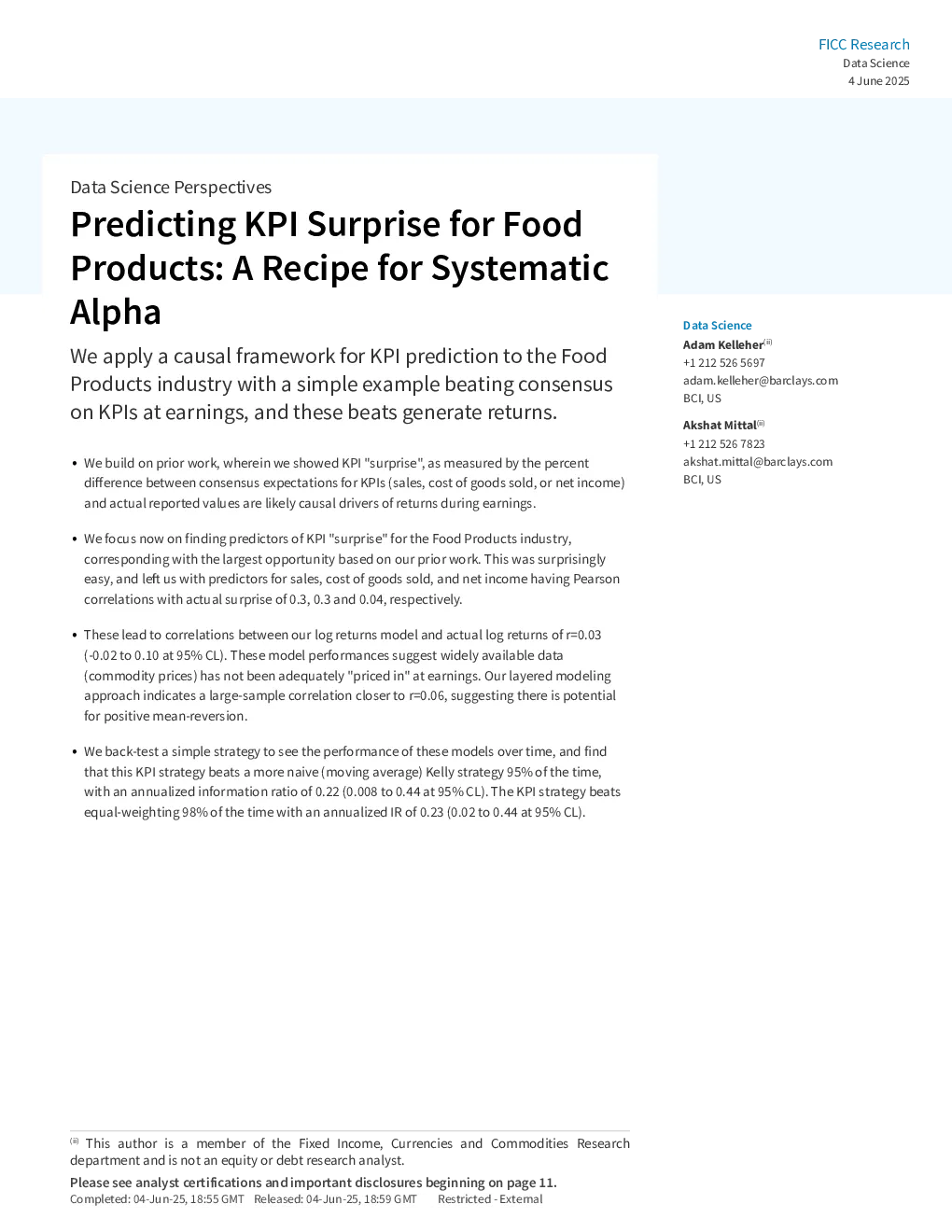
Predicting KPI Surprise for FoodProducts: A Recipe for SystematicAlpha Data Science Adam Kelleher(ii)+1 212 526 5697adam.kelleher@barclays.comBCI, US We apply a causal framework for KPI prediction to the FoodProducts industry with a simple example beating consensuson KPIs at earnings, and these beats generate returns. Akshat Mittal(ii)+1 212 526 7823akshat.mittal@barclays.comBCI, US •We build on prior work, wherein we showed KPI "surprise", as measured by the percentdifferencebetween consensus expectations for KPIs (sales, cost of goods sold, or net income)and actual reported values are likely causal drivers of returns during earnings. •We focus now on finding predictors of KPI "surprise" for the Food Products industry,corresponding with the largest opportunity based on our prior work. This was surprisinglyeasy, andleftus with predictors for sales, cost of goods sold, and net income having Pearsoncorrelations with actual surprise of 0.3, 0.3 and 0.04, respectively. •These lead to correlations between our log returns model and actual log returns of r=0.03(-0.02 to 0.10 at 95% CL). These model performances suggest widely available data(commodity prices) has not been adequately "priced in" at earnings. Our layered modelingapproach indicates a large-sample correlation closer to r=0.06, suggesting there is potentialfor positive mean-reversion. •We back-test a simple strategy to see the performance of these models over time, and findthat this KPI strategy beats a more naive (moving average) Kelly strategy 95% of the time,with an annualized information ratio of 0.22 (0.008 to 0.44 at 95% CL). The KPI strategy beatsequal-weighting 98% of the time with an annualized IR of 0.23 (0.02 to 0.44 at 95% CL). Source: LSEG, Barclays Research •This leaves most of the 3.7 IR opportunity on the table. These results show the feasibility ofour approach, establishing a framework for creating and building upon KPI prediction modelsas a method for finding alpha from traditional and alternative data. Working Backwards From Returns Recent Work Suggests the Causal Perspective is Useful In our recent work, Working Backwards From Returns (24 March, 2025), we explored a causalmodel for returns as driven by KPI reporting during quarterly earnings. We measured KPI"surprise" as the percentdifferencebetween reported KPIs and consensus expectations justprior to reporting. We found that these surprises, specifically for revenue, net income, and cost,are likely causes of (log) returns. A key insight that was robust across industries was that cost surprise naively had a positiveeffecton returns. This makes no sense from a causal perspective: costs exceeding expectations,most would agree, is bad for investment returns. We hypothesized the resolution of this"Simpson's paradox" comes from realizing that production volume is a direct cause of totalcost, so a surprise in cost levels likely results from selling more product. We can control for thisby regressing cost surprise alongside sales surprise, and when we do this we see theeffectofcost surprise on returns flip from positive to negative. This is a clear argument for the value of the causal perspective. If we hadn't noticed the positiveeffectof cost on returns, we might have allowed the positiveeffectto remain a part of ourmodel. This should only work as long as the variances of the exogenous variables remain static.Otherwise, as detailed in the appendix, the statistical model would break down and would leadto wrong predictions due to omitted variable bias – the bias in model parameter estimates is afunction of the variances of input variables and omitted variables' variances. Modeling Approach: Two Layers Our previous work established KPI surprise as a likely cause of log returns. The next stage, as wecontinue to "work backwards from returns", is to find predictors of KPIs. This leads us to twolayers of models. The first set of models "now-casts" each KPI surprise using a set ofpredictors. The second layer uses theseforward looking estimatesof KPI surprise to predictreturns. To be precise, the first layer of models are some functions of k predictors of KPIs,X1,X2, …,Xk,to predict future KPI surprise,S1,S2, …,Slusing one function for each KPI,S^l=S^l(X1, …,Xk). In the second layer, we separately fit a model for how observed (log) KPI surprise drives logreturns asr^ =r^(S1, …,Sl), where this is fit using actual (log) surprise, and estimates thestructuraleffectof surprise on returns. Note that this is independent of the surprise predictionswe make with the first layer. When we make our predictions, we nest these models to estimate log returns asr^ =r^(S1^ , …,Sl^ ),using parameters fitted using actual surprise, and therefore our whole model uses predictors ofsurprise to predict log returns asr^(X1, …,Xk) =r^(S^1(X1, …,Xk), …,S^l(X1, …,Xk)). Note that each model having statistically significant performance does not imply that thenested model also does. The KPI predictorsX1, …,Xk