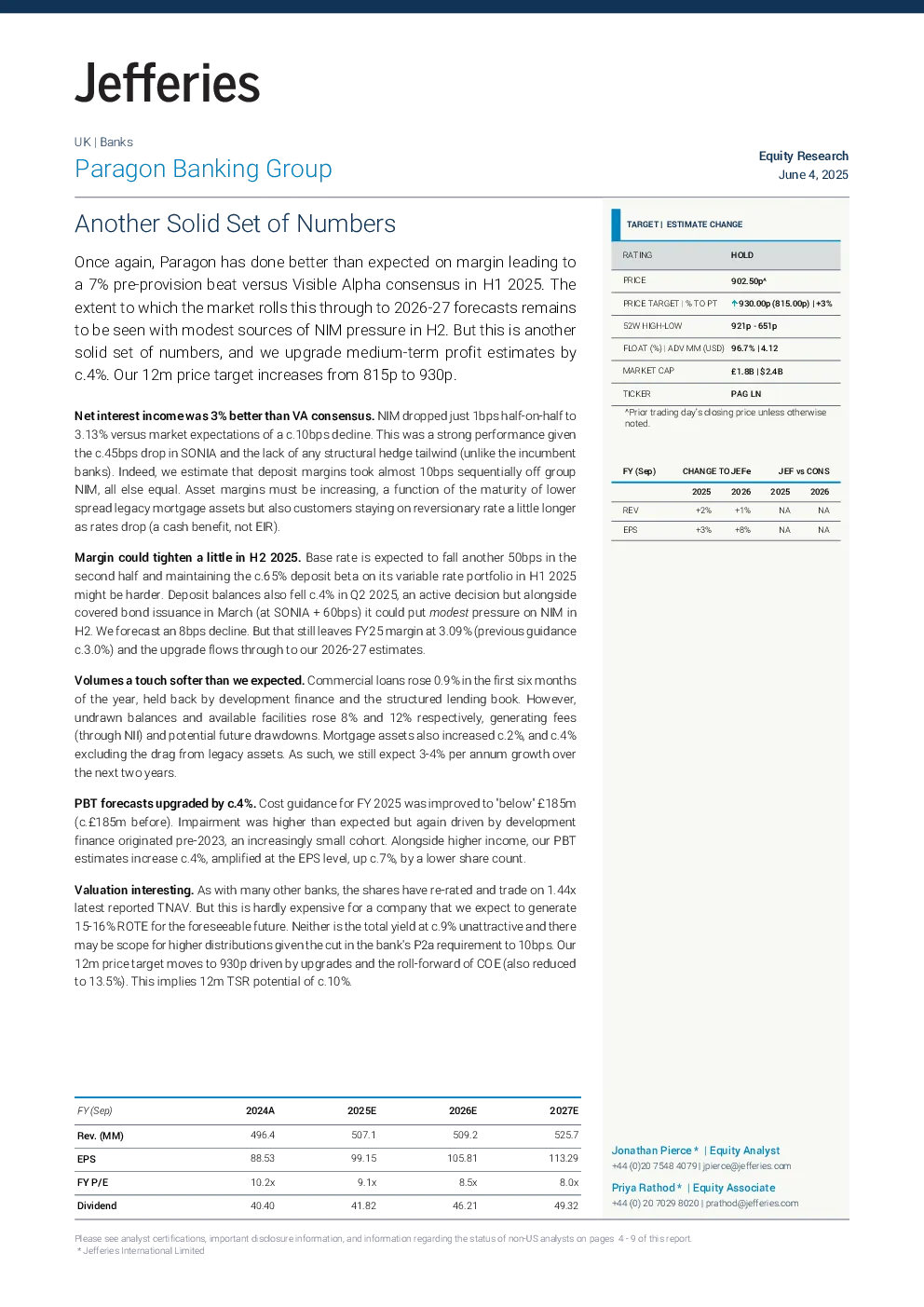
UK | Banks Paragon Banking Group Another Solid Set of Numbers Once again, Paragon has done better than expected on margin leading toa 7% pre-provision beat versus Visible Alpha consensus in H1 2025. Theextent to which the market rolls this through to 2026-27 forecasts remainsto be seen with modest sources of NIM pressure in H2. But this is anothersolid set of numbers, and we upgrade medium-term profit estimates byc.4%. Our 12m price target increases from 815p to 930p. Net interest income was 3% better than VA consensus.NIM dropped just 1bps half-on-half to3.13% versus market expectations of a c.10bps decline. This was a strong performance giventhe c.45bps drop in SONIA and the lack of any structural hedge tailwind (unlike the incumbentbanks). Indeed, we estimate that deposit margins took almost 10bps sequentially off groupNIM, all else equal. Asset margins must be increasing, a function of the maturity of lowerspread legacy mortgage assets but also customers staying on reversionary rate a little longeras rates drop (a cash benefit, not EIR). Margin could tighten a little in H2 2025.Base rate is expected to fall another 50bps in thesecond half and maintaining the c.65% deposit beta on its variable rate portfolio in H1 2025might be harder. Deposit balances also fell c.4% in Q2 2025, an active decision but alongsidecovered bond issuance in March (at SONIA + 60bps) it could putmodestpressure on NIM inH2. We forecast an 8bps decline. But that still leaves FY25 margin at 3.09% (previous guidancec.3.0%) and the upgrade flows through to our 2026-27 estimates. Volumes a touch softer than we expected.Commercial loans rose 0.9% in the first six monthsof the year, held back by development finance and the structured lending book. However,undrawn balances and available facilities rose 8% and 12% respectively, generating fees(through NII) and potential future drawdowns. Mortgage assets also increased c.2%, and c.4%excluding the drag from legacy assets. As such, we still expect 3-4% per annum growth overthe next two years. PBT forecasts upgraded by c.4%.Cost guidance for FY 2025 was improved to "below" £185m(c.£185m before). Impairment was higher than expected but again driven by developmentfinance originated pre-2023, an increasingly small cohort. Alongside higher income, our PBTestimates increase c.4%, amplified at the EPS level, up c.7%, by a lower share count. Valuation interesting.As with many other banks, the shares have re-rated and trade on 1.44xlatest reported TNAV. But this is hardly expensive for a company that we expect to generate15-16% ROTE for the foreseeable future. Neither is the total yield at c.9% unattractive and theremay be scope for higher distributions given the cut in the bank's P2a requirement to 10bps. Our12m price target moves to 930p driven by upgrades and the roll-forward of COE (also reducedto 13.5%). This implies 12m TSR potential of c.10%. Jonathan Pierce * | Equity Analyst+44 (0)20 7548 4079 | jpierce@jefferies.comPriya Rathod * | Equity Associate+44 (0) 20 7029 8020 | prathod@jefferies.com The Long View: Paragon Banking Group Investment Thesis / Where We Differ Paragon is a highly cash-generative business, adding over 200bps perannum to ET1 capital before the impact of RWA growth. "Underlying" ROTEof 17-18% is the also the best in the domestic banks sector right now. Wesee this drifting back a little over the next couple of years as deposit marginsfall but the PTNAV at c.1.4x is hardly expensive in this context. However, thedistribution yield of c.9% over 2025-27 is a little lower than elsewhere. Downside Scenario,535p, -41% Upside Scenario,1145p, +27% Base Case,930p, +3% - ROTE post 2027: 17.0%- Growth post 2027: 5%- Cost of equity post 2027: 12.5%- Implied LT PTNAV: 1.7- Implied PTNAV at March 26: 1.7 - ROTE post 2027: 12.5%- Growth post 2027: 3%- Cost of equity post 2027: 14.5%- Implied LT PTNAV: 0.9- Implied PTNAV at March 26: 0.8 - ROTE post 2027: 16.0%- Growth post 2027: 4%- Cost of equity post 2027: 13.5%- Implied LT PTNAV: 1.3- Implied PTNAV at March 26: 1.4 Sustainability Matters Catalysts 29th July 2025 - Q3 trading statementSummer 2025 - Supreme Court ruling3rd December 2025 - FY resultsRate changes by the Bank of England Top material issues 1) Following the GFC, regulators, working in concert with governments, created a more rigorous ever-evolving framework of capital and liquidity requirements. How regulators will implement ESG factorsinto these requirements will be a critical concern. 2) Fines have become a key tool used by banking regulators, with global banking fines since the GFCexceeding $300bn. How effectively Banks adopt ESG-responsible practices, particularly consumerprotection, will likely determine how exposed they will be to potential regulatory actions in the future. Company targets: 1) Operationally net zero by 2030 2) Target for 40% female representation in senior management positions by December 2025. Qs for Mgmt: 1) As a % of group