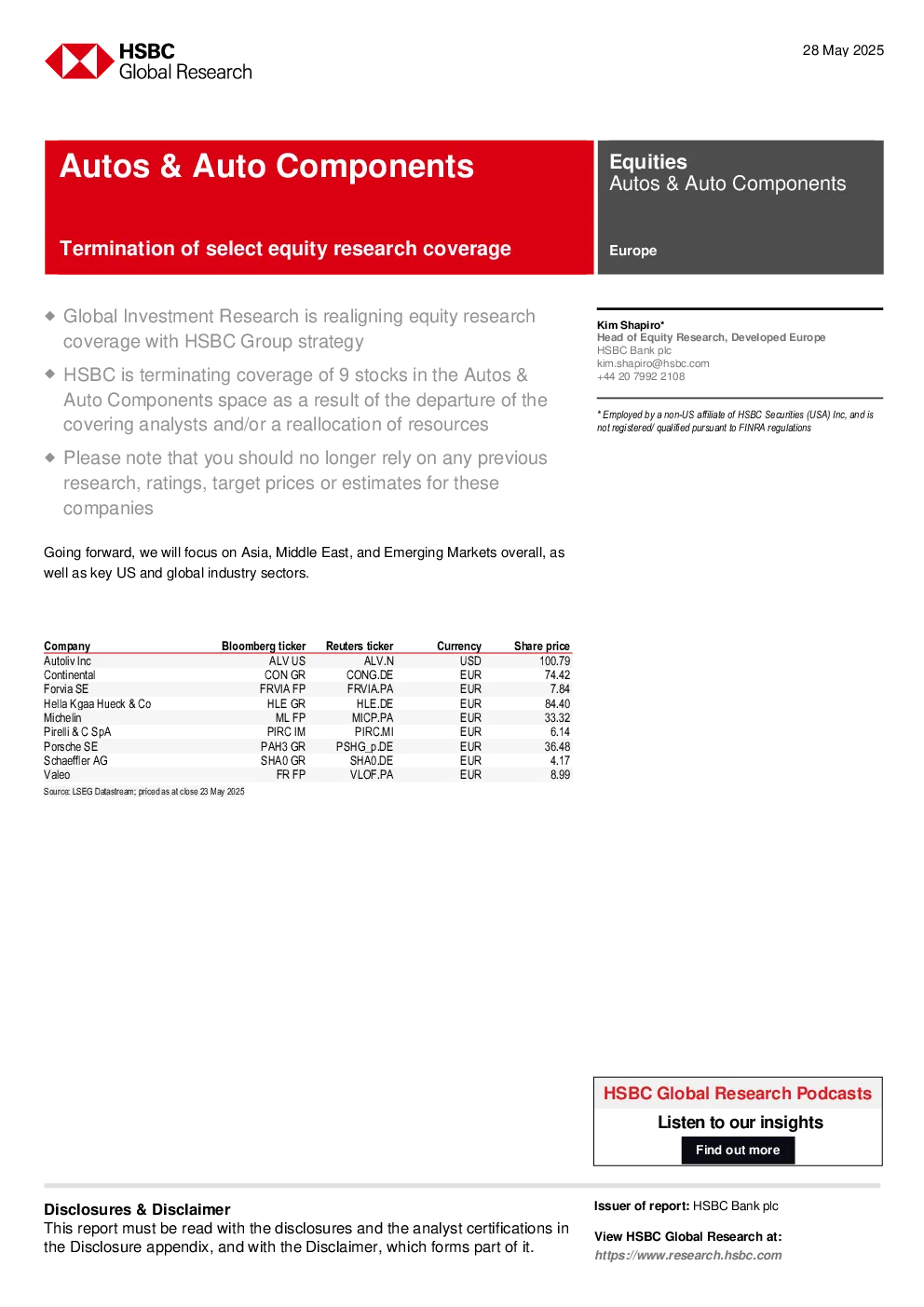
Issuer of report:HSBC Bank plcView HSBC Global Research at:https://www.research.hsbc.comListen to our insightsHSBC Global Research PodcastsKim Shapiro*Head of Equity Research, Developed EuropeHSBC Bank plckim.shapiro@hsbc.com+44 20 7992 2108* Employed by a non-US affiliate of HSBC Securities (USA) Inc, and isnotregistered/ qualified pursuant to FINRA regulationsEquitiesAutos & Auto ComponentsEurope Find out more Share price ◆◆◆100.79 74.427.8484.4033.326.1436.484.178.99 2Disclosure appendixAnalyst CertificationThe following analyst(s), economist(s), or strategist(s) who is(are) primarily responsible for this report,including any analyst(s)whose name(s) appear(s) as author of an individual section or sections of the report and any analyst(s) named as the coveringanalyst(s) of a subsidiary company in a sum-of-the-parts valuation certifies(y) that the opinion(s) on the subject security(ies) orissuer(s), any views or forecasts expressed in the section(s) of which such individual(s) is(are) named as author(s), and anyotherviews or forecasts expressed herein, including any views expressed on the back page of the research report, accurately reflecttheir personal view(s) and that no part of their compensation was, is or will be directly or indirectly related to the specificrecommendation(s) or views contained in this research report: Kim ShapiroImportant disclosuresEquities: Stock ratings and basis for financial analysisHSBC and its affiliates, including the issuer of this report (“HSBC”) believes an investor's decision to buy or sell a stockshoulddepend on individual circumstances such as the investor's existing holdings, risk tolerance and other considerations and thatinvestors utilise various disciplines and investment horizons when making investment decisions. Ratings should not be used orrelied on in isolation as investment advice. Different securities firms use a variety of ratings terms as well as different ratingsystems to describe their recommendations and therefore investors should carefully read the definitions of the ratings used ineach research report. Further, investors should carefully read the entire research report and not infer its contents from theratingbecause research reports contain more complete information concerning the analysts' views and the basis for the rating.From 23rd March 2015 HSBC has assigned ratings on the following basis:The target price is based on the analyst’s assessment of the stock’s actual current value, although we expect it to take sixto 12months for the market price to reflect this.When the target price is more than 20% above the current share price, the stockwillbe classified as a Buy; when it is between 5% and 20% above the current share price, the stock may be classified as a Buy oraHold; when it is between 5% below and 5% above the current share price, the stock will be classified as a Hold; when it isbetween5% and 20% below the current share price, the stock may be classified as a Hold or a Reduce; and when it is more than 20%below the current share price, the stock will be classified as a Reduce.Our ratings are re-calibrated against these bands at the time of any 'material change' (initiation or resumption of coverage, changein target price or estimates).Upside/Downside is the percentage difference between the target price and the share price.Prior to this date, HSBC’s rating structure was applied on the following basis:For each stock we set a required rate of return calculated from the cost of equity for that stock’s domestic or, as appropriate,regional market established by our strategy team. The target price for a stock represented the value the analyst expected thestock to reach over our performance horizon. The performance horizon was 12 months. For a stock to be classified as Overweight,the potential return, which equals the percentage difference between the current share price and the target price, includingtheforecast dividend yield when indicated, had to exceed the required return by at least 5 percentage points over the succeeding12months (or 10 percentage points for a stock classified as Volatile*). For a stock to be classified as Underweight, the stockwasexpected to underperform its required return by at least 5 percentage points over the succeeding 12 months (or 10 percentagepoints for a stock classified as Volatile*). Stocks between these bands were classified as Neutral.*A stock was classified as volatile if its historical volatility had exceeded 40%, if the stock had been listed for less than12 months(unless it was in an industry or sector where volatility is low) or if the analyst expected significant volatility. However, stocks whichwe did not consider volatile may in fact also have behaved in such a way.Historical volatility was defined as the past month'saverage of the daily 365-day moving average volatilities.In order to avoid misleadingly frequent changes in rating, however,volatility had to move 2.5 percentage points past the 40% benchm