您的浏览器禁用了JavaScript(一种计算机语言,用以实现您与网页的交互),请解除该禁用,或者联系我们。 [巴克莱银行]:阿斯利康:DESTINY-Breast09在ASCO会议上表现优异 - 发现报告

阿斯利康:DESTINY-Breast09在ASCO会议上表现优异

2025-06-02 巴克莱银行 江边的鸟
报告封面

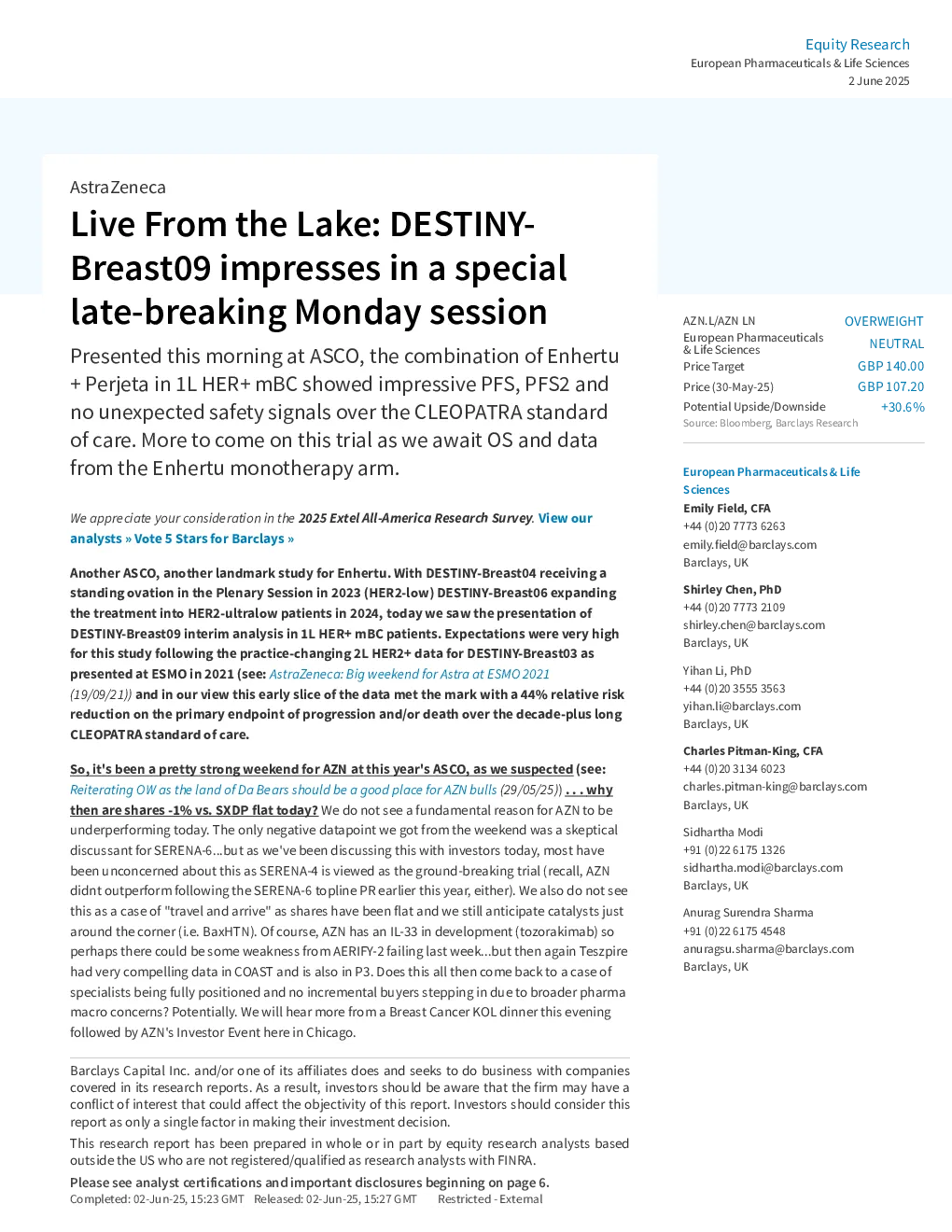
Restricted - External AZN.L/AZN LNOVERWEIGHTEuropean Pharmaceuticals& Life SciencesNEUTRALPrice TargetGBP 140.00Price (30-May-25)GBP 107.20Potential Upside/Downside+30.6%Source: Bloomberg, Barclays ResearchEuropean Pharmaceuticals & LifeSciencesEmily Field, CFA+44 (0)20 7773 6263emily.field@barclays.comBarclays, UKShirley Chen, PhD+44 (0)20 7773 2109shirley.chen@barclays.comBarclays, UKYihan Li, PhD+44 (0)20 3555 3563yihan.li@barclays.comBarclays, UKCharles Pitman-King, CFA+44 (0)20 3134 6023charles.pitman-king@barclays.comBarclays, UKSidhartha Modi+91 (0)22 6175 1326sidhartha.modi@barclays.comBarclays, UKAnurag Surendra Sharma+91 (0)22 6175 4548anuragsu.sharma@barclays.comBarclays, UK FIGURE 1. Summary of DESTINY-Breast09 interim analysis resultsSource: Barclays Research, Company data LBA Session: Trastuzumab deruxtecan (T-DXd) +pertuzumab (P) vs taxane + trastuzumab +pertuzumab (THP) for first-line (1L) treatment ofpatients (pts) with human epidermal growth factorreceptor 2–positive (HER2+) advanced/metastaticbreast cancer (a/mBC): Interim results from DESTINY-Breast09.Presentation and Discussion of LBA1008: DESTINY-Breast09Background:DESTINY-Breast09 (NCT04784715) is a global randomized Phase 3 study assessingtheefficacyand safety of 1L T-DXd ± P vs THP in 1157 pts with HER2+ a/mBC. The CLEOPATRAstudy established THP as standard of care in this setting over a decade ago.Methods:Eligible pts had centrally confirmed HER2+ (IHC 3+ or ISH+) a/mBC and no priorchemotherapy or HER2-directed therapy for a/mBC ([neo]adjuvant HER2-directed therapy /chemotherapy with a disease-free interval of >6 months [mo] and ≤1 line of endocrine therapyfor metastatic disease permitted). Pts were randomized 1:1:1 to T-DXd 5.4 mg/kg (+ placebo), T-DXd + P, or THP, stratified by de-novo vs recurrent disease, and hormone receptor (HR)andPIK3CAmutation status. In this planned interim analysis, data for T-DXd + P vs THP arepresented; the T-DXd + placebo arm remains blinded until final PFS analysis. The primaryendpoint was progression-free survival (PFS) by blinded independent central review (BICR) inthe intent-to-treat population. Other endpoints included overall survival (OS), PFS byinvestigator (INV), objective response rate (ORR), duration of response (DOR), and safety.•Study Design:No prior systemic treatment was allowed, except for one line of prior•endocrine therapy (ET) for metastatic breast cancer (mBC), which was permitted. ConcurrentET was allowed in patients with HR+ diseaseaftercompleting 6 cycles of T-DXd or upondiscontinuation of taxane in the THP arm. The two T-DXd arms were not powered to compareagainst each other.•Interim Analysis:The interim analysis met superiority criteria for T-DXd + P vs. THP. The T-•DXd + placebo arm remains blinded until the final PFS analysis. OS data are still immature.•Baseline Characteristics:50% of patients were from Asia. 83% of tumors were IHC 2+. 54% of•tumors were HR+.Results:Among the pts randomized to T-DXd + P (n=383) and THP (n=387), 52% had de-novodisease and 54% had HR+ status; demographic and disease characteristics were well balanced.At this interim datacut-off(Feb 26, 2025; median follow-up 29 mo; 38% mature for PFS), T-DXd+ P significantly improved PFS by BICR (hazard ratio 0.56; 95% CI 0.44, 0.71; P<0.00001) and INV(Table). PFS benefit was consistent across all subgroups. OS data were immature. Medianresponse duration with T-DXd + P exceeded 3 years.•In a pre-specified interim analysis, Enhertu + pertuzumab reduced the risk of disease•progression or death by 44% versus THP (HR = 0.56; 95% CI 0.44-0.71; p<0.00001). Median PFSwas 40.7 months vs 26.9 months with Enhertu+ pertuzumab vs THP, as assessed by BICR. ThePFS benefit for Enhertu + pertuzumab vs THP was consistent across subgroups, including forthe pre-specified stratification factors of de novo or recurrent disease, hormone receptorstatus andPIK3CAmutation status. Investigator-assessed PFS demonstrated a median PFS of 3 40.7 months vs 20.7 months for Enhertu + pertuzumab vs THP (HR = 0.49; 95% CI 0.39-0.61;nominal p-value <0.00001).Confirmed ORR with Enhertu + pertuzumab was 85.1% vs 78.6% with THP. There were 58 CRswith Enhertu + pertuzumab compared to 33 with THP. Median duration of response (DOR) forEnhertu + pertuzumab was 39.2 months vs 26.4 months with THP. OS was not mature at thetime of the interim analysis (16% maturity at datacut-off);however, showing an early trendfavouring the Enhertu+ pertuzumab vs THP (HR 0.84; 95% CI 0.59-1.19).Safety:Grade 3/4 AEs were similar between arms, though there were more doseinterruptions and reductions in the T-DXd + P arm, along with numerically more deathscompared to the THP arm. The most common AE on the T-DXd arm was diarrhea. ILDoccurred in 12% of patients on the T-DXd arm vs. 1% on the THP arm; the majority of ILDcases were low-grade, though two Grade 5 events were reported.The safety profile of Enhertu+ pertuzumab in DESTINY-Breast09 was consistent with theknown pr