您的浏览器禁用了JavaScript(一种计算机语言,用以实现您与网页的交互),请解除该禁用,或者联系我们。 [巴克莱银行]:重新强调汽车行业中钢铁 铝的风险敞口 - 发现报告

重新强调汽车行业中钢铁 铝的风险敞口

交运设备 2025-06-02 巴克莱银行 灰灰
报告封面

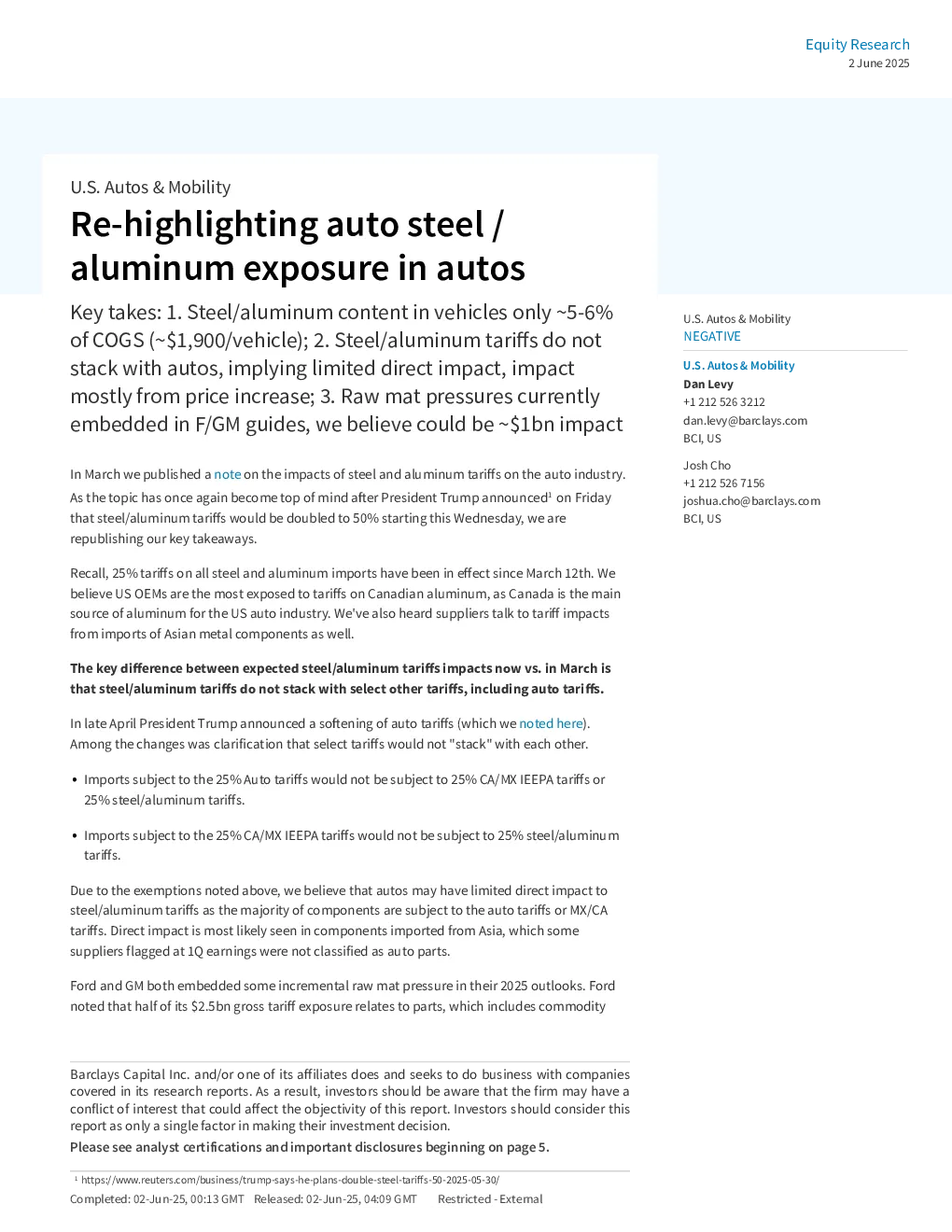
Restricted - External U.S. Autos & MobilityNEGATIVEU.S. Autos & MobilityDan Levy+1 212 526 3212dan.levy@barclays.comBCI, USJosh Cho+1 212 526 7156joshua.cho@barclays.comBCI, US 2https://plasticmakers.org/wp-content/uploads/2023/02/Chemistry-and-Automobiles-2024.pdfheadwinds; similarly, GM noted that it now assumes commodities to be flat y/y vs its prioroutlook of a benefit in 2025.While likely exempt from most directtariffimpacts, autos will still be subject to generalincreases in steel/aluminum pricing. As a result, we believe our steel/aluminumtariffsensitivelycalculations remain relevant despite the changes totariffmechanics.With investors increasingly gauging auto exposure to steel, we outlinesome of the key facts:Steel and aluminum are not as much of a cost for autos as you might thinkAccording to the American Chemistry Council2, the average steel usage in a light vehicleassembled in the US and Canada was ~2,153 lbs in 2023 - that is almost 1 metric ton (mt), whichincludes mild steel (553lb), high-strength steel (680lb), advanced high-strength steel (834lb),and specialty steel (86lb). Aluminum content is ~498lbs per vehicle. Both the total weight willvary (higher in pickups, lower in compact cars) as well as the mix of metals in a particularvehicle (e.g., aluminum for F-Series pickups). In addition, we believe automakers need to buymore steel and aluminum than winds up in the showroom vehicle due to scrap produced fromthe shaping and forming processes. While this could be up to 40-50% more raw mats than thefinished vehicle, the OEMs also recycle the scrap for cash – so we have assumed a ~25%additional cost to account for scrap.FIGURE 1. Material content of a light vehicle by weightSource: American Chemistry Council, Barclays ResearchGauging the impact for OEMsRoughly two-thirds of automotive CoGS for the OEMs is material content. Yet, only a smallportion of this is straight raw materials – we estimate only ~5-6% of automotive CoGS is steel/high-strength steel and aluminum (with ~3% in steel and ~2% in aluminum), implying ~$1,900per vehicle. Rather, the bulk of the material content in CoGS relate to purchasedsubcomponents and all the associated costs (supplier value-add engineering, logistics, etc.). 2 FIGURE 3. OEM net cost headwind sensitivity analysis (per vehicle)FIGURE 4. OEM EBIT headwind sensitivity analysis assuming a 25%tariff,$bn0%10%20%30%40%0%$0.0$0.1$0.2$0.3$0.510%$0.0$0.1$0.2$0.3$0.420%$0.0$0.1$0.2$0.3$0.430%$0.0$0.1$0.2$0.2$0.340%$0.0$0.1$0.1$0.2$0.350%$0.0$0.1$0.1$0.2$0.260%$0.0$0.0$0.1$0.1$0.270%$0.0$0.0$0.1$0.1$0.180%$0.0$0.0$0.0$0.1$0.190%$0.0$0.0$0.0$0.0$0.0100%$0.0$0.0$0.0$0.0$0.0% Tariff pass-through to vehicle input cost% Pass-through to consumerNote: Assumes average of Ford NA and GMNA productionSource: Barclays ResearchAs a reminder, OEM exposure to spot steel prices is mixed•Ford has noted that exposure is part spot / part contracted buy, with mostly 1-year longcontracts staggered through the year. 90% of Ford's steel buy is in the US and 10% is inCanada.•GM's exposure is roughly one-third spot, one-third 1-year, and one-third multi-year, withcontracts normally made in 3Q.Sensitivity considerations•Assuming a scenario where OEMs take a cost hit from a 25%tariff(i.e., overall importtariff),with 0 pass-through to customers, we assume ~$1.1bntariffheadwind, or ~$475 per vehicle.•Assuming a worst case scenario where OEMs take a cost hit from a 50%tariff,with 0 pass-through to customers, we assume a ~$2.3bntariffheadwind, or ~$950 per vehicle.•It remains unclear what the net price increase of steel and aluminum will be. We roughlyestimate that OEMs will face a ~$1bn headwind on an annual basis from suchtariffs.FIGURE 2. Average steel and aluminum content in a light vehicleMateriallbsNet Scrap Factor$cost/mtTotal ContentAHS Steel83425%$925$437HS Steel68025%$925$357Mild Steel55325%$925$290Other Steel8625%$925$45Aluminum49825%$2,706$764Total2,651$1,893Material usage in average light vehicleNote: AHS = Advanced high-strength, HS = high-strengthSource: American Chemistry Council, Bloomberg, Barclays Research 50%60%70%80%90%100%$0.6$0.7$0.8$0.9$1.0$0.5$0.6$0.7$0.8$0.9$0.5$0.5$0.6$0.7$0.8$0.4$0.5$0.6$0.6$0.7$0.3$0.4$0.5$0.5$0.6$0.3$0.3$0.4$0.5$0.5$0.2$0.3$0.3$0.4$0.4$0.2$0.2$0.2$0.3$0.3$0.1$0.1$0.2$0.2$0.2$0.1$0.1$0.1$0.1$0.1$0.0$0.0$0.0$0.0$0.0CommentUsing current spot Aluminum (LMAHDS03)Using current spot Hot-Rolled Steel (HRC1) $1.1$1.0$0.9$0.8$0.7$0.6$0.5$0.3$0.2$0.1$0.0 3https://www.cnbc.com/2018/05/31/trump-administration-will-put-steel-and-aluminum-tariffs-on-canada-mexico-and-the-eu.html4https://www.cnbc.com/2019/05/17/us-to-announce-deal-to-lift-steel-and-aluminum-tariffs-on-canada-and-mexico-as-soon-as-today-sources.htmlWhat happened in 2018?In March 2018 Trump placedtariffson steel (25%) and aluminum (10%) imports from Canada,Mexico, and the EU and quotas / volume limits on other countries such as South Korea andArgentina in lieu oftariffs.3; exemptions were later granted