关注H股银行估值上调
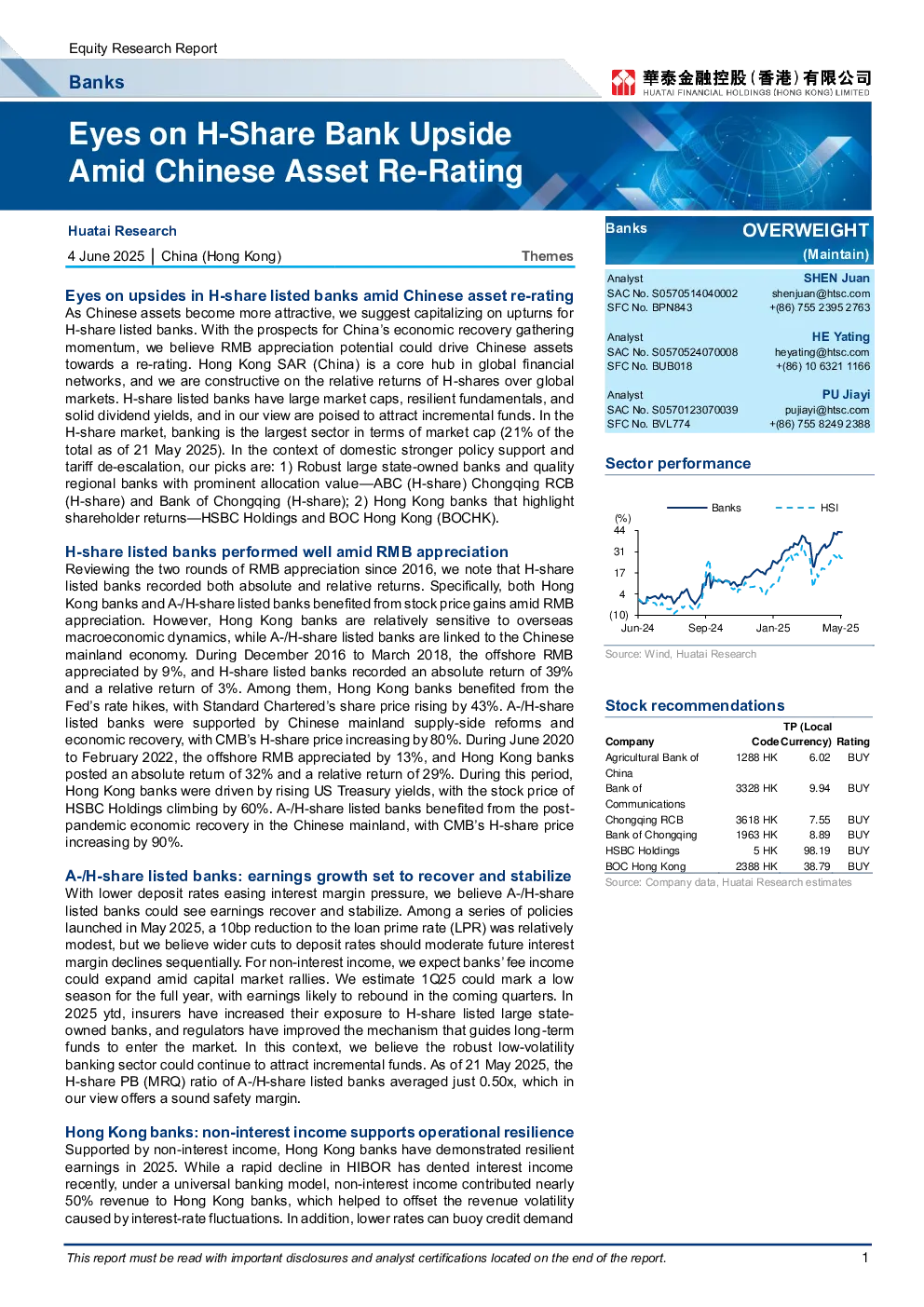
Banks OVERWEIGHT Huatai Research 4 June 2025│China (Hong Kong) (Maintain) Themes AnalystSHEN JuanSACNo. S0570514040002SFC No. BPN843shenjuan@htsc.com+(86) 755 2395 2763 Eyeson upsides in H-share listed banks amid Chinese asset re-ratingAs Chinese assets become more attractive, we suggest capitalizing on upturns for H-share listed banks. With the prospects for China’s economic recovery gatheringmomentum, webelieveRMB appreciation potential could drive Chinese assetstowards a re-rating. Hong Kong SAR(China)is a core hub in global financialnetworks, and we are constructive on the relative returns of H-shares over globalmarkets. H-share listed bankshave largemarket caps, resilient fundamentals, andsolid dividend yields,and in our view arepoised to attract incremental funds. In theH-share market, bankingisthe largest sector in terms of market cap (21% of thetotal as of 21 May 2025). In the context of domestic stronger policy support andtariff de-escalation, our picks are: 1) Robust large state-owned banks and qualityregional banks with prominent allocation value—ABC (H-share) Chongqing RCB(H-share) and Bank of Chongqing (H-share); 2)Hong Kongbanks that highlightshareholder returns—HSBC Holdings and BOC Hong Kong (BOCHK). AnalystHE YatingSAC No. S0570524070008SFC No. BUB018heyating@htsc.com+(86) 10 6321 1166 AnalystPU JiayiSAC No. S0570123070039SFC No. BVL774pujiayi@htsc.com+(86)755 8249 2388 H-share listed banks performed well amid RMB appreciationReviewing the two rounds of RMB appreciation since 2016, wenotethat H-share listed banksrecordedboth absolute and relative returns. Specifically, bothHongKongbanks and A-/H-share listed banks benefited from stock price gains amid RMBappreciation. However,Hong Kong banks are relatively sensitive to overseasmacroeconomic dynamics, while A-/H-share listed banks are linked to the Chinesemainland economy. During December 2016 to March 2018, the offshore RMBappreciated by 9%, and H-share listed banks recorded an absolute return of 39%and a relative return of 3%. Among them,Hong Kongbanks benefited from theFed’s rate hikes, with Standard Chartered’s share price rising by 43%. A-/H-sharelistedbanks were supported by Chinese mainland supply-side reforms andeconomic recovery, with CMB’s H-share priceincreasing by80%. During June 2020to February 2022, the offshore RMB appreciated by 13%, andHong Kongbanksposted an absolute return of 32% and a relative return of 29%. During this period,Hong Kongbanks were driven by rising US Treasury yields, with the stock price ofHSBC Holdings climbing by 60%. A-/H-share listed banks benefited from the post-pandemic economic recovery intheChinese mainland, with CMB’s H-share priceincreasing by 90%. Source: Wind, Huatai Research A-/H-share listed banks: earnings growth set to recover and stabilizeWith lower deposit rates easing interest margin pressure, webelieveA-/H-sharelisted banks could see earnings recover and stabilize. Among a series of policieslaunched in May 2025, a 10bp reduction to the loan prime rate (LPR) was relativelymodest, butwe believe wider cuts to deposit rates should moderate future interestmargin declines sequentially. For non-interest income, we expect banks’fee incomecould expand amid capital market rallies. We estimate 1Q25 could mark a lowseason for the full year,withearnings likely to rebound in the coming quarters. In2025 ytd, insurers have increased their exposure to H-share listed large state-owned banks, and regulators have improved the mechanism that guides long-termfunds to enter the market. In this context, we believe the robust low-volatilitybanking sector could continue to attract incremental funds. As of 21 May 2025, theH-share PB (MRQ) ratio of A-/H-share listed banks averagedjust0.50x, which inour view offersasound safety margin. Hong Kongbanks: non-interest incomesupportsoperational resilienceSupported by non-interest income,Hong Kongbanks have demonstrated resilientearnings in 2025. While a rapid decline in HIBOR has dented interest incomerecently, under a universal banking model,non-interest income contributed nearly50% revenue toHong Kongbanks, which helped to offset the revenue volatilitycaused by interest-rate fluctuations. In addition, lower rates can buoy credit demand andimprove asset quality.This,coupled with accelerated industry chainrestructuring and rising demand for cross-border wealth management (WM), injectsstrong growth momentum to the non-interest income of HK banks, with capitalmarket rallies set to shore up fee income. In 2010-2013, HIBOR remained at a lowlevel of c 0.1%, butHong Kongbanks maintained stable ROE at 9-15%. Specifically,HSBCHoldings and Standard Chartered,backed by lower HKD exposure,preemptive allocations to structural hedging instruments, and a low proportion ofHong Kongcommercialreal estate (CRE) loans, are wellpositioned to outperformlocal peers in earnings, in our view. Incremental funds injected, leading dividend yields offerasafety netWith southbound f