您的浏览器禁用了JavaScript(一种计算机语言,用以实现您与网页的交互),请解除该禁用,或者联系我们。 [巴克莱银行]:培生集团(PSON):IDP教育预警-可能暗示培生的PTE风险 - 发现报告

培生集团(PSON):IDP教育预警-可能暗示培生的PTE风险

2025-06-02 巴克莱银行 Elise
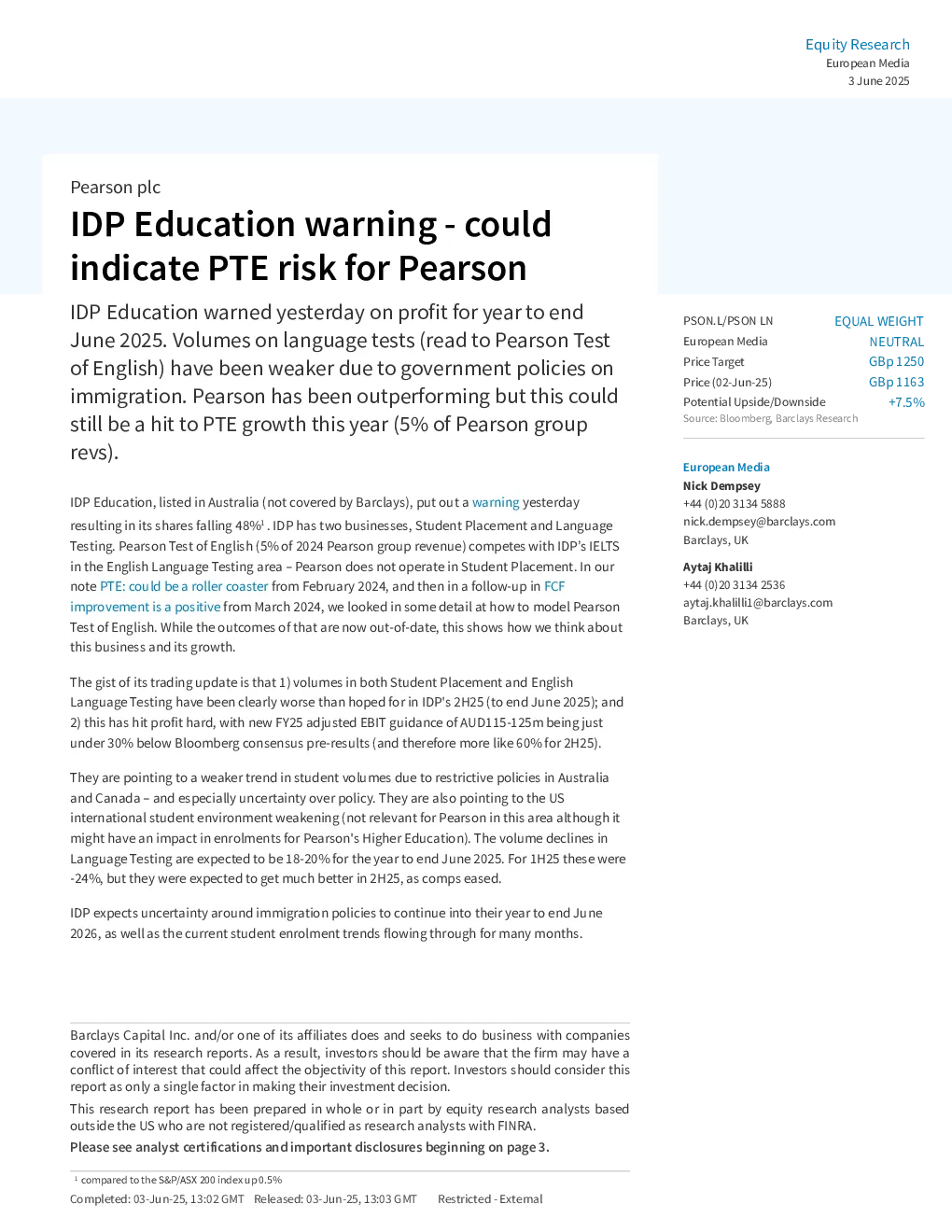
报告封面

Restricted - External PSON.L/PSON LNEQUAL WEIGHTEuropean MediaNEUTRALPrice TargetGBp 1250Price (02-Jun-25)GBp 1163Potential Upside/Downside+7.5%Source: Bloomberg, Barclays ResearchEuropean MediaNick Dempsey+44 (0)20 3134 5888nick.dempsey@barclays.comBarclays, UKAytaj Khalilli+44 (0)20 3134 2536aytaj.khalilli1@barclays.comBarclays, UK What have we learnt so far on Pearson Test of English and what could thiswarning mean?At the 1Q25 trading update, Pearson noted that "Pearson Test of English performed well againsta tough market backdrop and despite a decline in volumes we grew the business." But they alsoreiterated that "the likely impacts of elections on immigration rates in 2025" would lead the PTEbusiness to decline in the year.Pearson has been outperforming IDP on language testing for several years due to:1.Gaining share in Australia (though we think they now have a pretty high share so it might be1.difficultto continuing gaining);2.In Canada, PTE was added to the list of acceptable English Language tests in early 2024 so2.they are still very likely gaining share in a declining market;3.In the UK, PTE was added to the list in 2020, so they are probably still gaining some share3.naturally.But if the market is definitely worse than IELTS was expecting, it could be worse than Pearsonwas expecting as well, and this could have some impact on PTE, even preserving a big gapbetween PTE and IELTS.We currently forecast flat yoy organic revenue growth for PTE in cal. 2025We actually model 0% organic revenue growth for PTE in 2025,afterthe positive start to theyear. That means that our 10% growth for the rest of English Language Learning for FY25 gets usto 5.5% organic growth for the ELL division. The rest of ELL declined somewhere around 11-13%in 1Q25, but against a very tough comp. But "rest of ELL" needs to achieve yoy organic revenuegrowth in the higher teens in Q2-Q4 on average to hit our +10% for FY25. We find it hard tobelieve that they can exceed that number in the remaining quarters, though we accept that thispart of ELL has been strong in the last couple of years. Our 5.5% organic revenue growth for ELLfor FY25 compares to Bloomberg consensus at 6.1%. Guidance is for growth to "moderate" vsthe 8% seen in 2024.So if PTE were -5% in FY25, that would have a negative impact on Pearson FY25 group organicrevenue growth of 25bps (and -230bps on ELL growth) and if it were -10%, the hit would clearlybe 50bps (and 460bps).Our forecast for FY25 organic revenue growth is 3.8%, which compares to company-compiledconsensus of 4.4% from late January. We do not think that has changed much (Bloombergconsensus is above that but has only three contributions). If PTE were to be -5% for FY25, ourgroup organic revenue growth would be 3.5-3.6%.So while PTE is a small part of Pearson, there is potential for some risk to EnglishLanguage Learning organic revenue growth, which could trim group organic revenuegrowth a little. We think that this year's organic growth matters as it is an indication forwhether Pearson can be a mid-single-digit organic growth business in coming years, asindicated by management.It is possible that IDP's comments about international students in the US at this updatecould have an impact on total US college enrolments in Fall 2025. International studentsare c.6% of total US college students, so they would need to change significantly to movethe total enrolment needle. Cengage (a competitor to Pearson in Higher Education) willreport on Thursday so we will see if they have any updated thoughts on collegeenrolments.2 Analyst(s) Certification(s):I, Nick Dempsey, hereby certify (1) that the views expressed in this research report accurately reflect my personal views about any or all of the subjectsecurities or issuers referred to in this research report and (2) no part of my compensation was, is or will be directly or indirectly related to the specificrecommendations or views expressed in this research report.Important Disclosures:Barclays Research is produced by the Investment Bank of Barclays Bank PLC and itsaffiliates(collectively and each individually, "Barclays"). Allauthors contributing to this research report are Research Analysts unless otherwise indicated. The publication date at the top of the report reflects thelocal time where the report was produced and maydifferfrom the release date provided in GMT.Availability of Disclosures:Where any companies are the subject of this research report, for current important disclosures regarding those companies please refer to https://publicresearch.barclays.com or alternatively send a written request to: Barclays Research Compliance, 745 Seventh Avenue, 13th Floor, New York, NY10019 or call +1-212-526-1072.The analysts responsible for preparing this research report have received compensation based upon various factors including the firm's total revenues,a portion of which is generated by investment banking activities, the profitability and revenues of the Markets b