深入探讨低免疫细胞治疗领域 - SANA如何脱颖而出并向前发展
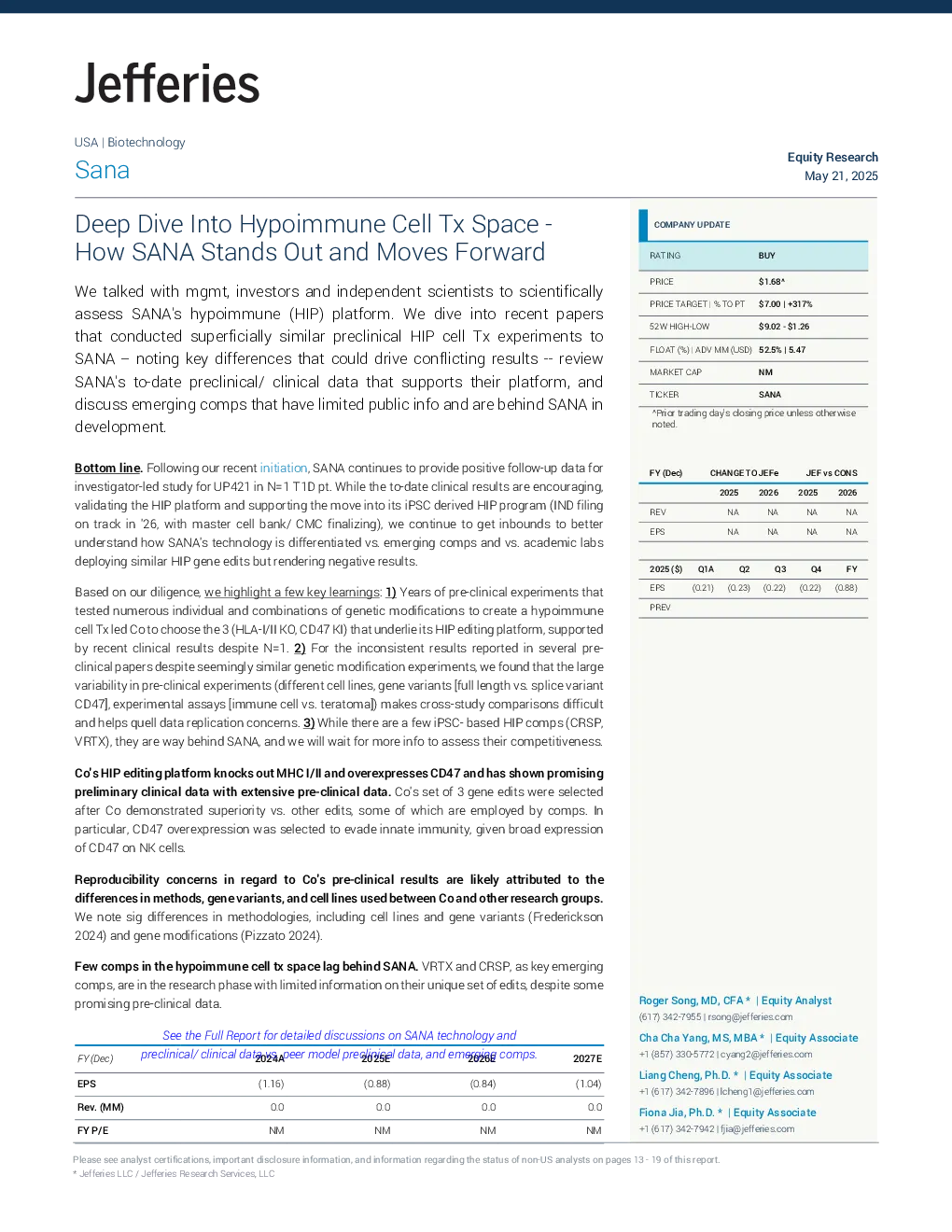
2024A2025E2026E(1.16)(0.88)(0.84)0.00.00.0NMNMNM 2027E(1.04)0.0NM Roger Song, MD, CFA * | Equity Analyst(617) 342-7955 | rsong@jefferies.comCha Cha Yang, MS, MBA * | Equity Associate+1 (857) 330-5772 | cyang2@jefferies.comLiang Cheng, Ph.D. * | Equity Associate+1 (617) 342-7896 | lcheng1@jefferies.comFiona Jia, Ph.D. * | Equity Associate+1 (617) 342-7942 | fjia@jefferies.com The Long View: SanaInvestment Thesis / Where We DifferSANA is a clinical stage biotech focused on bringing engineered cellsas medicines to market by leveraging its proprietary hypoimmune editingplatform. SANA has 3 assets in development for 3 different disease spaces:Type 1 Diabetes (T1D), autoimmune diseases (AiDs), and oncology. SANA’sasset for T1D, SC451, has the potential to bring an innovative functional cureto a disease space that has used insulin as SOC for 100+ years. SANA hasshown preliminary proof-of-concept and safety data for its hypoimmune celltherapy in T1D with its investigator-sponsored study using gene-edited donor-derived pancreatic islets in its UP421 program. We model peak adjustedrevenues in the multi-billions, driven by SANA’s T1D franchise.Base Case,$7, +317%•SC451peakT1D(25%/15%/10% POS adjusted for US/ Europe/RoW)•Platform / pipeline value: $500M•DCF based PT: $7Sustainability MattersTopMaterial Issues:1)Employee Engagement,Diversity,&Inclusion.Pharmaceutical andbiotechnology firms compete fiercely for workers. To create new goods, carry out clinical trials indiverse patient populations, handle regulatory regulations, and market new items, the sector needs highlyqualified workers. In light of a limited talent pool, if SANA can retain and recruit personnel, it may bebetter positioned to safeguard and grow shareholder value.2)Product Quality & Safety.Upon controlledclinical studies and regulatory approval, information on product safety might become available, whichsubjects companies such as SANA to the financial effects of recalls and other unfavorable occurrences.Qs to Mgmt: 1)How are you promoting patient diversity when enrolling your pivotal trials?2)What effortshave you made to hire diverse candidates into your workforce?Please see important disclosure information on pages 13 - 19 of this report.This report is intended for Jefferies clients only. Unauthorized distribution is prohibited. salesof~$2.8B Upside Scenario,$14, +733%•SC451peakT1D(40%/30%/20% POS adjusted for US/ Europe/RoW)•Platform / pipeline value: $500M•DCF based PT: $14 Downside Scenario,$1, -40%•SC451 program fails, peak T1D sales of ~$0B (0%/0%/0% POS adjusted for US/ Europe/RoW)•Cash runway: $199M•DCF based PT: $1Catalysts2025:UP421 long term follow-up data2025:SC451 data update2025:SC291 Ph 1 data release2025:SC262 Ph 1 data release2026:SG299 IND filing2026:SC451 IND filing salesof~$2.8B 2 Co's HIP platform's 3 genetic modifications were chosen after countless experiments lookingat different individual and combination modifications.The edited hypoimmune cells are modifiedto evade both the adaptive and innate immune system. Co drew inspiration from viruses, tumors,and the fetomaternal border. The first 2 modifications knock out B2M and CIITA to block MHC I/II and evade attacks from CD8+ and CD4+ T cells. The third modification over expresses CD47to prevent clearance of the transplanted cells by innate immune cells including NK cells andmacrophages. These modifications were chosen after extensive experiments employing dozens ofdifferent combinations of gene edits (Chart 1). Co studied molecules such as HLA-E and PD-L1 butfound that overexpression of these molecules was not enough to prevent NK cell attacks, likelybecause their corresponding receptors are not expressed on all NK cells; for example, the CD94receptor for HLA-E is only expressed on ~28% of NK cells. Additionally, Co found that overexpressinga combination of molecules such as HLA-E and PD-L1, was not sufficient to evade all NK cell attacksdespite initial hypotheses of a potential additive effect. CD47 overexpression, in contrast, showedtotal protection from NK cell attacks, likely because its receptor is expressed on all NK cells. Whileco's lead program focuses on creating hypoimmune islets for T1D, Co has tested these edits in avariety of cell types including islet cell, T cell, myocardiocyte, and smooth muscle cells, noting theplatform working in any cell types despite various CD47 overexpression levels required for immuneevasion.Chart 1 - SANA's Previously Tested Gene Edits.Source: Company reportsSANA has showed compelling preclinical data to address one of key debates if Co's gene editedcells can sufficiently avoid being killed by NK cells.NK cells are able to detect and attack cellsthat are missing MHC I. Mechanistically, CD47 overexpression reduces phagocytosis by cells suchas macrophages and NK cells. SANA has presented positive pre-clinical data showing that HIP-edited cells are able to evade NK cell immune responses using NK cell toxicity assays, while MHCI/II doub