武田制药:在应对美国政策难题的同时,专注于新产品推出(2024年第四季度投资者关系讨论后)
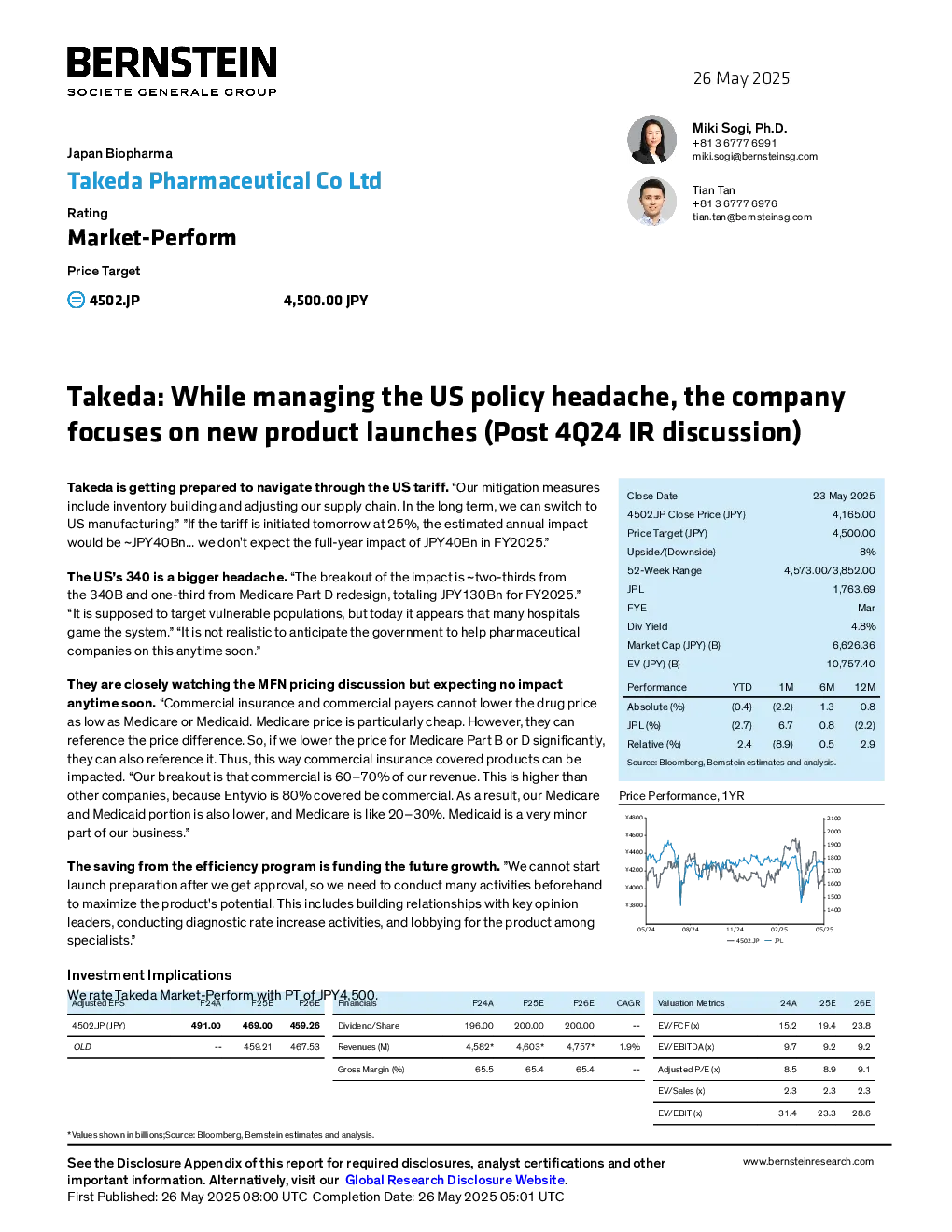
F24AF25EF26ECAGR196.00200.00200.00--4,582*4,603*4,757*1.9%65.565.465.4--Valuation Metrics24A25EEV/FCF (x)15.219.4EV/EBITDA (x)9.79.2Adjusted P/E (x)8.58.9EV/Sales (x)2.32.3EV/EBIT (x)31.423.3Close Date23 May 20254502.JP Close Price (JPY)4,165.00Price Target (JPY)4,500.00Upside/(Downside)52-Week Range4,573.00/3,852.00JPL1,763.69FYEDiv YieldMarket Cap (JPY) (B)6,626.36EV (JPY) (B)10,757.40PerformanceYTD1M6MAbsolute (%)(0.4)(2.2)1.3JPL (%)(2.7)6.70.8Relative (%)2.4(8.9)0.5Source: Bloomberg, Bernstein estimates and analysis.Price Performance, 1YR¥4800¥4600¥4400¥4200¥4000¥380005/2408/2411/2402/2505/25140015001600170018001900200021004502.JPJPLwww.bernsteinresearch.com DETAILSTAKEDA Q4FY24 POST-EARNINGS IR DISCUSSION TRANSCRIPT (EDITED FOR CLARITY)US DYNAMICS - TARIFF, 340B, MEDICARE PART D REDESIGN AND MOST-FAVORED-NATION PRICINGQ:You mentioned that you were considering potential mitigation measures for the US tariff, including supply chainmanagement. Could you elaborate on what kind of supply chain management you were referring to?A:Our mitigation measures include inventory building and adjusting our supply chain. In the long term, if products becomesubject to tariffs, we can switch to US manufacturing (ours and/or CDMO). If the tariff is initiated tomorrow at 25%, theestimated annual impact would be around JPY40Bn. We will start implementing these mitigation measures, and the tariff is yetto be imposed so we don't expect the full-year impact of JPY40Bn in FY2025.Q:Regarding the 2025 forecast, you mentioned that you have included a JPY130Bn impact from the Medicare Part D redesign,which started in Jan this year, and the 340B expansion. Is it correct to assume that your estimated impact is mainly fromthe 340B program? Takeda doesn't have any key pharmacy-dispensed products for the Medicare population that could beaffected by the Part D redesign. Does the 340B program have a greater impact on hospital infusion centers as opposed to thosepharmacy-dispensed products?A:The breakout of the impact is approximately two-thirds from the 340B and one-third from Medicare Part D redesign,totaling JPY130Bn for FY2025. The impact of Medicare Part D on our company is relatively small compared to other largepharmaceutical companies with similar revenue because Medicare Part D primarily affects outpatient drugs (i.e., retailpharmacy-dispensed with prescription as opposed to hospital-administered meds), and thus, our Medicare Part D portion isquite small (e.g., Entyvio IV’s main target patients are in their 30’s and 40’s and IV is administered at hospitals/infusion centers).However, some of our oral products, particularly those for oncology such as Fruzaqla, Alunbrig and Ninlaro, are having asignificant impact due to the high coverage of Medicare for older patients since January. Regarding the 340B program, it shouldmainly affect hospital-administered products, such as Entyvio and PDT. However, some hospitals have specialty pharmacieswithin their networks, making it unclear whether the 340B program only targets medications used in hospitals. The 340Bprogram originally aims to ensure access to innovative medicines for low-income individuals with limited healthcare insurance.It is supposed to target vulnerable populations, but today it appears that many hospitals game the system. The hospital ownercan apply for the 340B program if they meet the criteria, which is based on the ratio of low-income patients to total patients.Once they enroll in the 340B program and get huge discounts on medications from pharma companies. This system wasimplemented in the 1990s when it was a size of USD6Bn and now it's becoming USD50Bn. Nowadays, it's becoming like ahospital business scheme to secure profit. Some hospitals are becoming large networks by acquiring small hospitals. Theyacquire hospitals in a low-income region with majority patients with limited insurance coverage. And then, these hospitalsbecome 340B eligible and can get huge discounts on medications. They have rich patients who are treated at different hospitalswithin their network for whom they can use these discounted drugs and can get good insurance reimbursement. So, manypharmaceutical companies are not happy with this, including us.Q:When looking at some reports, it appears that immunology products tend to get higher 340B benefit for hospitals. Why?A:PDT products are administered in hospitals. So, if 340B covers these immunology products, hospitals can get them at a muchcheaper price. Same as Entyvio. If the hospital orders Entyvio under 340B, they can get a huge discount.Q:In the case of Entyvio, currently, IV is still the main source of revenue for you. But once it shifts more to subcutaneous andmoves to pharmacy dispensing. If it goes outside those hospitals, do you think the impact of 340B might decrease?A:I think it's premature to speculate, because currently, Entyvio’s subcutaneous business is quite limited compared to IV.Q:There are a lot of lobbying and legal initiatives on