周末医疗动态衰老研究的新进展?欧米伽- 3、周末战士及更多
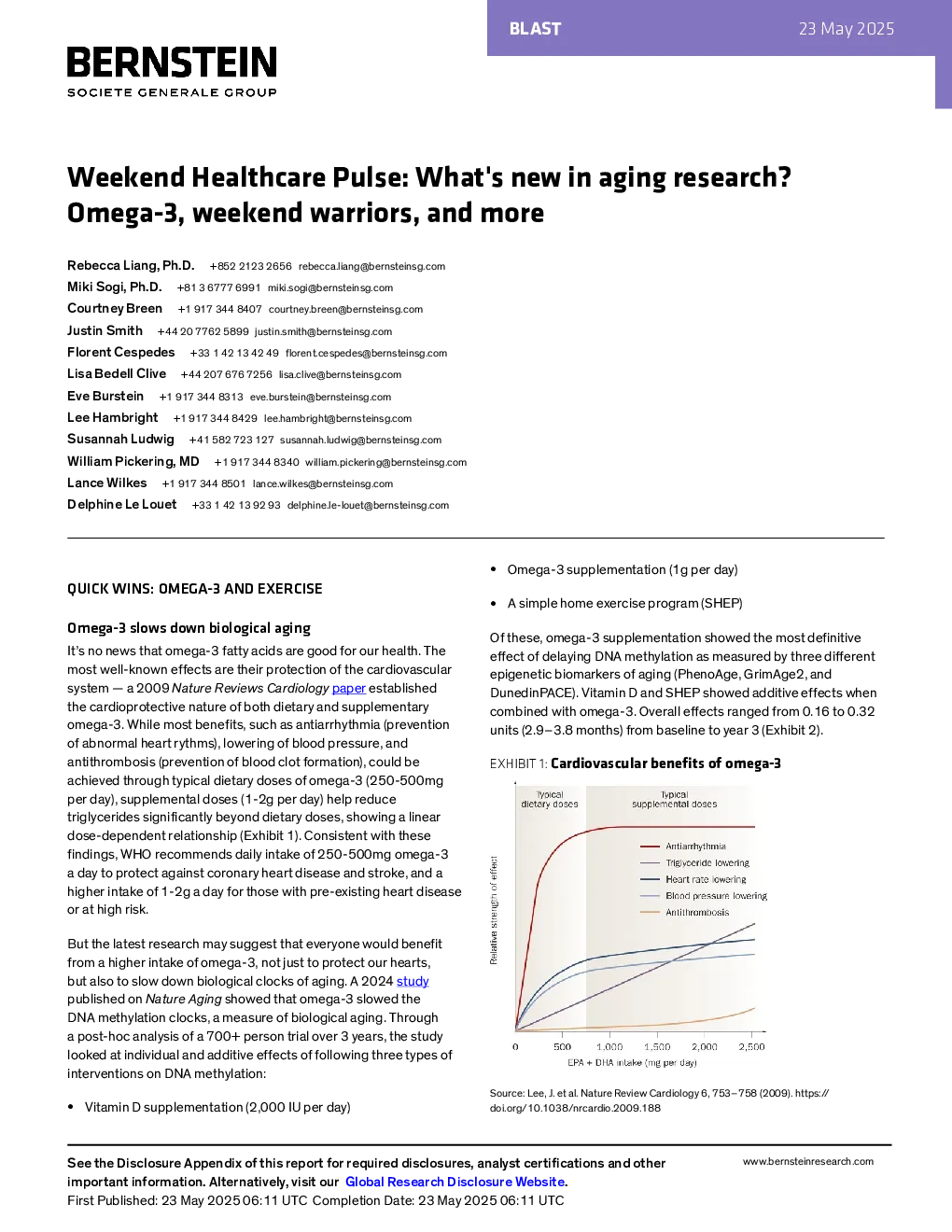
EXHIBIT 2:Omega-3 alone has a statistically significantslowing effect of the DNA methylation clock PhenoAge.Other factors Vitamin D and SHEP (simple home exerciseprogram) show additive effects.Source: Bischoff-Ferrari, et al. Nature Aging 5, 376–385 (2025). https://doi.org/10.1038/s43587-024-00793-yWhat about other omega fatty acids? Does omega-6 reallycause inflammation?Now that we have all the more reason to increase omega-3 intake,the question is, how? While typical supplemental pills or capsulesprovide a direct way to achieve 1g or more a day, some mayprefer a more natural approach through dietary choices (besides,not all of us could stand the fishy after-taste of typical omega-3supplements). When opting for omega-3-rich foods (Exhibit 3), acommon concern fueled by popular science recently is we couldalso be getting too much omega-6, and that may not be desirableas omega-6 is associated with inflammation.Omega-3 and omega-6 fatty acids are both polyunsaturated fattyacids. They are long carbon chains with one or more double bondsbetween the carbon atoms and end with a methyl group on oneend and a carbonyl group on the other. The number 3 or 6 simplyindicates the position of the first double bond from the methyl end(Exhibit 4). Typical omega-6 fats are vegetable oils, and typicalomega-3 fats are fish oils. But many foods that are rich in omega-3also have high levels of omega-6, such as nuts and seeds.According to Harvard Health Publishing (site), there is no need toavoid omega-6 fats. Both fatty acids are beneficial to our CV health,and omega-6 particularly helps lower LDL (“bad cholesterol) andboost HDL (“good cholesterol”). As for the accusation on causinginflammation, the article argues that the good outweighs the bad.Linolenic acid, the most common type of omega-6 fatty acids,could be converted in the body to building blocks for moleculesthat are pro-inflammation. But the conversion rate is low, and AHAreviewers concluded that eating omega-6 fats would not drive upinflammation.Instead of avoiding omega-6, argued the researchers, we should beeating extra omega-3 to increase the omega-3 to omega-6 ratio.Foods that are differentially high in each type of fatty acids are:CHINA PHARMA AND BIOTECH •Omega-6 fats: Safflower oil, sunflower oil, corn oil, soybean oil,sunflower seeds, walnuts, pumpkin seeds•Omega-3 fats: Oily fish such as salmon, herring, mackerel, andsardines; fish oil and flaxseed oil; flaxseeds, walnuts, and chiaseedsEXHIBIT 3:Besides supplements, one can also increase theiromega-3 intake through foodsSource: https://optimisingnutrition.com/omega-3-foods/EXHIBIT 4:Difference between omega-3 and omega-6: wherethe first double bond isSource: https://www.eufic.org/en/whats-in-food/article/the-importance-of-omega-3-and-omega-6-fatty-acids 2 EXHIBIT 5:“Weekend warrior” exercise pattern shows similar(even slightly stronger) association with reduced risks ofmild dementia as the regularly active type.Source: O'Donovan G et al. British Journal of Sports Medicine 2025;59:325-332.https://doi.org/10.1136/bjsports-2024-108460EXHIBIT 6:Weekend warrior pattern is associated withsimilarly lower risks of dementia, stroke, Parkinson’s, andvarious mood disorders as the regularly active.Source: Min, J. et al. Nature Aging 4, 1394–1402 (2024). https://doi.org/10.1038/s43587-024-00688-y3 Exercise slows aging no matter how you do it — “weekendwarrior” worksWhen it comes to lifestyle choices for healthy aging, exercise isanother no-brainer. Of course, we all know the benefits of stayingactive. But a common challenge is to stay active regularly, or asconventional wisdom has it, work out at least four to five days aweek. To those that find regular exercises difficult because of timecommitment, it should be welcome news that weekend warriorstyle exercise works just as well as far as aging benefits go.Two recent studies looked into the effect of different physicalactivity patterns on the risks of dementia and other age-relateddiseases. One is a prospective cohort study of over 10,000participants in Mexico City followed for an average of 16 years.Those that exercised once or twice a week were categorized as“weekend warriors” and those who exercised more often weretermed “regularly active”. The key finding is that weekend warriorshad a similar, if not better, risk reduction of mild dementia as theregularly active group, when compared to those without exercise.The hazard ratio was 0.75 (95% CI 0.61 to 0.91) for the weekendwarriors vs. 0.89 (95% CI 0.78 to 1.02) for the regularly active,i.e., a 25% and 11% risk reduction of mild dementia, respectively(Exhibit 5).Similarly, a second study followed over 70,000 participants inthe UK for the impact of moderate to vigorous physical activities(MVPA). More specific thresholds were applied for the grouping:•Inactive (<150 min / week of MVPA)•Weekend warrior (≥150 min / week with ≥50% of total MVPAoccurring within 1–2 days)•Regularly active (≥150 min / week but not meeting weeke