您的浏览器禁用了JavaScript(一种计算机语言,用以实现您与网页的交互),请解除该禁用,或者联系我们。[世界卫生组织]:纳米比亚:NEMLIST-2021年纳米比亚基本药物清单 - 发现报告

纳米比亚:NEMLIST-2021年纳米比亚基本药物清单

AI智能总结
查看更多
纳米比亚:NEMLIST-2021年纳米比亚基本药物清单

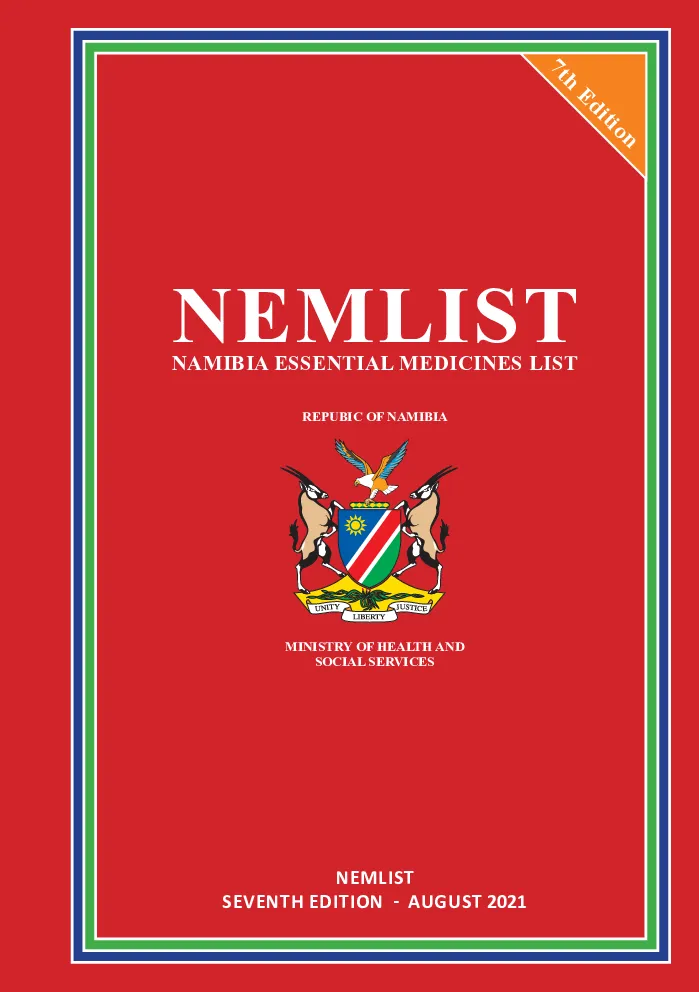
NEMLISTNAMIBIA ESSENTIAL MEDICINES LIST REPUBIC OF NAMIBIA MINISTRY OF HEALTH ANDSOCIAL SERVICES NEMLISTSEVENTH EDITION - AUGUST 2021 NEMLIST NAMIBIA ESSENTIAL MEDICINES LIST Seventh Edition / August 2021 Directorate: Pharmaceutical ServicesDivision: National Medicines Policy Co-ordinationPrivate Bag 13198Windhoek, NamibiaTel.: 061 203 2351Email: Essential.Medicines@mhss.gov.na CONTENTSForeword...................................................................................................................................... iiPreface........................................................................................................................................ iiiEssential Medicines List Committee (EMLC) 2021................................................................... vList of Abbreviations.................................................................................................................. vi1.How to use the Seventh Edition of the Namibia Essential Medicines List(NEMList)..........................................................................................................................11.1General..................................................................................................................... 11.2Structure and Layout................................................................................................ 11.3Ordering of items on the NEMList.......................................................................... 31.4Purchase of medicines not included in the NEMList............................................... 41.5Feedback and requests for changes to the NEMList.................................................42.Restricted Use Classification........................................................................................... 52.1 NiMART items............................................................................................................. 52.2 Restricted (R) Items..................................................................................................... 63.The Namibian Essential Medicines List - organised according to the maintherapeutic groups......................................................................................................... 104.The Namibian Essential Medicines List - Alphabetic Index...................................... 305.Annexes........................................................................................................................... 455.1Annex 1: Overview of processes for requesting, and evaluating applicationsfor changes to the Nemlist or buy-out items.......................................................... 455.2Annex 2: Summary of technical guidelines for evaluating requests for changesto the Nemlist And Buyouts................................................................................... 505.3Annex 3: Guidelines for submitting requests for changes to the Nemlist andNamibia Standard Treatment Guidelines............................................................... 535.4Annex 4: Request form for changes to the Namibia Standard TreatmentGuidelines (STGS) and the Namibia Essential Medicines List (Nemlist)............. 565.5Annex 5: Guidelines for requesting procurement of a non-Nemlist Medicine(Buy-Out)............................................................................................................... 615.6Annex 6: Application form for buyouts................................................................. 63 FOREWORD The World Health Organization introduced the concept of essential medicines in 1977. Essentialmedicines are those that satisfy the priority health care needs of the population. They are selectedwith due regard to public health relevance, evidence on efficacy and safety, and comparative cost-effectiveness. Essential medicines are intended to be available within the context of functioning health systems, atall times in adequate amounts, in the appropriate dosage forms, with assured quality and adequateinformation, and at a price the individual and the community can afford. The implementationof the concept of essential medicines is intended to be flexible and adaptable to many differentsituations; exactly which medicines are regarded as essential remains a national responsibility.Evidence and experience has shown that careful selection of a limited range of essential medicinesresults in a higher quality of care, better management of medicines and a more cost-effective useof available health resources. The National Medicines Policy for Namibia, which was adopted by cabinet in 1998, confirms therelevance of the essential medicines concept and contains a set of guidelines for the selection ofmedicines to be included in Namibia’s Essential Medicine List, as well as procedures to follow inkeeping this list up to date. The first main policy decision within the pharmaceutical sector afterIndependence was the adoption of the essential medici