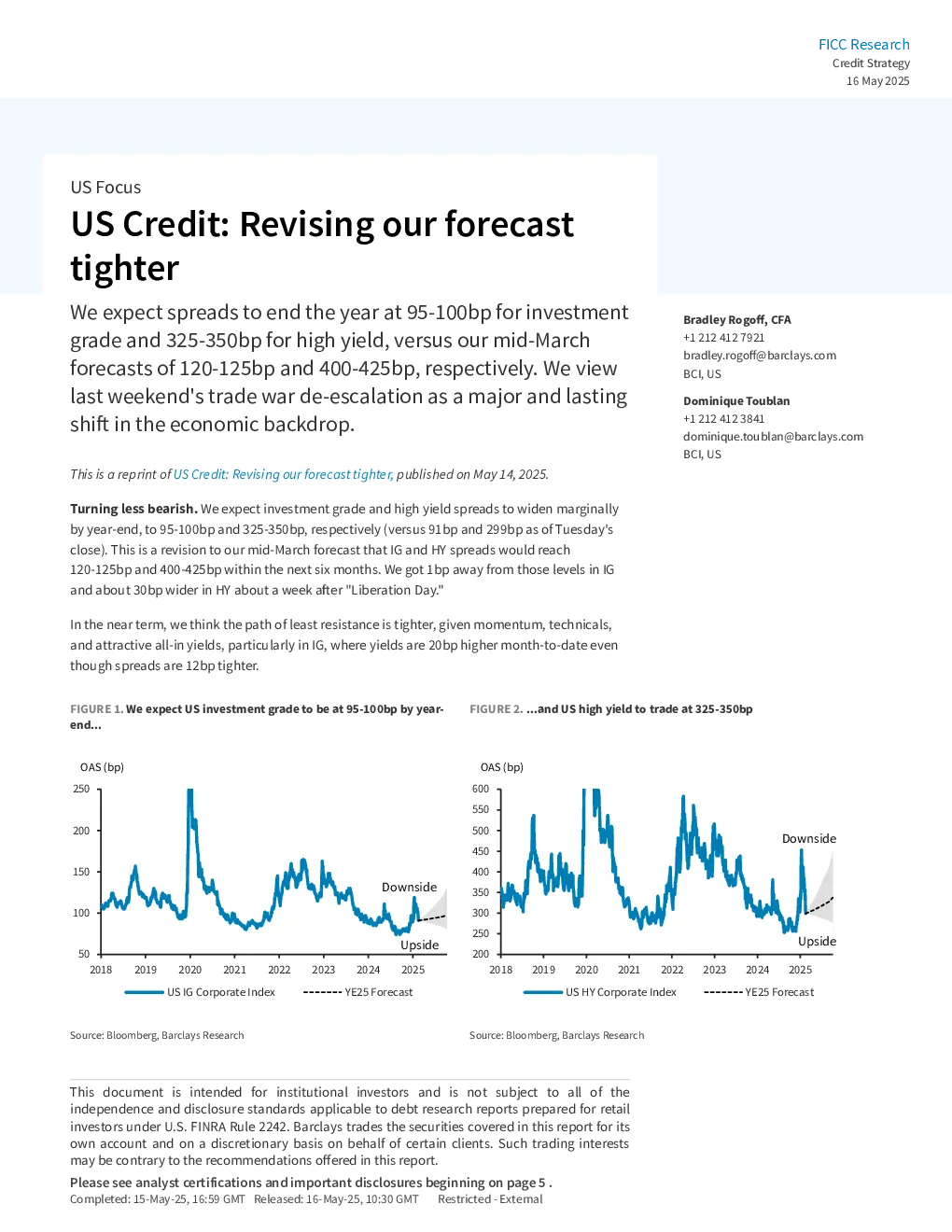
FIGURE 2. ...and US high yield to trade at 325-350bp202020212022202320242025US IG Corporate IndexYE25 ForecastDownsideUpside200250300350400450500550600201820192020US HY Corporate IndexOAS(bp)Source: Bloomberg, Barclays ResearchRestricted - External 2021 2022202320242025YE25 ForecastDownsideUpsideBradleyRogoff,CFA+1 212 412 7921bradley.rogoff@barclays.comBCI, USDominique Toublan+1 212 412 3841dominique.toublan@barclays.comBCI, US FIGURE 3. IG and HY leverage has been moving sideways for the pastFIGURE 4. 1Q25 earnings were fine but on the weaker side comparedwith the past few quarters55%% of Companies withScore of 4 or 5on Earnings ScorecardQ1 243.13.03.03.12.602.803.003.203.403.60OverallCyclicalNon-CyclicalFinancial4Q231Q242Q243Q244Q241Q25AvgScoreSource: Factset, Compustat, S&P CapIQ, Barclays ResearchSource: Barclays ResearchWe view last weekend'stariffde-escalation as a material change in the macro backdrop.Barclays Economics believes that the overall picture has improved materially, with a bettergrowth trajectory and less pressure on inflation and unemployment, but only one Fed cut in2025, as discussed in China trade war de-escalation: Running it back.The bottom line is that our economists estimate the overall trade-weightedtariffto be about14% now, compared with 25% before. They also assume that the US will maintain the newlyannouncedtariffrates on China over the medium term,afterupcoming negotiations.They expect growth to be positive in every quarter this year (1.0%, 0.5%, and 1.0% q/q saar inthe last three quarters of the year), core PCE of 3.3%, and unemployment only a tick higher, at4.3% by YE25. The flip side is that they now forecast only one Fed cut in 2025 (in December) andthree in 2026. This slow growth, combined with a slow-moving Fed, should make it hard forcredit spreads to go back to cycle tights for an extended period.The main known unknowns on the macro side aretariffre-escalation, as well as US taxesand the deficit.There are still significant potential risks ahead. On thetariffside, the US-Europe situation is key for further improvement on trade tensions. Furthermore, we have nowreached a pause, not a final agreement, and there is risk of re-escalationafterward(but that'snot our base case).For the US, long-end Treasury yields have continued to climb and are now at levels thattriggered a reaction from the White House the last time they were reached. The deficit and taxsituations are likely among the main drivers of the increase. Proposals are on the table in theHouse, so we might get updates on that front relatively soon.Credit fundamentals look fine, with an okay 1Q25 earnings season.Overall, net leverage hasbeen relatively stable across IG and HY, as shown in Figure 3. Companies have remainedcautious since COVID, as many expected a recession in 2022-23 and waited for more clarity onthe trade and tax fronts before becoming more aggressive with their balance sheets. However,all is not rosy on the fundamental front, as illustrated by our Earnings Scorecard, which is finebut on the weak side of recent quarters, as shown in Figure 4. As a consequence, idiosyncraticrisk remains and the risk of downgrades has likely increased. Q2 242 FIGURE 5. Retail is underexposed to creditFIGURE 6. Taiwan has been buying through the market volatility05010015020025030035040012y+ Net Buy ($mn)Weekly AvgOvernight Net Buying 12y+, $mnSource: TRACE, Barclays ResearchHigh all-in yields create a positive technical backdrop that should keep spreads tight.Treasury yields remain high, particularly in the long end. 10y and 30y Treasury yields are closeto local highs at 4.5% and 4.9%, respectively, and forwards markets imply that investors expectyields to remain elevated for at least the rest of the year. Higher yields continue to be a tailwindfor spreads; for instance, history shows that 12-month forward total returns for long-end BBBsare positive about 85% of the time when they trade between 6.0% and 6.5% (see here).On the demand side, retail flows should pick upaftersignificant outflows in April, andinstitutional flows should remain robust.Institutional flows were robust throughout therecent volatility, as seen in both the primary and secondary markets. This is partially due to 1)defensive positioning ahead of "Liberation Day," and 2) high cash inflows from coupons (highestindex coupons in ten years) and large maturities from the slew of 5y bonds issued at the heightof COVID in 2020. Furthermore, foreign demand for corporate bonds did not abate in the pastfew weeks, despite large gyrations on the FX side (see Figure 6, here, and here).Finally, investor positioning remains defensive, as indicated by our Complacency Signal, whichis at "slightly complacent," and by conversations with investors. This is also true structurally onthe retail side, as allocations to corporate debt by mutual funds benchmarked to the credit agghas fallen in recent years ( Figure 5).Issuance might pick up with thetariffwar de-escalation,