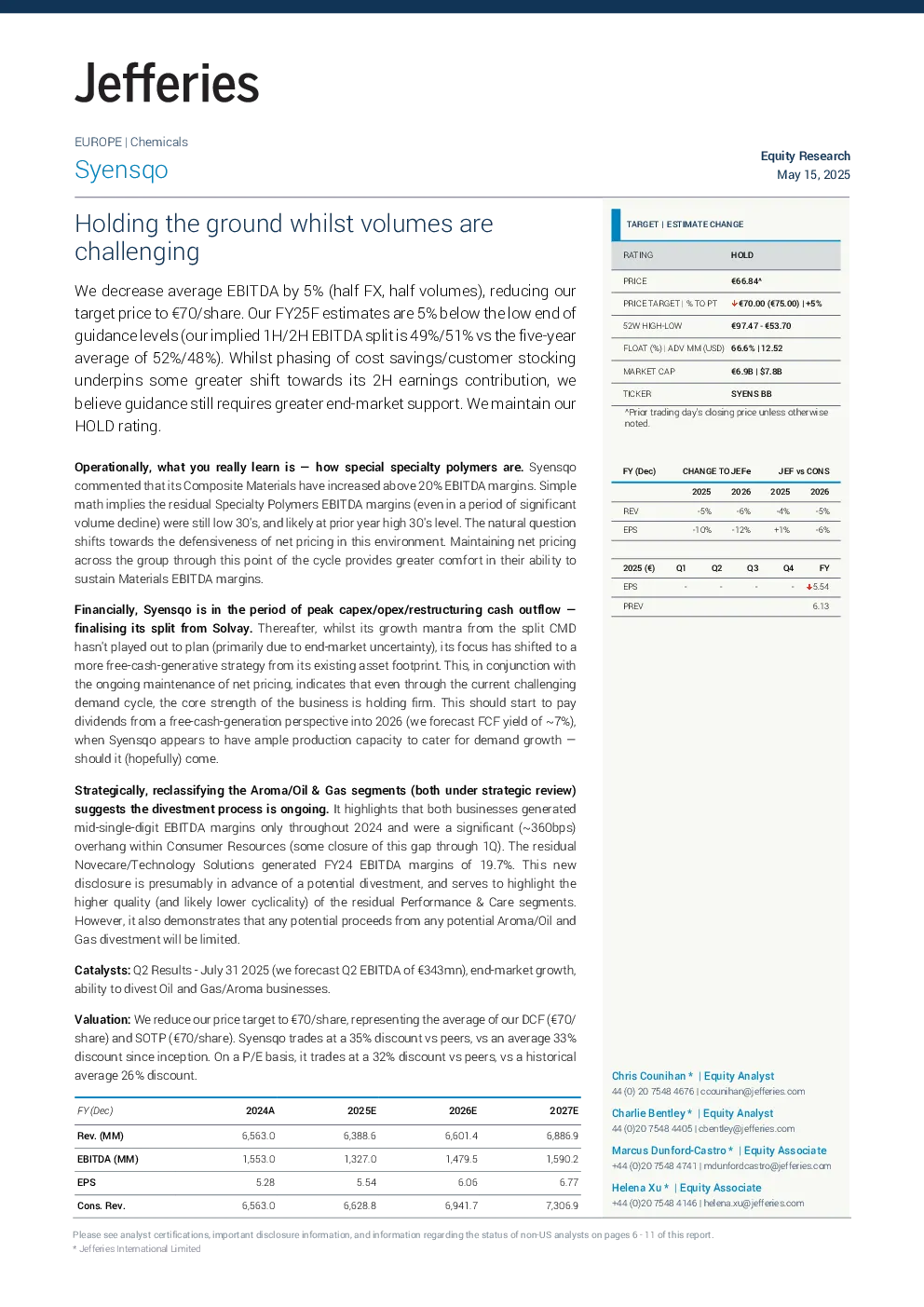
EUROPE | ChemicalsSyensqo Holding the ground whilst volumes arechallenging We decrease average EBITDA by 5% (half FX, half volumes), reducing ourtarget price to €70/share. Our FY25F estimates are 5% below the low end ofguidance levels (our implied 1H/2H EBITDA split is 49%/51% vs the five-yearaverage of 52%/48%). Whilst phasing of cost savings/customer stockingunderpins some greater shift towards its 2H earnings contribution, webelieve guidance still requires greater end-market support. We maintain ourHOLD rating. Operationally, what you really learn is — how special specialty polymers are.Syensqocommented that its Composite Materials have increased above 20% EBITDA margins. Simplemath implies the residual Specialty Polymers EBITDA margins (even in a period of significantvolume decline) were still low 30's, and likely at prior year high 30's level. The natural questionshifts towards the defensiveness of net pricing in this environment. Maintaining net pricingacross the group through this point of the cycle provides greater comfort in their ability tosustain Materials EBITDA margins. Financially, Syensqo is in the period of peak capex/opex/restructuring cash outflow —finalising its split from Solvay.Thereafter, whilst its growth mantra from the split CMDhasn't played out to plan (primarily due to end-market uncertainty), its focus has shifted to amore free-cash-generative strategy from its existing asset footprint. This, in conjunction withthe ongoing maintenance of net pricing, indicates that even through the current challengingdemand cycle, the core strength of the business is holding firm. This should start to paydividends from a free-cash-generation perspective into 2026 (we forecast FCF yield of ~7%),when Syensqo appears to have ample production capacity to cater for demand growth —should it (hopefully) come. Strategically, reclassifying the Aroma/Oil & Gas segments (both under strategic review)suggests the divestment process is ongoing.It highlights that both businesses generatedmid-single-digit EBITDA margins only throughout 2024 and were a significant (~360bps)overhang within Consumer Resources (some closure of this gap through 1Q). The residualNovecare/TechnologySolutionsgeneratedFY24EBITDAmarginsof19.7%.Thisnewdisclosure is presumably in advance of a potential divestment, and serves to highlight thehigher quality (and likely lower cyclicality) of the residual Performance & Care segments.However, it also demonstrates that any potential proceeds from any potential Aroma/Oil andGas divestment will be limited. Catalysts:Q2 Results - July 31 2025 (we forecast Q2 EBITDA of €343mn), end-market growth,ability to divest Oil and Gas/Aroma businesses. Valuation:We reduce our price target to €70/share, representing the average of our DCF (€70/share) and SOTP (€70/share). Syensqo trades at a 35% discount vs peers, vs an average 33%discount since inception. On a P/E basis, it trades at a 32% discount vs peers, vs a historicalaverage 26% discount. Chris Counihan * | Equity Analyst44 (0) 20 7548 4676 | ccounihan@jefferies.com Charlie Bentley * | Equity Analyst44 (0)20 7548 4405 | cbentley@jefferies.com Marcus Dunford-Castro * | Equity Associate+44 (0)20 7548 4741 | mdunfordcastro@jefferies.com Helena Xu * | Equity Associate+44 (0)20 7548 4146 | helena.xu@jefferies.com The Long View: Syensqo Investment Thesis / Where We Differ •Moving from a heavy investment phase to a FCF harvest phase.•Defendability of net pricing (in particular across specialty polymers),which represents >half of group EBITDA.•Returning cash to shareholders via an onmarket buyback Upside Scenario,€107, +60% Downside Scenario,€50, -25% Base Case,€70, +5% •An upside scenario of €107/share implies 9.9xEV/EBITDA (assuming no valuation discountto peers)•ThisassumespeakcyclegroupEBITDAmargins (23.5%) are sustained. •A downside scenario of €50/share implies adiscount to historic low cycle margins (21%EBITDA)•Apply5.6xEV/EBITDA-a33%discountto peer valuations (consistent with currenttrading valuation). •A base case of €70/share implies 7.1x EV/EBITDA•WeakerConsumerResourcesdemandoverhangs earnings progression. Sustainability Matters Catalysts Top Material Issue(s): GHG Emissions:Chemical companies are leading contributors of industrialcarbon emissions (at ~6% of global CO2 emissions). Actions to reduce CO2 emissions are startingto be reflected in valuation. Among ESG considerations, GHG emissions are estimated to have themost negative impact on valuation. •Q2 Results - July 31 2025 Company Target(s):1) Reduce scope 3 greenhouse gas emissions by 23% by 2030; 2) Reduce scope1 and 2 emissions 40% by 2030; 3) Achieve carbon neutrality for scope 1 and 2 by 2040. Qs to Mgmt:1) Could you detail the level of capital investment required to achieve your targets; 2)How would the divestment of Oil & Gas impact your environmental targets, is this already baked in;3) When do you expect your remaining 35% of sites to transition to solely renew