您的浏览器禁用了JavaScript(一种计算机语言,用以实现您与网页的交互),请解除该禁用,或者联系我们。[国际能源署]:热刀技术对晶体硅光伏组件分层的生命周期评估 - 发现报告

热刀技术对晶体硅光伏组件分层的生命周期评估

AI智能总结
查看更多
热刀技术对晶体硅光伏组件分层的生命周期评估

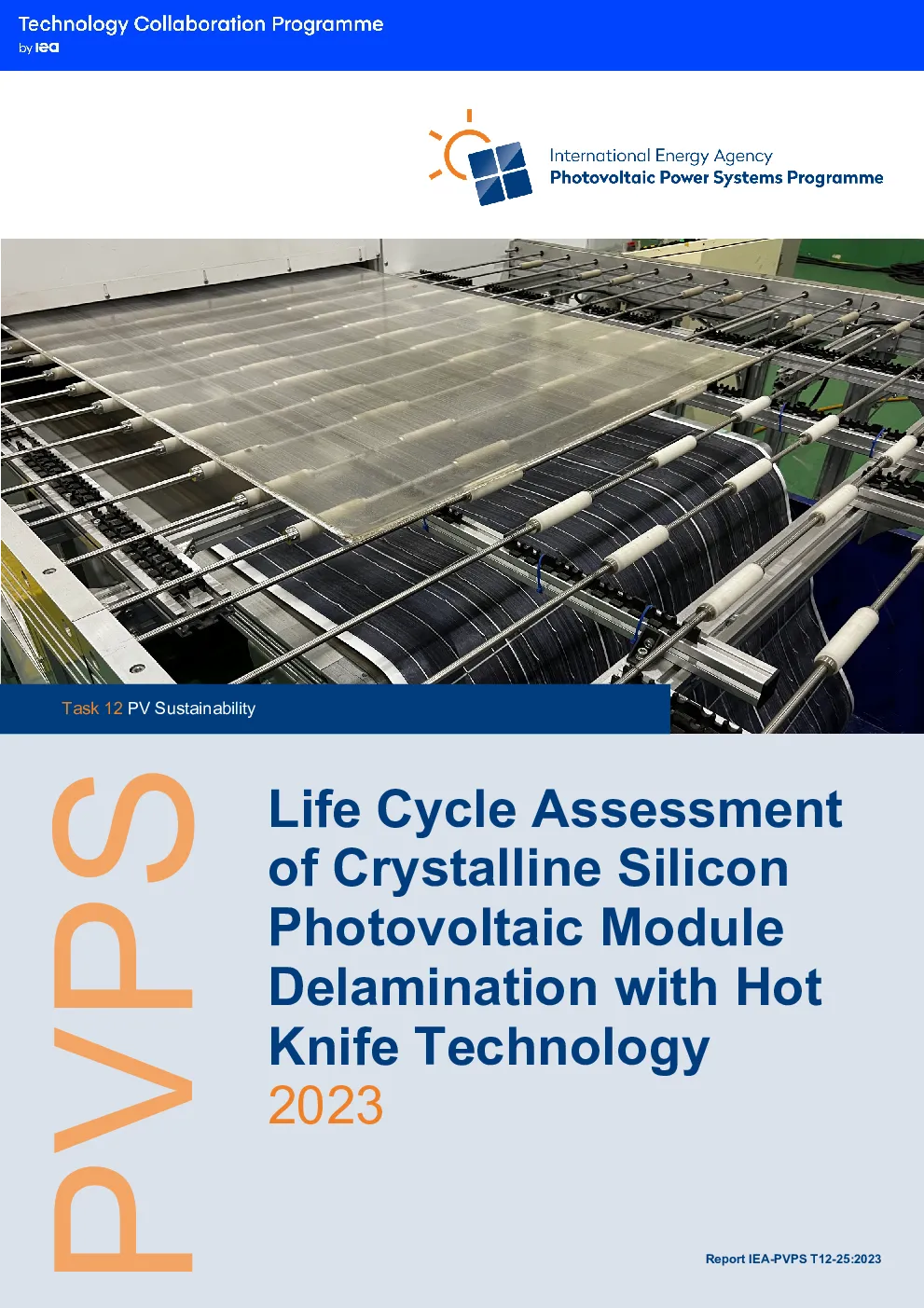
Life Cycle Assessmentof Crystalline SiliconPhotovoltaic ModuleDelamination with HotKnife Technology2023Report IEA-PVPS T12-25:2023 What is IEA PVPS TCP?The International Energy Agency (IEA), founded in 1974, is an autonomous body within the framework of the Organisationfor Economic Co-operation and Development (OECD). The Technology Collaboration Programme (TCP) was created witha belief that the future of energy security and sustainability starts with global collaboration. The program comprises expertsacross government, academia, and industry dedicated to advancing common research and the application of specificenergy technologies.The IEA Photovoltaic Power Systems Programme (PVPS) is a TCP within the IEA; it was established in 1993. The missionof the program is to “enhance the international collaborative efforts which facilitate the role of photovoltaic solar energy asa cornerstone in the transition to sustainable energy systems.” To achieve this, the program’s participants have undertakena variety of joint research projects in photovoltaic (PV) power systems applications. The overall program is headed by anexecutive committee comprising one delegate from each country or organization member, which designates distinct“tasks,” which may be research projects or activity areas.The 25 IEA PVPS participating countries are Australia, Austria, Belgium, Canada, China, Denmark, Finland, France,Germany, Israel, Italy, Japan, Korea, Malaysia, Morocco, the Netherlands, Norway, Portugal, South Africa, Spain, Sweden,Switzerland, Thailand, Turkey, and the United States of America. The European Commission, Solar Power Europe, theSmart Electric Power Alliance, the Solar Energy Industries Association, the Solar Energy Research Institute of Singaporeand Enercity SA are also members.Visit us at:www.iea-pvps.org.What is IEA PVPS Task 12?Task 12 aims to foster international collaboration in safety and sustainability that are crucial for ensuring that PVpenetration increases to levels high enough to make a major contribution to the energy needs and emissions reductionsof the member countries and the world. The overall objectives of Task 12 are to (1) quantify the environmental profile ofPV compared to other energy technologies; (2) investigate end-of-life management options for PV systems as deploymentincreases and as older systems are decommissioned; and (3) define and address environmental health and safety andother sustainability issues that are important for market growth. The first objective of this task is well served by life cycleassessments that describe the energy, material, and emissions flows in all stages of the life of PV. The second objectiveis addressed through the analysis of recycling and other circular economy pathways. For the third objective, Task 12develops methods to quantify risks and opportunities on topics of stakeholder interest. Task 12 is jointly operated by theNational Renewable Energy Laboratory and the University of New South Wales (UNSW Sydney). Support from the U.S.Department of Energy and the UNSW are gratefully acknowledged.AuthorsMain content:Rolf Frischknecht, Keiichi Komoto, Taisuke DoiDISCLAIMERThe IEA PVPS TCP is organised under the auspices of the International Energy Agency (IEA) but is functionally and legally autonomous.Views, findings and publications of the IEA PVPS TCP do not necessarily represent the views or policies of the IEA Secretariat or itsindividual member countriesCOVER PICTURE: PV module recycling facility, courtesy of NPC Incorporated, JapanISBN978-3-907281-41-3: Life Cycle Assessment of Crystalline Silicon Photovoltaic Module Delamination with Hot Knife Technology INTERNATIONAL ENERGY AGENCYPHOTOVOLTAIC POWER SYSTEMS PROGRAMMELife Cycle Assessment of Crystalline SiliconPhotovoltaic Module Delamination with Hot KnifeTechnologyIEA PVPSTask 12: PV SustainabilityReport IEA-PVPS T12-25:2023June 2023ISBN 978-3-907281-41-3Task Managers:Garvin Heath, National Renewable Energy Laboratory, Golden, CO, USAJose Bilbao, University of New South Wales, Sydney, AustraliaAuthors:Rolf Frischknecht, Keiichi Komoto, Taisuke DoiCitation: R. Frischknecht, K. Komoto, T. Doi 2023, Life Cycle Assessment of Crystalline Silicon Photovoltaic ModuleDelamination With Hot Knife Technology, IEA PVPS Task 12, International Energy Agency (IEA) PVPS Task 12,Report T12-25:2023. ISBN 978-3-907281-41-3. Acknowledgements...........................................................................................................6List of abbreviations ..........................................................................................................7Executive summary...........................................................................................................81Introduction............................................................................................................101.1Motivation and goal ....................................................................................101.