您的浏览器禁用了JavaScript(一种计算机语言,用以实现您与网页的交互),请解除该禁用,或者联系我们。[世界黄金协会]:为什么是2025年的黄金?跨资产视角 - 发现报告

为什么是2025年的黄金?跨资产视角

为什么是2025年的黄金?跨资产视角

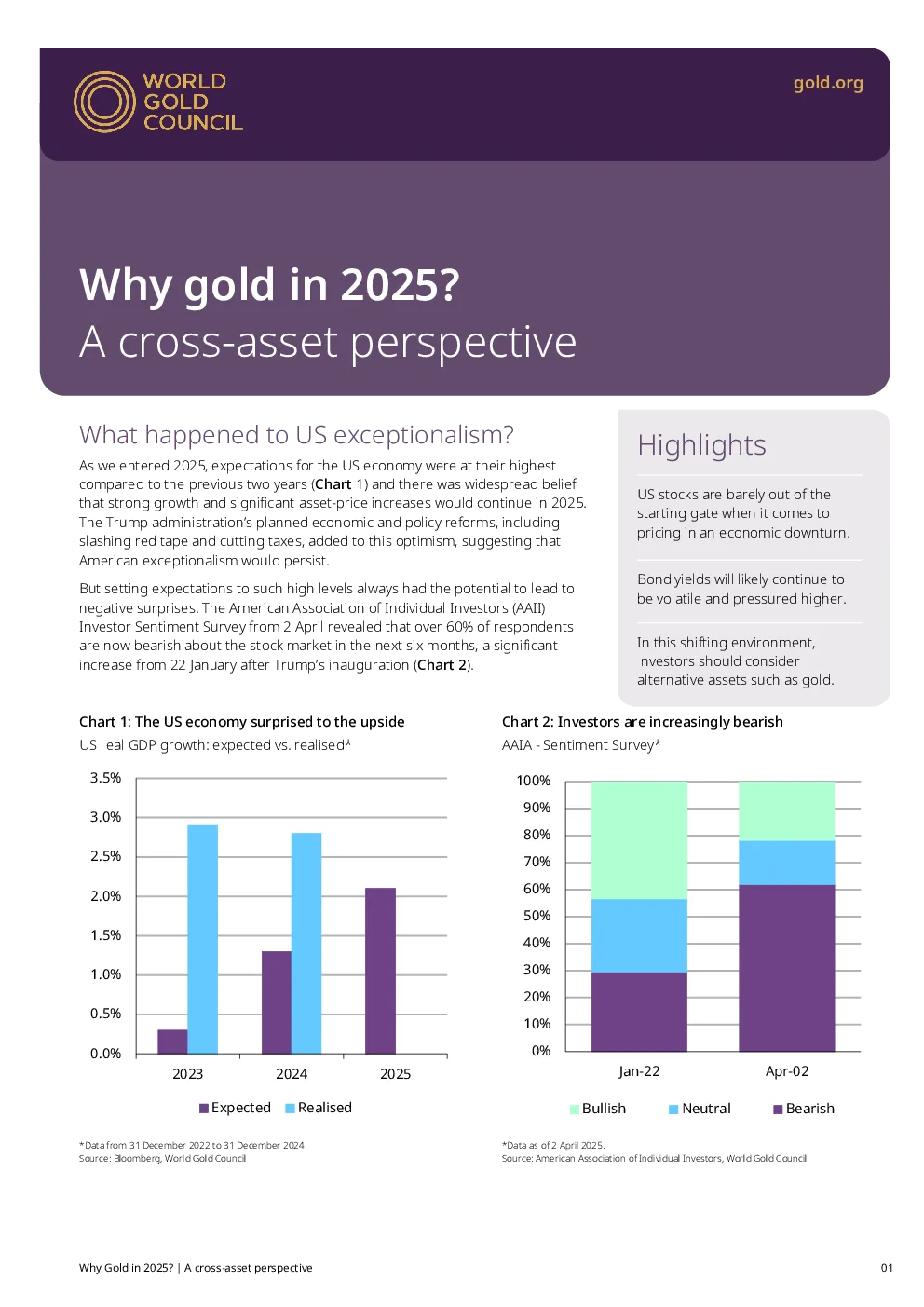
Why gold in 2025?A cross-asset perspective What happened to US exceptionalism? Highlights As we entered 2025, expectations for the US economy were at their highestcompared to the previous two years (Chart1) and there was widespread beliefthat strong growth and significant asset-price increases would continue in 2025.The Trump administration’s planned economic and policy reforms, includingslashing red tape and cutting taxes, added to this optimism, suggesting thatAmerican exceptionalism would persist. US stocks are barely out of thestarting gate when it comes topricing in an economic downturn. Bond yields will likely continue tobe volatile and pressured higher. But setting expectations to such high levels always had the potential to lead tonegative surprises. The American Association of Individual Investors (AAII)Investor Sentiment Survey from 2 April revealed that over 60% of respondentsare now bearish about the stock market in the next six months, a significantincrease from 22 January after Trump’s inauguration (Chart2). In this shifting environment,nvestors should consideralternative assets such as gold. USeal GDP growth: expected vs. realised* AAIA - Sentiment Survey* Chart4:Anxiety attack Investors are now growing increasingly concerned over thegrowth and inflation outlook, both at the US and globallevels, from the fallout of the ongoing trade war (Chart3). University of Michigan Consumer Sentiment ndex and 1yrinflation expectations* Chart3: Gold has outperformed as the Trump trade fades Y-t-d performance of key asset classes, value at start = 100* And with tariffs looking likely to produce a stagflationaryimpulse, the Fed faces a dilemma: should it prioritisecontrolling inflation, which is set to rise,or support growth,which is expected to decline? Unlike in 2024, the Fed is lesslikely to get ahead of any growth concerns. And a reactiveFed typically spells trouble for equities. More broadly,stagflation has historically been detrimental to equity returnsand beneficial for gold returns (Chart5). All told, until calm is restored on the political and economicpolicy fronts, volatility is likely to stay elevated acrossfinancial markets – both equities and bonds – which in ourview supports an allocation to gold. Equities: a bumpy roadahead… Chart5: Gold a clear winner in stagflation Major asset returns per cycle phase since 1973* The longer the uncertainty lasts, the bigger the risks, but fora hint as to the bumpy road ahead, look no further than thecollapse in the University of Michigan Consumer SentimentIndex and the surge in inflation expectations – moves thatpoint to stagflation as consumers respond to tariff concerns(Chart4). Furthermore, given the recent bruising moves, investorscould be forgiven for thinking that equities must now befactoring in a lot of downside risk. In fact, US stocks arebarely out of the starting gate when it comes to pricing in aneconomic downturn as the US stock market was highlyvalued to begin with. With the recent relief rally, thebenchmark is trading on 19 times analysts’ 2025 earningsper share forecasts. And on all common valuation metrics,the S&P 500 remains more expensive than historicalaverages (Table1). Chart6:Gold provides downside protection Gold returned positive performance in 8 out of the 10 worstquarters for US equities* Common valuation metrics of the S&P 500* The return of the bondvigilantes? If one thing is true of the bond market at the moment, it isthat, on the face of it, it looks attractive on a risk-adjustedbasis. Current yields are well above long-term returns formany of the global fixed income sub-asset classes, whichmeans that fixed income may be well positioned to deliverrobust returns in the period ahead. And amid the trade onslaught, the probability of a recessionhas risen substantially. The future trajectory will depend onkey indicators such as jobless claims, consumer spendingand corporate profits. But a recession would be a particularlytough scenario for equities, and investors should keep inmind that considerable downside would be yet to come forthe asset class, leading to greater safe-haven demand,notably gold. In fact, with few exceptions, gold has beenespecially effective during these periods of systemic risk,generating positive returns in 8 out of the 10 worst quartersof performance for the MSCI USA index (Chart6). But markets have been continuously in a pre-COVID mindsetof returning to ultra-low rates, hence under-pricing howhawkish the Fed would be, and we believe these dynamicscould continue in the near term (Chart7, p4). Chart8: Is the only way up? Chart7: What if the next Fed move was up? US govt interest payments vs. 10yr term premia* All in all, maintaining a diversified portfolio can feel likechasing a moving target in today’s rapidly evolving marketenvironment where bonds are now providing less of adiversification benefit than in the past, but also demand ahigher portion of investors’ risk budgets.Chart9