经合组织2024年工业原材料出口限制清单:监测市场和政策紧张局势下出口限制的使用情况
 AI智能总结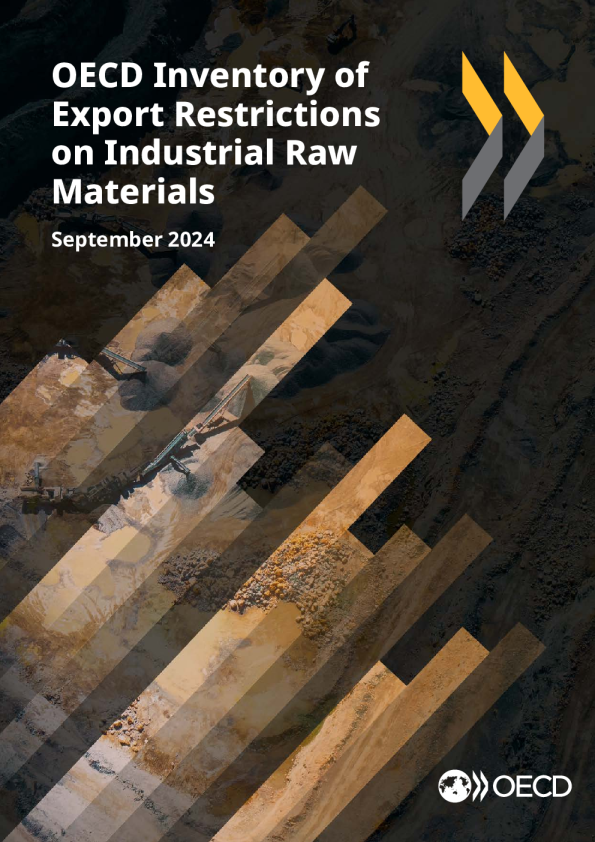
September2024 OECD Inventory of ExportRestrictions on IndustrialRaw Materials2024 MONITORING THE USE OF EXPORT RESTRICTIONSAMID MARKET AND POLICY TENSIONS This work is published under the responsibility of the Secretary-General of the OECD. The opinions expressed andarguments employed herein do not necessarily reflect the official views of the Member countries of the OECD. This document, as well as any data and map included herein, are without prejudice to the status of or sovereignty overany territory, to the delimitation of international frontiers and boundaries and to the name of any territory, city or area. Photo credits:Cover © Curioso.Photography/Shutterstoc Attribution 4.0 International (CC BY 4.0)This work is made available under the Creative Commons Attribution 4.0 International licence. By using this work, you accept to be bound by the terms of this licence(https://creativecommons.org/licenses/by/4.0/).Attribution– you must cite the work.Translations– you must cite the original work, identify changes to the original and add the following text:In the event of any discrepancy between the original work and thetranslation, only the text of original work should be considered valid.Adaptations– you must cite the original work and add the following text:This is an adaptation of an original work by the OECD. The opinions expressed and arguments employed inthis adaptation should not be reported as representing the official views of the OECD or of its Member countries.Third-party material– the licence does not apply to third-party material in the work. If using such material, you are responsible for obtaining permission from the third party and forany claims of infringement.You must not use the OECD logo, visual identity or cover image without express permission or suggest the OECD endorses your use of the work.Any dispute arising under this licence shall be settled by arbitration in accordance with the Permanent Court of Arbitration (PCA) Arbitration Rules 2012. The seat of arbitration shallbe Paris (France). The number of arbitrators shall be one. Table of contents 1 International trade in industrial raw materials42 Key trends in the use of export restrictions, 2009-202263 Implications124 About the OECD Inventory on Export Restrictions on Industrial Raw Materials13References17Also in this series17 FIGURES Figure2.1.Export restrictions increased fivefold over 2009-226Figure2.2.Waste and scrap products and ores and minerals face the highest incidence of export restrictions7Figure2.3.Some products have experienced a sharp increase in export restrictions8Figure2.4.More than 20% of trade in certain key minerals for the green transition faced atleast one exportrestriction over 2020-229Figure2.5.Five countries accounted for more than half of the newrestrictions introduced over 2009-202210Figure2.6.While export taxes and quotas are the most common measures, export prohibitions haveincreased in recent years11Figure2.7.Export prohibitions were the most commonly introduced measure in 202211 TABLES Table4.1.Products covered in the Inventory14Table4.2.Countries covered in the Inventory14Table4.3.Measures restricting exports included in the Inventory15 1International trade in industrialraw materials Keymessages •With supply concentrated and demand widespread, trade is critical for access to critical rawmaterials for the green and digital transitions. Yet export restrictions have increased morethan fivefold over the last decade.•While export quotas andtaxes are the most common measures, export bans–the mostrestrictive measures–are increasing and were the most commonly introduced measure in2022.•Waste and scrap products and ores and minerals face the highest incidence of exportrestrictions, reflecting both industrial policy and environmental considerations.•More than 20% of trade in certain key minerals for the green transition faced at least oneexport restriction over 2020-22. International tradehas long beenthebackbone of the rawmaterials industry.The economic viability of thisindustry requiresextraction and processingto takeplace where materials are the most naturally abundant,or where the geological and climatic conditions and available technology and resources make theirextraction and processing economically viable.Mining and processing operations also require significantlong-term investment and typically face extended approval periods. Additionally, the raw materials industryhas long been characterised by pervasive state intervention, including in the form of special regulations(e.g.natural monopolies,licenses),state ownership,investment restrictions,subsidies,and exportrestrictions. Thiscombination of natural endowments, economic viability, economies of scale and policiesexplains whythe extraction and processing of certain raw materials is highly concentrated, bothgeographicallyandinterms of ownership andcontrol. The figures tell the story: for example, the three top producing countries in 2023 a