经合组织和欧盟国家的次国家公共就业:SUBEMP试点数据库的启示
 AI智能总结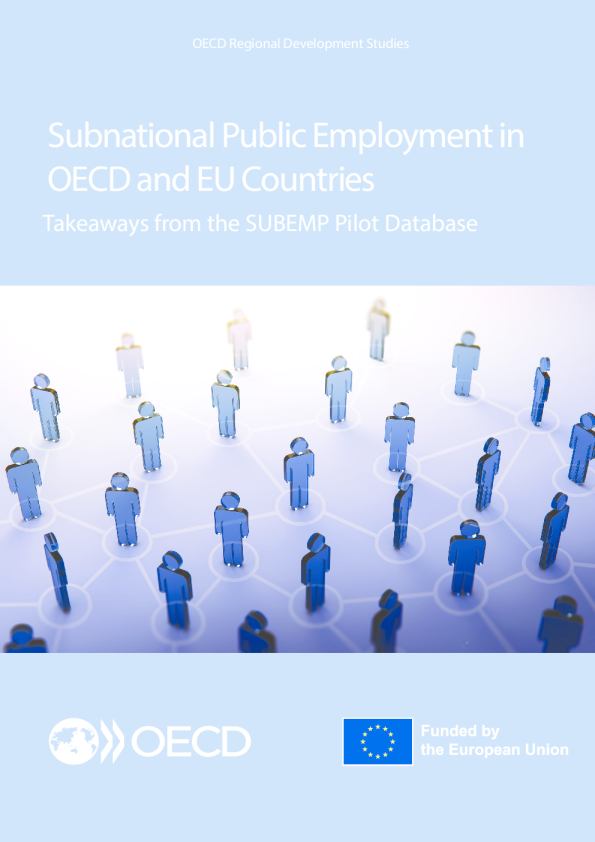
Takeaways from the SUBEMP Pilot DatabaseTakeaways from the SUBEMP Pilot Database Subnational Public Employment in OECDand EU Countries Takeaways from the SUBEMP Pilot Database This report presents methodological considerations and main findingsfrom the development of a pilot database on subnational publicemployment (SUBEMP) for OECD and EU countries. The result of a jointOECD-EC project, it aims to provide granular information on thecharacteristics (gender, age, education, employment conditions,occupation and policy areas) of subnational public sector employees, inorder to assess their capacity and potential to deliver public services andinfrastructure. The report also features guidelines to assist thedevelopment of high-quality comparable subnational public employmentdata, outlining the methodological challenges and success factors, suchas stakeholder engagement and data dissemination strategies. It closeswith a section on avenues for further research and potential for expandingthe database in the future. ABOUT THE OECD The OECD is a multi-disciplinary inter-governmental organisation with member countries whichengages in its work an increasing number of non-members from all regions of the world. TheOrganisation’s core mission today is to help governmentswork together towards a stronger,cleaner, fairer global economy. Through its network of specialised committees and workinggroups, the OECD provides a setting where governments compare policy experiences, seekanswersto common problems,identify good practice,and co-ordinate domestic andinternational policies. More information available:www.oecd.org. This document was approved by theRegional Development Policy Committee by writtenprocedure under cote [CFE/RDPC/(2024)20] on24 October 2024and prepared for publicationby the OECD Secretariat. This paper wasauthorised for publication by Lamia Kamal-Chaoui, Director,Centre forEntrepreneurship, SMEs, Regions and Cities, OECD. The statistical data for Israel are supplied by and under the responsibility of the relevant Israeliauthorities. The use of such data by the OECD is without prejudice to the status of the GolanHeights,East Jerusalem and Israeli settlements in the West Bank under the terms ofinternationallaw. Note by the Republic of Türkiye: The information in this document with reference to “Cyprus”relates to the southern part of the Island. There is no single authority representing both Turkishand Greek Cypriot people on the Island. Türkiye recognisesthe Turkish Republic of NorthernCyprus (TRNC). Until a lasting and equitable solution is found within the context of the UnitedNations, Türkiye shall preserve its position concerning the “Cyprus issue”. Note by all the European Union Member States of the OECD and the European Union: TheRepublic of Cyprus is recognised by all members of the United Nations with the exception ofTürkiye. The information in this document relates to the area under the effective control of theGovernment of the Republic of Cyprus. This document, as well as any statistical data and map included herein, are without prejudiceto the status of or sovereignty over any territory, to the delimitation of international frontiers andboundaries and to the name of any territory, city orarea. This document was produced with the financial assistance of the European Union. The viewsexpressed herein can in no way be taken to reflect the official opinion of the European Union. © OECD (2024)Cover image:jongho shin/ Getty Images Plus Attribution 4.0 International (CC BY 4.0) This work is made available under the Creative Commons Attribution 4.0 International licence. By using this work, you acceptto bebound by the terms of this licence (https://creativecommons.org/licenses/by/4.0/). Attribution–you must cite the work. Translations–you must cite the original work, identify changes to the original and add the following text: In the event of any discrepancybetween the original work and the translation, only the text of original work should be considered valid. Adaptations–you must cite the original work and add the following text: This is an adaptation of an original work by the OECD. Theopinions expressed and arguments employed in this adaptation should not be reported as representing the official views of the OECDor of its Member countries. Third-party material–the licence does not apply to third-party material in the work. If using such material, you are responsible forobtaining permission from the third party and for any claims of infringement. You must not use the OECD logo, visual identityor coverimage without express permission or suggest the OECD endorses your use of the work. Anydispute arising under this licence shall be settled by arbitration in accordance with the Permanent Court of Arbitration (PCA)Arbitration Rules 2012. The seat of arbitration shall be Paris (France). The number of arbitrators shall be one. Acknowledgments This report was produced by the OECD Centre for Entre