以任务为导向的净零排放创新政策:各国如何实施实现气候目标的任务?
 AI智能总结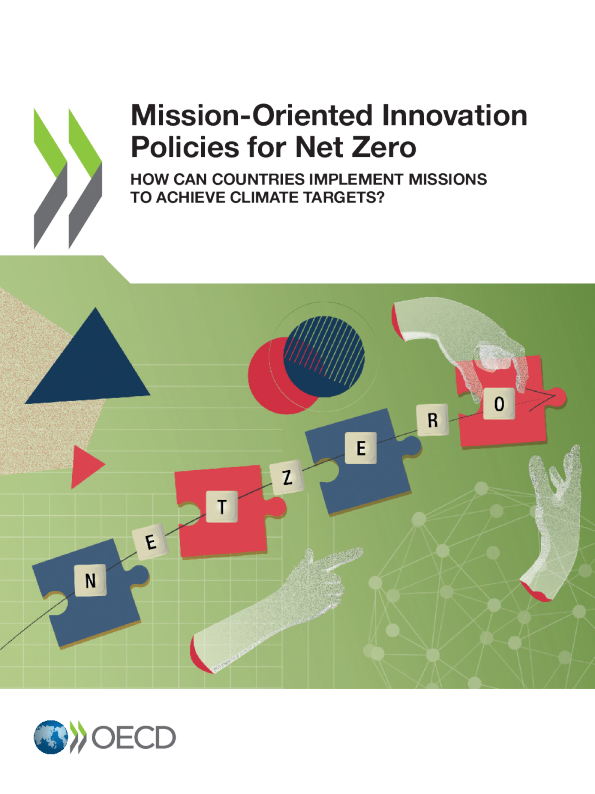
HOW CAN COUNTRIES IMPLEMENT MISSIONSTO ACHIEVE CLIMATE TARGETS? Mission‑Oriented InnovationPolicies for Net Zero HOW CAN COUNTRIES IMPLEMENT MISSIONSTO ACHIEVE CLIMATE TARGETS? This document, as well as any data and map included herein, are without prejudice to the status of or sovereignty overany territory, to the delimitation of international frontiers and boundaries and to the name of any territory, city or area. ISBN 978-92-64-64045-0 (print)ISBN 978-92-64-81498-1 (PDF)ISBN 978-92-64-58249-1 (HTML)ISBN 978-92-64-96231-6 (epub) Photo credits:Cover design by Sylvain Fraccola, Directorate for Science, Technology and Innovation. Corrigenda to OECD publications may be found at: https://www.oecd.org/en/publications/support/corrigenda.html.© OECD 2024 Attribution 4.0 International (CC BY 4.0)This work is made available under the Creative Commons Attribution 4.0 International licence. By using this work, you accept to be bound by the terms of this licence(https://creativecommons.org/licenses/by/4.0/).Attribution– you must cite the work.Translations– you must cite the original work, identify changes to the original and add the following text:In the event of any discrepancy between the original work and thetranslation, only the text of original work should be considered valid.Adaptations– you must cite the original work and add the following text:This is an adaptation of an original work by the OECD. The opinions expressed and arguments employed inthis adaptation should not be reported as representing the official views of the OECD or of its Member countries.Third-party material– the licence does not apply to third-party material in the work. If using such material, you are responsible for obtaining permission from the third party and forany claims of infringement.You must not use the OECD logo, visual identity or cover image without express permission or suggest the OECD endorses your use of the work.Any dispute arising under this licence shall be settled by arbitration in accordance with the Permanent Court of Arbitration (PCA) Arbitration Rules 2012. The seat of arbitration shallbe Paris (France). The number of arbitrators shall be one. Foreword The OECD report onMission-oriented policies for Net Zero arrives at a critical moment. As more countriesadopt mission-oriented innovation policies (MOIPs) to address urgent challenges such as climate change,the need for clear evidence of their effectiveness has never beenmore pressing. While still in the earlystages of implementation, MOIPs are already under scrutiny to demonstrate their impact and added valuecompared to traditional approaches. This report aims to address that gap, providing insights from 101 net-zero missions and 17 in-depth case studies to assess how well MOIPs support national greenhouse gasemissions reduction commitments. MOIPs have introduced a new approach to tackling large-scale challenges by fostering the collectivedevelopment of ambitious objectives, aligning their plans on these objectives and moving together towardstheir realisation. This report highlights the progress made by net-zero missions.Over the last five years ofintense implementation of and learning on missions, the leadership ofScience, Technology, and Innovation(STI) authorities has been crucial in these missions, convening diverse stakeholders to align efforts. However, many of these missions still face obstacles, such as a lack of clear directions,persisting siloes,limited joint-action,andunfit evaluation.Furthermore, whilemissions tend to benefit from more stable,long-term funding than traditional STI initiatives, their resources are often fragmented. To fully unlock theirpotential, dedicated multi-annual funding isessential to incentivise partners, fill gaps, and enhance portfoliomanagement. Furthermore, private sector engagement remains underdeveloped, requiring new fundingmechanisms and financial models to raise the necessary capital for large-scale implementation. These issues highlight the need fordeeper change, not only of the missions themselves but also of thewider systems in which they are embedded, including for instance the structure of incentives, budgetingmechanisms, agencies capabilities and practices. Going forward, a major challenge remains: securing stronger commitments from sectoral and financialpartners to scale up and implement solutions.Missions must ensure they are connected to national climateand industrial policyfunds and otherlargesustainability resources to bridge the final gap from innovationtolarge-scaledeployment. Overcomingobstacles will require a new generation of MOIPs–ones that are truly transformative andequipped with the necessary tools, resources, and collaborations to meet national and global targets. Acknowledgements This report was drafted by Philippe Larrue, lead for the work on mission-oriented innovation policy underthe aegis of the OECD Committee for Scientific and Technological Policy (CSTP). Valuable fieldworksupport