全球贸易的风险和弹性:2023-2024年的主要趋势
 AI智能总结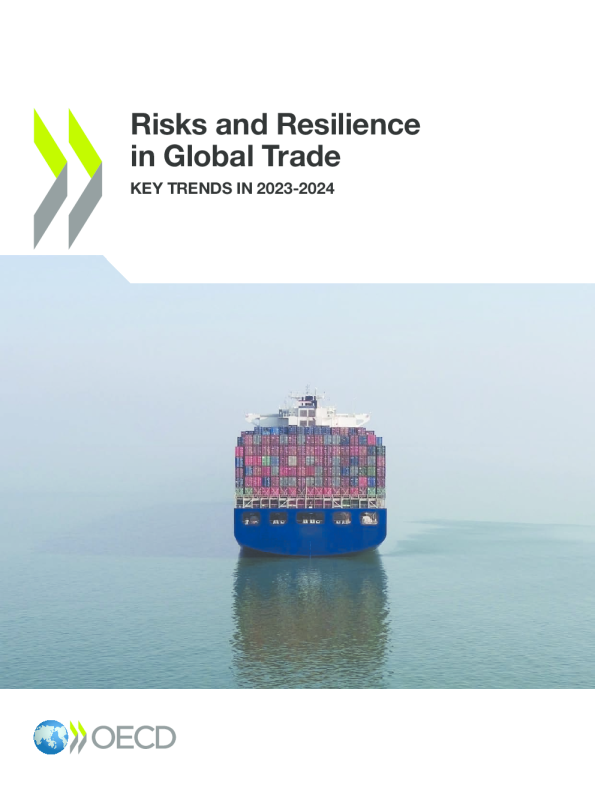
KEY TRENDS IN 2023-2024 Risks and Resiliencein Global Trade KEY TRENDS IN 2023‑2024 This document, as well as any data and map included herein, are without prejudice to the status of or sovereignty overany territory, to the delimitation of international frontiers and boundaries and to the name of any territory, city or area. The statistical data for Israel are supplied by and under the responsibility of the relevant Israeli authorities. The use ofsuch data by the OECD is without prejudice to the status of the Golan Heights, East Jerusalem and Israeli settlements inthe West Bank under the terms of international law. Note by the Republic of Türkiye The information in this document with reference to “Cyprus” relates to the southern part of the Island. There is no singleauthority representing both Turkish and Greek Cypriot people on the Island. Türkiye recognises the Turkish Republic ofNorthern Cyprus (TRNC). Until a lasting and equitable solution is found within the context of the United Nations, Türkiyeshall preserve its position concerning the “Cyprus issue”. Note by all the European Union Member States of the OECD and the European UnionThe Republic of Cyprus is recognised by all members of the United Nations with the exception of Türkiye. Theinformation in this document relates to the area under the effective control of the Government of the Republic of Cyprus. Photo credits:Cover © bartuchna@yahoo.pl/Shutterstock.com. Corrigenda to OECD publications may be found at: https://www.oecd.org/en/publications/support/corrigenda.html.© OECD 2024 Attribution 4.0 International (CC BY 4.0)This work is made available under the Creative Commons Attribution 4.0 International licence. By using this work, you accept to be bound by the terms of this licence(https://creativecommons.org/licenses/by/4.0/).Attribution– you must cite the work.Translations– you must cite the original work, identify changes to the original and add the following text:In the event of any discrepancy between the original work and thetranslation, only the text of original work should be considered valid.Adaptations– you must cite the original work and add the following text:This is an adaptation of an original work by the OECD. The opinions expressed and arguments employed inthis adaptation should not be reported as representing the official views of the OECD or of its Member countries.Third-party material– the licence does not apply to third-party material in the work. If using such material, you are responsible for obtaining permission from the third party and forany claims of infringement.You must not use the OECD logo, visual identity or cover image without express permission or suggest the OECD endorses your use of the work.Any dispute arising under this licence shall be settled by arbitration in accordance with the Permanent Court of Arbitration (PCA) Arbitration Rules 2012. The seat of arbitration shallbe Paris (France). The number of arbitrators shall be one. Foreword Since 2020, international trade has been significantly impacted by multiple, overlapping shocks thatcontinue to reshape global trading patterns. The COVID-19 pandemic’s initial wave of restrictions shutdown many economies, abruptly shifting consumption from services to goods and causing widespreaddisruptions across supply chains and transportation networks. As economies began to recover, pent-updemand stemming from theCOVID-19 period added further pressure on already strained supply chains.At the sametime, new challenges soon emerged─ including the ongoing Russian Federation's(hereafter,Russia)war of aggression against Ukraine and associated sanctions againstRussia, increasing tradetensions between theUnited Statesandthe People’s Republic ofChina(hereafter, China), and the crisisin the Middle East and the Red Sea─ further disrupting trade flows and adding uncertainty to markets. It was during the COVD-19 recovery that international trade and trade policy community recognised theneed fortimely information on these rapidly evolving trade patterns and this is when the OECD launchedits first in a series of annual reports monitoring the rapid developments in global trade. These updatesprovide essential analysis of the impacts of these unprecedented disruptions on the international tradingsystem. Using high-frequency, detailed data and advanced modelling tools, past reports in this series haveoffered insights into the ongoing recovery from the pandemic and highlighted the trade implicationsof theRussia's war of aggression against Ukraine. As the fourth report in this series, this update on international trade developments continues to monitorimportant trends in international trade amidst the aftermath of the pandemic and recent escalations ingeopolitical tensions, such as changes in aggregate trade flows, trading patterns at the product and partnerlevel and international commodity prices. In addition, this report includes an overview of maritime routesand choke points an