荷兰对新冠肺炎疫情的国际发展和人道主义应对(2020-2022年)
 AI智能总结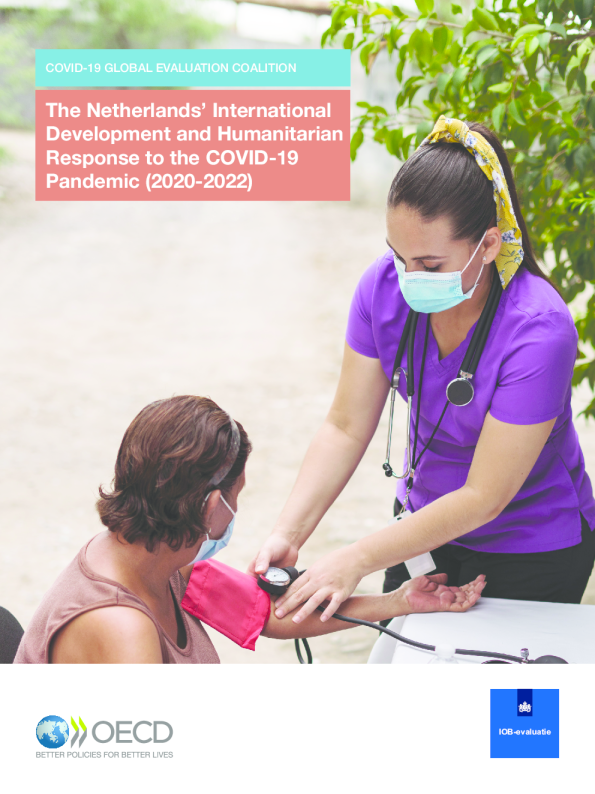
The Netherlands’ InternationalDevelopment and HumanitarianResponse to the COVID-19Pandemic (2020-2022) Thiswork is publishedunder the responsibility of the Secretary-General of the OECD and IOB. Theopinions expressed and arguments employed herein do not necessarily reflect the official views of theMember countries of the OECD. Please cite this publication as: OECD/IOB (2025),The Netherlands’ International Development and Humanitarian Response to the COVID-19 Pandemic(2020-2022),OECD Publishing, Paris,https://doi.org/10.1787/322da298-en. Photocredits:Cover©aldomurillo, Getty Images.A nurse treating a patient in rural Mexico (2020). Corrigenda toOECDpublications may be found at:https://www.oecd.org/en/publications/support/corrigenda.html. Attribution–you must cite the work. Foreword The COVID-19 pandemic presented an unprecedented test of the global community’s ability to respondswiftly, adapt to evolving needs, reallocate resources and co-ordinate effectively across borders andsectors. As governments, organisations and development actors worked to mitigate both the immediateeffectsof the pandemic and the broader socio-economic repercussions,the role of internationaldevelopment co-operation and humanitarian assistance in supporting national response efforts becamecrucial. In 2022, the participants of the COVID-19 Global Evaluation Coalition (hereafter referred to as the“Coalition”) launched the“Strategic Joint Evaluation of the Collective International Development andHumanitarian Assistance Response to the COVID-19 Pandemic”to take stock ofand learn fromthisresponse. Conducted under the auspices of the Coalition and led by the Organisation for EconomicCo-operationand Development’s (OECD) Development Co-operation Directorate, this evaluation seeks togenerate credible evidence, assess coherence and effectiveness, and draw lessons to strengthen futureresponses to global crises. TheCoalition was established in 2020 to provide actionable insights and foster accountability ininternational co-operation during the COVID-19 pandemic. Comprising more than 65 organisations,including evaluation units from OECD and non-OECD governments, UN agencies and multilateralinstitutions,–the Coalition leverages diverse experiences to create high-quality, timely evaluations and tofeed evidence into decision making in near real time. Its collective efforts enable learning acrossstakeholders and ensure that the global development community can better deliver on its commitments. Inline with the Coalition’s values of credibility, usefulness and partnership, this strategic joint evaluationbuilds and complements other evaluations and reviews conducted on COVID-19 responses over the pastfour years. It brings together multiple actors to address the gap in evaluative evidence around the overallresults of the collective pandemic response effort, offering a system-wide perspective. This provider case study on the Netherlands was preparedbyMiyabi Babasaki, Echica van KelleandMaritvan Zomeren (IOB) andMayanka Vij(OECD). We are deeply grateful for the expertise, insights, andresources provided by allthose involved in this collaborative undertaking, including theNetherlands andotherOECD member states that provided funding for the Coalition project and the strategic joint evaluation. Thisis one ofa set ofcase studies of international supportby individual providers,andof support inninepartnercountrystudies, which together form a major source of evidence for the evaluation, along with asynthesis of evaluations,anda study of the philanthropic response. The final overarching report will bepublished in 2025, along with supporting policy briefs and thematic summaries. The lessons emergingfrom this analysis–focused on the ways international partners work together andengage with local authorities and impacted communities–provide valuable insights to guide more relevant,coherent, effective and efficient international co-operation and, in turn,to support humanitarian andsustainable development progress. Table of contents Foreword3 Abbreviations and acronyms 6 Executive summary8 Lessons to be learned10 1 Introduction11 1.1. Background1.2. Methodology1.3. Limitations 111213 2 The Netherlands’ development co-operation and humanitarian assistancelandscape15 2.1. Policy frameworks152.2. Institutional set-up152.3. ODA overview17 3 The Netherlands’ international COVID-19 response21 3.1. Response overview3.2. Objectives of theresponse3.3. Evolution of the Dutch COVID-19 aid package3.4. Financial allocation overview of the Dutch COVID-19 aid package3.5.Up close: The Dutch bilateral support to Suriname 2124262832 4 Findings 36 4.1. Relevance of the Dutch development and humanitarian COVID-19 response364.2. Coherence of the Dutch development and humanitarian COVID-19 response394.3. Efficiency of the Dutch development and humanitarian COVID-19 response454.4. Effectiveness of the Dutch development and humanitarian COVID-19 response49 5 Conc