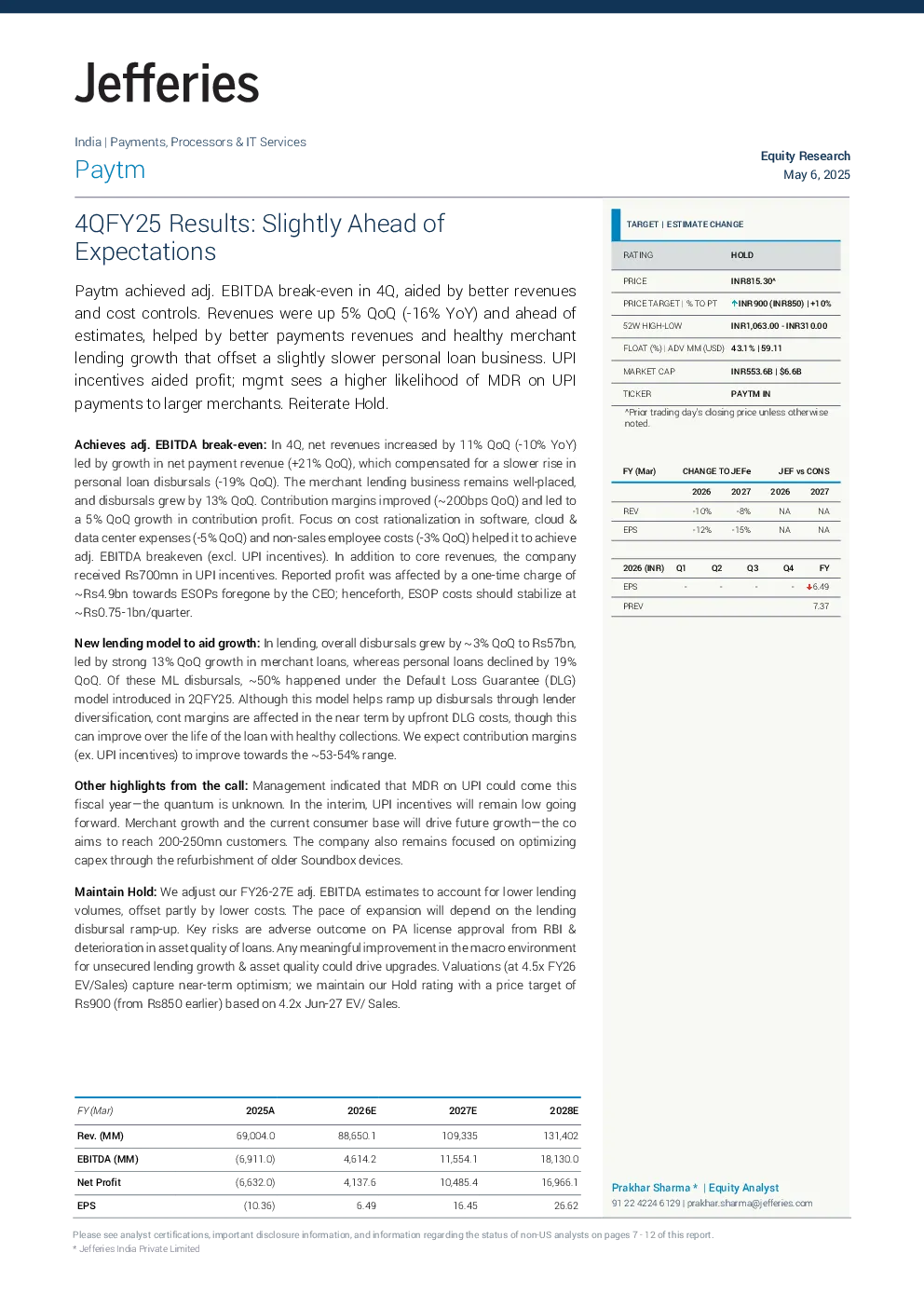
4QFY25 Results: Slightly Ahead ofExpectations Paytm achieved adj. EBITDA break-even in 4Q, aided by better revenuesand cost controls. Revenues were up 5% QoQ (-16% YoY) and ahead ofestimates, helped by better payments revenues and healthy merchantlending growth that offset a slightly slower personal loan business. UPIincentives aided profit; mgmt sees a higher likelihood of MDR on UPIpayments to larger merchants. Reiterate Hold. Achieves adj. EBITDA break-even:In 4Q, net revenues increased by 11% QoQ (-10% YoY)led by growth in net payment revenue (+21% QoQ), which compensated for a slower rise inpersonal loan disbursals (-19% QoQ). The merchant lending business remains well-placed,and disbursals grew by 13% QoQ. Contribution margins improved (~200bps QoQ) and led toa 5% QoQ growth in contribution profit. Focus on cost rationalization in software, cloud &data center expenses (-5% QoQ) and non-sales employee costs (-3% QoQ) helped it to achieveadj. EBITDA breakeven (excl. UPI incentives). In addition to core revenues, the companyreceived Rs700mn in UPI incentives. Reported profit was affected by a one-time charge of~Rs4.9bn towards ESOPs foregone by the CEO; henceforth, ESOP costs should stabilize at~Rs0.75-1bn/quarter. New lending model to aid growth:In lending, overall disbursals grew by ~3% QoQ to Rs57bn,led by strong 13% QoQ growth in merchant loans, whereas personal loans declined by 19%QoQ. Of these ML disbursals, ~50% happened under the Default Loss Guarantee (DLG)model introduced in 2QFY25. Although this model helps ramp up disbursals through lenderdiversification, cont margins are affected in the near term by upfront DLG costs, though thiscan improve over the life of the loan with healthy collections. We expect contribution margins(ex. UPI incentives) to improve towards the ~53-54% range. Other highlights from the call:Management indicated that MDR on UPI could come thisfiscal year—the quantum is unknown. In the interim, UPI incentives will remain low goingforward. Merchant growth and the current consumer base will drive future growth—the coaims to reach 200-250mn customers. The company also remains focused on optimizingcapex through the refurbishment of older Soundbox devices. Maintain Hold:We adjust our FY26-27E adj. EBITDA estimates to account for lower lendingvolumes, offset partly by lower costs. The pace of expansion will depend on the lendingdisbursal ramp-up. Key risks are adverse outcome on PA license approval from RBI &deterioration in asset quality of loans. Any meaningful improvement in the macro environmentfor unsecured lending growth & asset quality could drive upgrades. Valuations (at 4.5x FY26EV/Sales) capture near-term optimism; we maintain our Hold rating with a price target ofRs900 (from Rs850 earlier) based on 4.2x Jun-27 EV/ Sales. Prakhar Sharma * | Equity Analyst91 22 4224 6129 | prakhar.sharma@jefferies.com The Long View: Paytm Investment Thesis / Where We Differ •We expect 24% net revenue CAGR over FY25-28E, led by healthy growthin financial services (+28%) & payments (+25%).•We expect contribution margins excl. UPI incentives to sustain in the~53-54% range over the period.•Paytm has met its target of achieving adj. EBITDA break-even in 4QFY25,and is now expected to turn PAT positive in FY26E. Upside Scenario,INR1,000.00, +23% Downside Scenario,INR650.00, -20% Base Case,INR900, +10% •GMV growth of 29% CAGR over FY25-28E•Net revenue CAGR of 27% with contributionmargin expanding by ~300bps to ~56%•PT of Rs1,000 based on 4.5x Jun-27E EV/Sales for core business •GMV growth of 20% CAGR over FY25-28E•Net revenue CAGR of 20% with contributionmargin staying flat at ~53%•PT of Rs650 based on 3.5x Jun-27E EV/Salesfor core business •GMV growth of 26% CAGR over FY25-28E•Net revenue CAGR of 24% with contributionmargin improving by ~200bps to ~55%•PT of Rs900 based on 4.2x Jun-27E EV/Salesfor core business Sustainability Matters Catalysts Top Material Issue(s):1) Financial inclusion, 2) Customer privacy & data security •Broad-basing of lenders with onboarding oflarge banks & NBFCs•Stabilization and potential improvement inpayments margins•Better asset quality and lower credit costs Company Target(s):1) The company has a mission to bring half a billion Indians into the mainstreameconomy by providing access to financial services to people previously excluded from the formalbanking system. 2) Embracing data protection and privacy as the foundation of business operationsand identifying the importance of safeguarding sensitive information. Qs to Mgmt:1) What steps is the company taking to ensure strong data security and customerprivacy, given the exponential growth of volumes in digital transactions? 2) What steps is the companytaking to promote financial inclusion at different levels? 3) What steps is the company taking tosensitize employees/vendors to its core sustainability goals? Quarterly trends Source: Company data, Jefferies estimates Source: Company data, Jefferi


