亚太资本市场2025年第一季度亮点
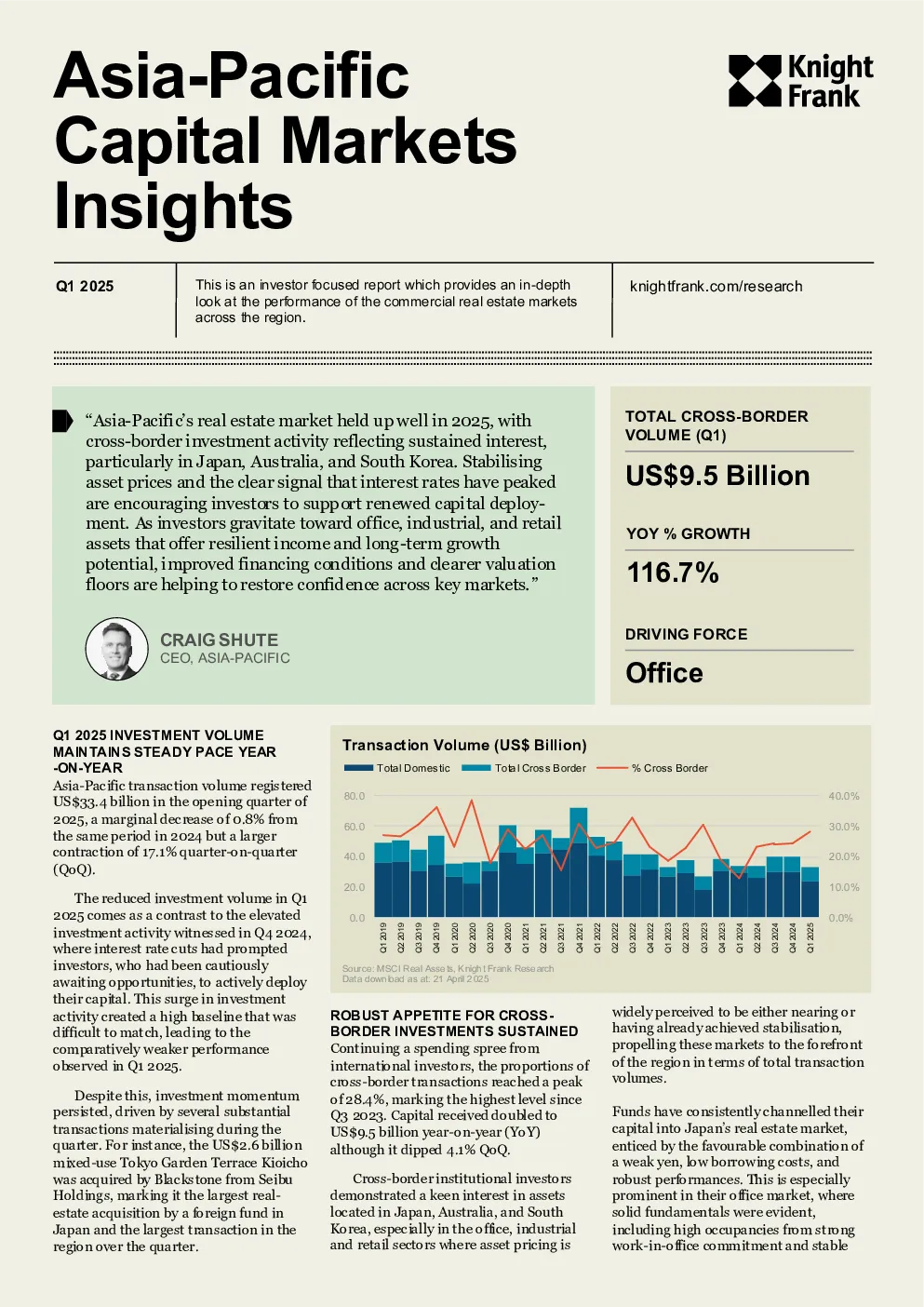
Q1 2025 This is an investor focused report which provides an in-depthlook at the performance of the commercial real estate marketsacross the region. knightfrank.com/research TOTAL CROSS-BORDERVOLUME (Q1) “Asia-Pacific’sreal estate market heldup well in 2025, withcross-border investment activity reflecting sustained interest,particularly in Japan, Australia, and South Korea. Stabilisingasset prices and the clear signal that interest rates have peakedare encouraging investors tosupport renewed capital deploy-ment. Asinvestors gravitate toward office, industrial, and retailassets that offer resilient income and long-term growthpotential, improved financing conditions and clearer valuationfloors are helping to restore confidence across key markets.” US$9.5 Billion YOY % GROWTH 116.7% DRIVING FORCE CRAIG SHUTECEO, ASIA-PACIFIC Office Q1 2025 INVESTMENT VOLUMEMAINTAINS STEADY PACE YEAR-ON-YEAR Asia-Pacific transaction volume registeredUS$33.4 billion in the opening quarter of2025, a marginal decrease of 0.8% fromthe same period in 2024 but a largercontraction of 17.1% quarter-on-quarter(QoQ). The reduced investment volume in Q12025 comes as a contrast to the elevatedinvestment activity witnessed in Q4 2024,where interest rate cuts had promptedinvestors, who had been cautiouslyawaiting opportunities, to actively deploytheir capital. This surge in investmentactivity created a high baseline that wasdifficult to match, leading to thecomparatively weaker performanceobserved in Q1 2025. widelyperceivedto be either nearing orhaving already achievedstabilisation,propelling these marketsto the forefrontof the region in terms of total transactionvolumes. ROBUST APPETITE FOR CROSS-BORDER INVESTMENTS SUSTAINEDContinuing a spending spree from international investors, the proportions ofcross-border transactions reached a peakof 28.4%, marking the highest level sinceQ3 2023. Capital received doubled toUS$9.5 billion year-on-year (YoY)although it dipped 4.1% QoQ. Despite this, investment momentumpersisted, driven by several substantialtransactions materialising during thequarter. For instance, the US$2.6 billionmixed-use Tokyo Garden TerraceKioichowas acquired by Blackstone from SeibuHoldings, marking it the largest real-estate acquisition by a foreign fund inJapan andthe largest transaction in theregion over the quarter. Funds have consistently channelled theircapital into Japan’s real estate market,enticed by the favourable combination ofa weak yen, low borrowing costs, androbust performances. This is especiallyprominent in their office market, wheresolid fundamentals were evident,including high occupancies from strongwork-in-office commitment and stable Cross-border institutional investorsdemonstrated a keen interest in assetslocated in Japan, Australia, and SouthKorea, especially in the office, industrialand retail sectors where asset pricing is rental growth.The net absorption rate hassurpassedprojections, while new primesupply constraints caused by highconstruction costs and labour shortageshave resulted in a supply-demandimbalance. activity. Positive leasing trends andrising retail sales signify the sector'sresilience amidst consumer struggles,presenting investors with attractivelong-term growth opportunities duringeconomic recovery. off again tariffs are muddying the outlookfor further recovery in the investmentlandscape. Should tariffs lead to asustained increase in inflation, the Fedwould likely raise interest rates, exertingupward pressure on long-term interestrates and cap rates, potentiallydampening capital markets activityglobally. Against the backdrop of economic andpolitical uncertainty, the industrial sectorin South Korea has experienced a surge inforeign investor confidence over the pastyear. This renewed optimism can beattributed to several factors, includingmore acceptable interest rates, thesector's resilience, and growing leasingactivities amidst a tightening supply ofprime assets. OUTLOOKThe Asia-Pacific real estate market continues to exhibit resilience andstrong investor confidence, as evidencedby transaction volumes nearing levelsseen a year ago. With US$5.6 billion indeals already captured at the onset of Q22025, the market shows promising signsof growth. If implemented in full force, theindustrial and retail sectors are likely tobear the brunt, with decreasing consumerspending and shifting goods movementdirectly influencing demand. Not withstanding broader macro-economic uncertainties, the office sectorin Asia-Pacific appears comparativelywell-insulated, underpinned by aconvergence of structural and cyclicaltailwinds. In particular, tier-one cities inJapan and Australia continue to exhibithigh occupancies and resilient rentaltrajectories. Central Banks' rate cuts have furtherenhanced the attractiveness of debt-financed acquisitions, andstabilisingasset prices have fueled increasedactivity in the market. Global investors also favoured Australianretail assets in Q1 2025, whe