您的浏览器禁用了JavaScript(一种计算机语言,用以实现您与网页的交互),请解除该禁用,或者联系我们。[普华永道]:普华永道第28届全球CEO年度调查:在未来的边缘重塑 - 发现报告

普华永道第28届全球CEO年度调查:在未来的边缘重塑

金融2025-01-15普华永道张***
AI智能总结
查看更多
普华永道第28届全球CEO年度调查:在未来的边缘重塑

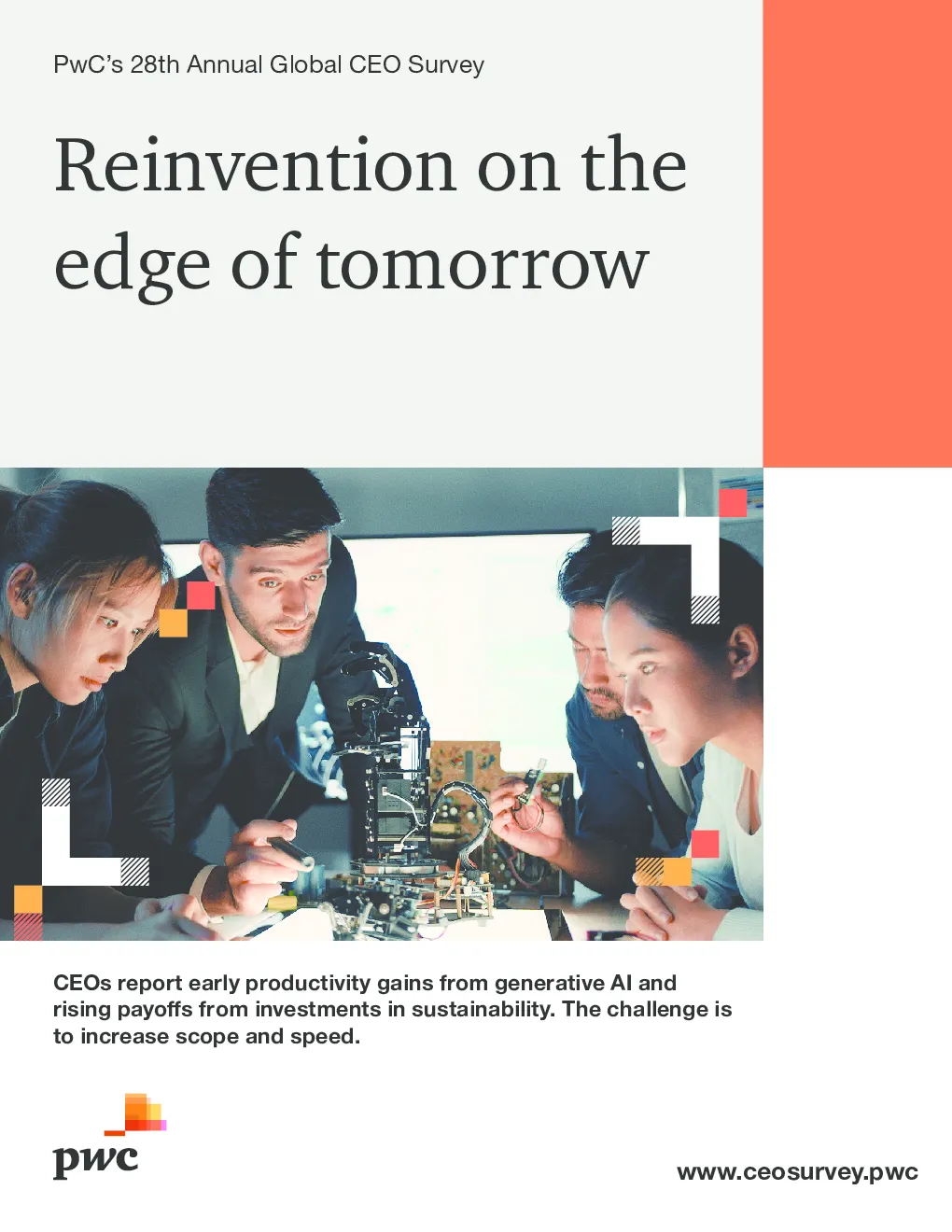
Reinvention on theedge of tomorrow CEOs report early productivity gains from generative AI andrising payoffs from investments in sustainability. The challenge isto increase scope and speed. ‘The future is already here—it’s just not evenly distributed,’ said speculativefiction author William Gibson. This sentiment echoes through the resultsof PwC’s 28th Annual Global CEO Survey, based on responses from 4,701chief executives representing every region of the world economy. Some CEOs are moving rapidly to capture the growth and value-creation potential inherent inthe defining forces of our era. They’re investing in generative AI, addressing the opportunitiesand threats posed by climate change, and reinventing their operations and business modelsto create value in new ways. Yet many others are moving slowly, constrained by leadershipmindsets and processes that lead to inertia. This latter group has two options: either accelerate their reinvention efforts or bet on hope—hope that, with just a few tweaks, today’s operating and business models will continue todeliver results even as AI and the transition to a low-carbon economy set value in motionacross the economy. Among the key findings:. Expectations for GenAI remain high. One-third of CEOs say GenAI has increased revenueand profitability over the past year, and half expect their investments in the technology toincrease profits in the year ahead. Yet trust remains a hurdle to adoption.. Investment in climate actions and sustainability is paying off. One in three CEOs reportthat climate-friendly investments made over the last five years have resulted in increasedrevenue. In addition, two-thirds say these investments have either reduced costs or hadno significant cost impact..Sector boundaries are blurring. Almost 40% of CEOs say their companies started tocompete in new sectors in the last five years. Consistent with last year’s survey, four inten CEOs believe their company will no longer be viable in ten years if it continues on itscurrent path..The pace of reinvention is slow. On average, only 7% of revenue over the last five yearshas come from distinct new businesses added by organisations in this period. Barriers toreinvention include weak decision-making processes, low levels of resource reallocationfrom year to year, and a mismatch between the short expected tenure of many CEOs andpowerful long-term forces, or megatrends, at work. .Underlining the tension across time horizons, CEOs are optimistic about the near-termoutlook even as they worry about their company’s long-term viability. Almost 60%expected global economic growth to increase over the next 12 months, up from 38% inlast year’s survey and only 18% two years ago. By a ratio of more than two to one, CEOsexpect to increase rather than decrease (42% vs. 17%) headcount in the year ahead. Two defining issues: AI and climate change Early returns on GenAI Only two years after GenAI appeared on the radar of most executives, companies aroundthe world are adopting it at scale. What’s more, many CEOs are seeing promising results.More than half (56%) tell us that GenAI has resulted in efficiencies in how employees usetheir time, while around one-third report increased revenue (32%) and profitability (34%). These outcomes are slightly below the heady expectations CEOs shared with us a yearago, but this has not dampened their optimism. CEO expectations for GenAI impacts in theyear ahead are, in fact, remarkably similar to those reported in last year’s survey. About halfof CEOs (49%) expect GenAI to increase the profitability of their company over the next12 months. These figures are broadly consistent with other PwC researchamong executives, employeesand investors. In PwC’s Global Workforce Hopes and Fears Survey 2024, 62% of employeessaid they expected GenAI to increase their efficiency at work over the next 12 months. InourGlobal Investor Survey 2024, two-thirds of investors and analysts said they expect thecompanies in which they invest to achieve productivity gains from GenAI in the year ahead. CEO predictions about theimpacts of GenAI in 2024 turnedout to be slightly optimistic Question (CEO27):To what extent will generative AIincrease or decrease the following in your company in thenext 12 months? Question (CEO28):To what extent did generative AIincrease or decrease the following in your company in thelast 12 months? More CEOs say they increased headcount asa result of GenAI investments over the lastyear than say they decreased headcount Question:To what extent didgenerative AI increase or decrease[headcount] in your company in thelast 12 months? About half of CEOs expect GenAI toincrease profitability in the year ahead,similar to expectations a year ago Question:To what extent willgenerative AI increase or decreaseprofitability in your company in thenext 12 months? Although it is early days, there’s nothing in our data to suggest a widespread reduction inemployment opportunities across