您的浏览器禁用了JavaScript(一种计算机语言,用以实现您与网页的交互),请解除该禁用,或者联系我们。 [IISD]:2024马达加斯加水产养殖可持续资产估值报告 - 发现报告

2024马达加斯加水产养殖可持续资产估值报告

农林牧渔 2025-04-02 IISD 邵泽
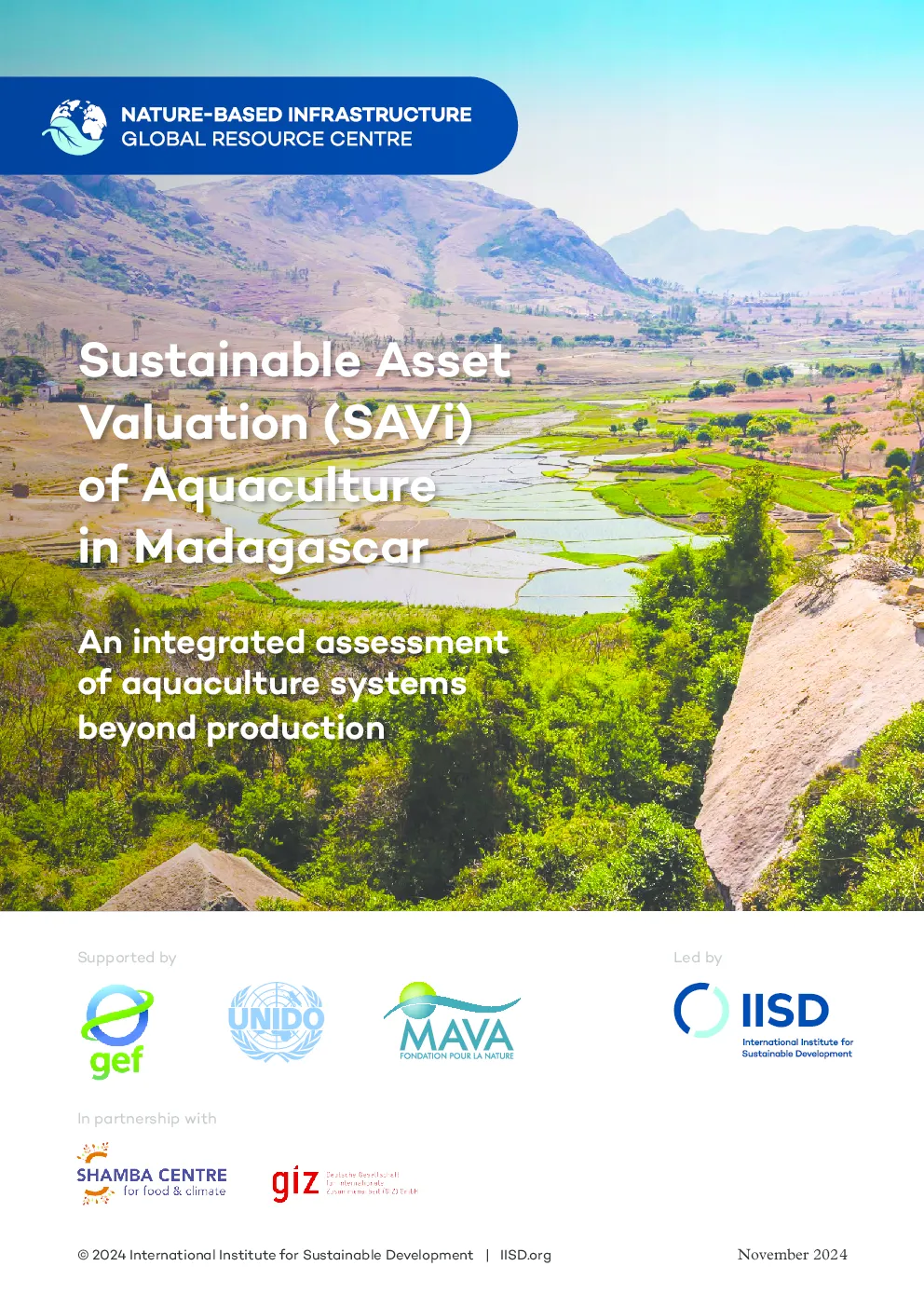
报告封面

An integrated assessmentof aquaculture systemsbeyond production November 2024 © 2024 International Institute for Sustainable Development|IISD.org Sustainable Asset Valuation (SAVi) of Aquaculture in Madagascar © 2024 International Institute for Sustainable Development andUnited Nations Industrial Development OrganizationPublished by the International Institute for Sustainable DevelopmentThis publication is licensed under aCreative Commons Attribution-NonCommercial-ShareAlike 4.0 International License. TheNature-Based Infrastructure (NBI) Global Resource Centreaimsto improve the track record of NBI to deliver infrastructure services andadapt to climate change while delivering other environmental, social, andeconomic benefits. We provide data, training, and customized valuationsof NBI projects, based on the latest innovations in systems thinking andfinancial modelling. IISDnbi.iisd.org@iisd_sustinfra UNIDOunido.org@unido The Centre is an initiative led by IISD, with the financial support ofthe Global Environment Facility (GEF) and the MAVA Foundation, inpartnership with the United Nations Industrial Development Organization. GEFthegef.org@theGEF Sustainable Asset Valuation (SAVi) of Aquaculture in Madagascar MAVAmava-foundation.org@MavaFdn November 2024Written by Henri Contor Photo: iStock The opinions, statistical data, and estimates contained in publications are the responsibility of IISD andshould not necessarily be considered as reflecting the views or bearing the endorsement of UNIDO or GEF.Although great care will be taken to maintain the accuracy of information herein, UNIDO does not assumeany responsibility for consequences that may arise from the use of the material. In partnership with Acknowledgements We would like to thank Jens Kahle and Olivier Joffre from the German DevelopmentCooperation (GIZ) and Louise Scholtz and Oshani Perera from the Shamba Centre forFood & Climate for their engagement throughout this process, support in providing localdata for the analysis, and review of the technical report. Andrea M. Bassi, Liesbeth Casier, David Uzsoki, and Benjamin Simmons reviewed thisreport and provided valuable feedback. Executive Summary Aquaculture plays a pivotal role in global food systems, with significant impacts on foodsecurity, economic growth, and livelihoods. By 2022, the sector achieved a record productionlevel of 130 million tonnes, surpassing traditional capture fisheries. This growth underscoresaquaculture’s vital contribution to the 2030 Agenda for Sustainable Development, as it helpsmeet nutritional needs and boosts economic opportunities. The sector is expected to expandrapidly, especially in Asia, potentially doubling by 2050. This expansion will offer benefits likepoverty reduction but will also contribute to persistent issues such as environmental harmand social disparities, as well as trade-offs between using resources for fish feed versus directhuman consumption. Aquatic foods offer essential nutrients with a lower environmental costcompared to land-based animal products, making them crucial for a sustainable food system.Addressing challenges such as climate change and biodiversity loss is essential for enhancingthe sector’s resilience and long-term sustainability. In Madagascar, aquaculture has significant potential to address challenges like food insecurity,poverty, and environmental degradation. However, the sector faces obstacles such as limitedaccess to capital, inadequate infrastructure, and environmental risks. This report employsthe Sustainable Asset Valuation (SAVi) methodology to provide a comprehensive assessmentof Madagascar’s aquaculture systems. SAVi considers financial, environmental, social, andeconomic dimensions. The findings, while specific to Madagascar, offer insights relevant tobroader contexts, helping stakeholders make informed decisions for sustainable aquaculturedevelopment. Building on this context, this study assesses the performance of four key aquaculture systemsfor Madagascar: extensive rice-fish farming, semi-intensive fish farming, intensive net cagefish farming, and intensive fish farming in tanks. It aims to comprehensively evaluate theenvironmental, social, economic, and financial impacts of these systems over a 25-year horizonfrom 2025 to 2050. The assessment utilizes a holistic approach combining qualitative andquantitative methods to analyze the sustainability and profitability of different approachesto aquaculture in Madagascar. Quantitative modelling, informed by system mapping, isemployed to capture the complex interactions among variables such as water and nutrientdynamics, fish, and rice production. Data was collected from various sources to calculatecosts, benefits, and externalities associated with each system, ensuring a comprehensiveevaluation. Key Findings: •Comparative Environmental Performance.Thanks to the relationship betweenrice and fish, extensive rice-fish farming demonstrates high environmenta