AI智能总结
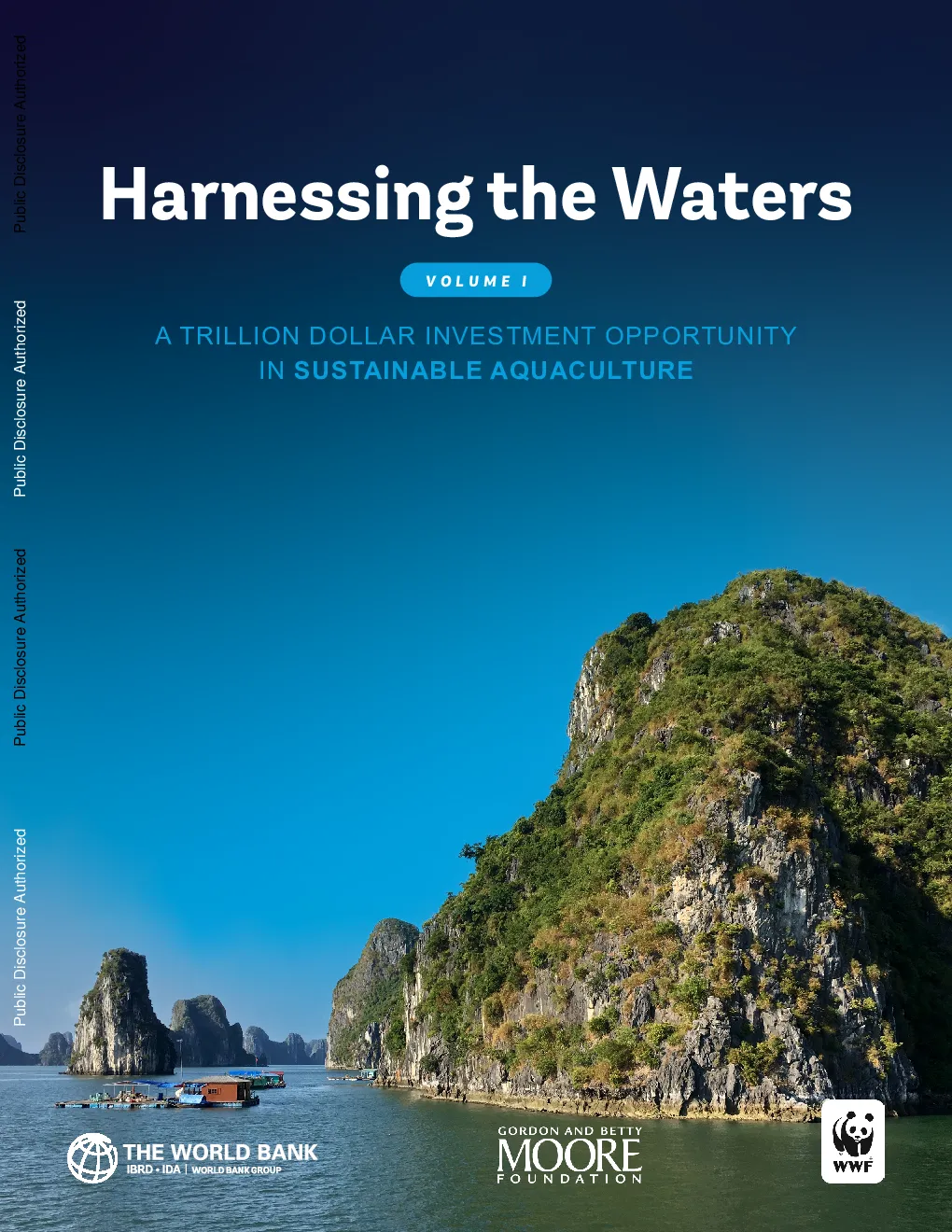
A TRILLION DOLLAR INVESTMENT OPPORTUNITYINSUSTAINABLE AQUACULTURE Copyright © 2025 by International Bank for Reconstruction and Development / The World Bank 1818 H Street NW, Washington, DC 20433 This publication is Volume 1 of the Harnessing the Waters series. Rights and Permissions Some rights reserved. This work is available under the Creative Commons Attribution-NonCommercial 3.0 IGO license (CC BY-NC 3.0 IGO) https://creativecommons.org/licenses/by-nc/3.0/igo/. Disclaimers The findings, interpretations, and conclusions expressed in this work do not necessarily reflectthe views of The World Bank, its Board of Executive Directors, or the governments they repre-sent, or those of WWF or the United Nations. The World Bank and WWF do not guarantee theaccuracy, completeness, or currency of the data included in this work and do not assume respon-sibility for any errors, omissions, or discrepancies in the information, or liability with respect tothe use of or failure to use the information, methods, processes, or conclusions set forth. The boundaries, colors, denominations, links/footnotes and other information shown in thiswork do not imply any judgment on the part of The World Bank and/or WWF concerning thelegal status of any territory or the endorsement or acceptance of such boundaries. The citation ofworks authored by others does not mean the World Bank or WWF endorses the views expressedby those authors or the content of their works. All queries on rights and licenses should be addressed to World Bank Publications, The WorldBank Group, 1818 H Street NW, Washington, DC 20433, USA; e-mail: pubrights@worldbank.org Cover Photo: “Fish Farm in Halong Bay” by Sandra Cohen-Rose and Colin Rose, licensed underCC BY 2.0. Available at flickr.com Acknowledgments In 2007, the World Bank published Changing the Face of the Waters, a landmark report that outlined theopportunities and challenges of sustainable aquaculture. It helped shape global thinking on aquaculture’spotential to contribute to economic growth, food security, and environmental protection. Eighteen years on, aquaculture has expanded rapidly, becoming a vital part of global food systemsas wild fisheries face increasing pressure and demand for animal protein rises. Yet access to financeremains a key constraint—particularly in developing countries where capital is limited and risks are high. Harnessing the Waters: A Trillion Dollar Investment Opportunity in Sustainable Aquaculture revisits theaquaculture story with a new focus on finance. Through case studies of seven key industries, it examineshow financial systems have supported or hindered sector development. The report distills lessons to guidesmarter investment and promote inclusive, sustainable growth in aquaculture. This report, “Harnessing the Waters: A Trillion Dollar Investment Opportunity in SustainableAquaculture” is part of the AquaInvest Platform, a global advisory services and analytics (ASA). It wasprepared by Harrison Charo Karisa (AquaInvest Platform Co-Task Team Leader and Senior FisheriesSpecialist and Serge Mayaka (Founder and Managing Principal at Akipeo) and Sergio Nates (WWF) withsupport from Christopher Ian Brett (Task Team Leader AquaInvest Platform Lead Agribusiness Specialist). The team extends gratitude to the authors of individual case studies Andrew Kaelin, Wenbo Zhang, Md.Nazmul Ahsan, Krishna R. Salin, Adolfo Alvial, Gamal El Naggar, Flavio Corsin (whose details are inVolume II). These case studies informed the synthesis of this volume. The team is particularly grateful toAaron McNevin formerly WWF (now Costco) who together with Harrison ideated this work and guided itswriting. The authors are indebted to peer reviewers: Hardwick Tchale – Lead Agriculture Economist (SAWA1),Oegmundur Haukur Knutsson – Senior Fisheries Specialist (SAWE1), and Sachiko Kondo – SeniorNatural Resources Management Specialist (SAEE3). Further comments were received from Diego Arias– Practice Manager (SLCAG) and his team and Lisa Villeneuve (Consultant, IFC). The following WorldBank staff supported finalization of the report: Thuy Dan Khanh Tran (ST Consultant), Ruth Garcia Gomez(ET Consultant), and Samanmalee Kuruppu De Alwis – Program Assistant (SENGL), Julie Mollins –Communication Specialist (SAGGL)) and Sabrina Sidhu – Communication Specialist (SENGL), MelissaBryant – Communications Lead (ENV) and Mayya Revzina (Co-Publishing). ~ Special thanks to Shobha Shetty, Global Director, Global Agriculture and Food Department, GenevieveConnors, Acting Global Director, Global Environment Department and Tuukka Castren, acting ManagerGlobal Environment Department and Marianne Grosclaude, Manager Global Agriculture and FoodDepartment, who advised the team during the finalization of this report. Further comments were receivedfrom several World Bank colleagues from the case study countries. This work was co-convened by the Moore Foundation in partnership with the World Bank and WorldWildlife F