您的浏览器禁用了JavaScript(一种计算机语言,用以实现您与网页的交互),请解除该禁用,或者联系我们。 [世界卫生组织]:Module 4: The role of the publichealth workforce - 发现报告

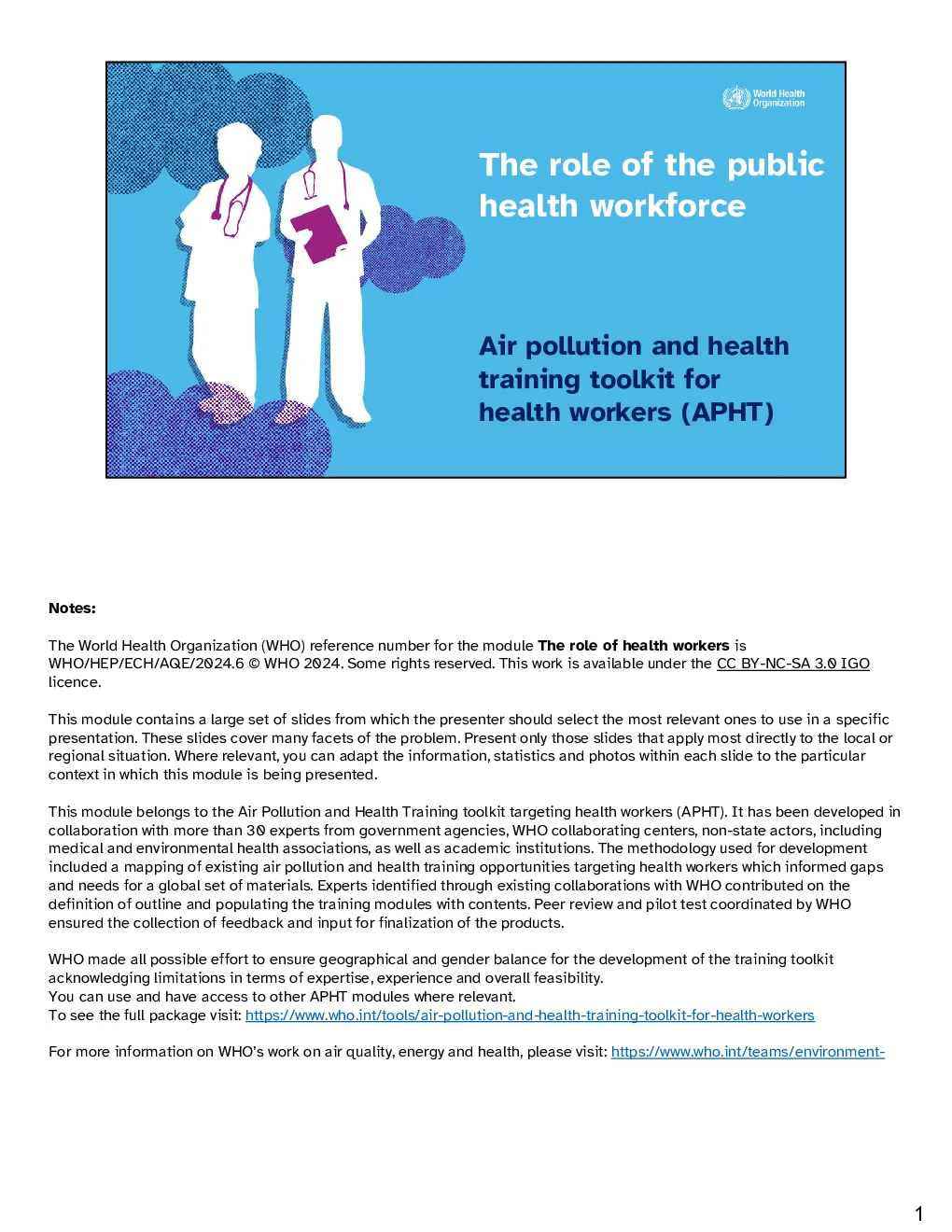
Module 4: The role of the publichealth workforce

信息技术 2025-03-16 世界卫生组织 LIHUYUN
报告封面

Air pollution and healthtraining toolkit forhealth workers (APHT) Notes: The World Health Organization (WHO) reference number for the moduleThe role of health workersisWHO/HEP/ECH/AQE/2024.6 © WHO 2024. Some rights reserved. This work is available under the CC BY-NC-SA 3.0 IGOlicence. This module contains a large set of slides from which the presenter should select the most relevant ones to use in a specificpresentation. These slides cover many facets of the problem. Present only those slides that apply most directly to the local orregional situation. Where relevant, you can adapt the information, statistics and photos within each slide to the particularcontext in which this module is being presented. This module belongs to the Air Pollution and Health Training toolkit targeting health workers (APHT). It has been developed incollaboration with more than 30 experts from government agencies, WHO collaborating centers, non-state actors, includingmedical and environmental health associations, as well as academic institutions. The methodology used for developmentincluded a mapping of existing air pollution and health training opportunities targeting health workers which informed gapsand needs for a global set of materials. Experts identified through existing collaborations with WHO contributed on thedefinition of outline and populating the training modules with contents. Peer review and pilot test coordinated by WHOensured the collection of feedback and input for finalization of the products. WHO made all possible effort to ensure geographical and gender balance for the development of the training toolkitacknowledging limitations in terms of expertise, experience and overall feasibility.You can use and have access to other APHT modules where relevant.To see the full package visit:https://www.who.int/tools/air-pollution-and-health-training-toolkit-for-health-workers For more information on WHO’s work on air quality, energy and health, please visit:https://www.who.int/teams/environment- climate-change-and-health/air-quality-and-health © World Health Organization 2024. This training material was developed by the World Health Organization (WHO). It is intended to beused as educational material. All reasonable precautions have been taken by WHO to verify the information contained in this training.However, the content is being distributed without warranty of any kind, either expressed or implied. The responsibility for theinterpretation and use of the online training lies with the reader. In no event shall WHO be liable for damages arising from its use. Thedesignations employed and the presentation of the material in this publication do not imply the expression of any opinion whatsoeveron the part of WHO concerning the legal status of any country, territory, city or area or of its authorities, or concerning the delimitationof its frontiers or boundaries. Dotted and dashed lines on maps represent approximate border lines for which there may not yet be fullagreement. The mention of specific projects or entities does not imply that they are endorsed or recommended by WHO in preferenceto others of a similar nature that are not mentioned. Learning objectives for this module are:1.Identify patients and individuals at higher risk of negative health effects from exposure to air pollution.2.Explore and communicate principles for reducing individual exposure to air pollution3.Describe the role of the health workforce for clean air advocacy Acronyms AQ(H)ICHESTxCOPDxCVDEPHFHAPICDxIFMSAxIHDLPGair quality (health) indexclean household energy solutionstoolkitchronic obstructive pulmonarydiseasecardiovascular diseaseEssential public health functionhousehold air pollutioninternational classification ofdiseasesInternational Federation ofMedical Students’ Associationsischaemic heart diseaseliquified petroleum gas RECAP VIDEO: How is air pollution able toaffect the health of our body? Let’s watch a video to remind ourselves of how air pollution can affect the health of our body. (To play thevideo, double-click on the screen.) As shown in the previous video, air pollution not only affect the lungs. Its massive burden of health hasbeen confirmed from the consistent scientific evidence, and air pollution is now recognized as a riskfactor for the development of noncommunicable diseases (NCDs). In September 2018, the United Nations General Assembly staged the third High-level Meeting on theprevention and control of NCDs. The meeting undertook a comprehensive review of the global and national progress achieved in puttingmeasures in place that protect people from dying too young from heart and lung diseases, cancers anddiabetes. A political declaration was adopted, transforming the historically 4 x 4 agenda (4 risk factors and 4 maindiseases) into a 5 x 5 agenda, including air pollution as a risk factor and mental health as a disease. Bibliography•Political declaration of the third high-level meeting of the General Assembly