您的浏览器禁用了JavaScript(一种计算机语言,用以实现您与网页的交互),请解除该禁用,或者联系我们。 [Congressional Budget Office&Federal Deposit Insurance Corporation]:重新审视债务与长期利率之间的关系:工作文件2024 - 发现报告

重新审视债务与长期利率之间的关系:工作文件2024

金融 2024-11-01 Andre R. Neveu, Jeffrey Schafer Congressional Budget Office&Federal Deposit Insurance Corporation 记忆待续
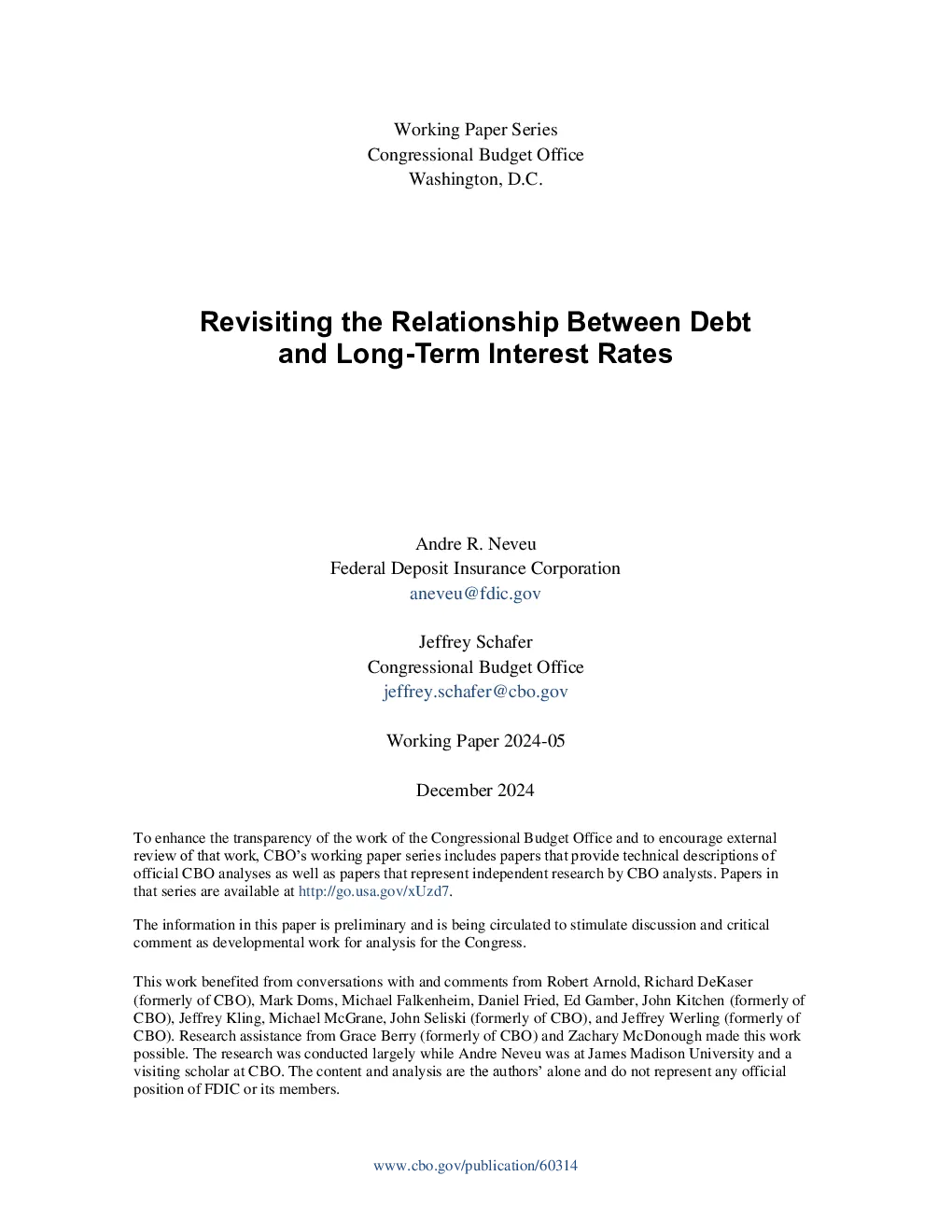
报告封面

Revisiting the Relationship Between Debtand Long-Term Interest Rates Andre R. NeveuFederal Deposit Insurance Corporationaneveu@fdic.gov Jeffrey SchaferCongressional Budget Officejeffrey.schafer@cbo.gov Working Paper2024-05 December2024 To enhance the transparency of the work of the Congressional Budget Office and to encourage externalreview of that work, CBO’s working paper series includes papers that provide technical descriptions ofofficial CBO analyses as well as papers that represent independent research by CBO analysts. Papers inthatseries are available athttp://go.usa.gov/xUzd7. The information in this paper is preliminary and is being circulated to stimulate discussion and criticalcomment as developmental work for analysis for the Congress. This work benefited from conversationswithand comments from Robert Arnold, Richard DeKaser(formerly of CBO),MarkDoms, Michael Falkenheim, Daniel Fried, Ed Gamber, John Kitchen(formerly ofCBO), JeffreyKling, MichaelMcGrane, John Seliski(formerly of CBO), and Jeffrey Werling(formerly ofCBO).Research assistance from GraceBerry(formerly of CBO)and ZacharyMcDonoughmade this workpossible. The research was conductedlargelywhile Andre Neveu was at James Madison University and avisitingscholar atCBO. The content and analysis arethe authors’alone and do not represent any officialposition of FDIC or its members. Abstract In forming its long-run projections of the interest rate on 10-year Treasury notes, theCongressional Budget Office estimates that a1percentage-point increase in the projectedratioof debt to gross domestic productraises average long-run interest rates by 2basis points(bps).The agency refers to that estimated relationship as the debt sensitivity of interest rates (DSIR).Herewe extend the sample used inaprevious CBO working paperto empirically estimate theDSIR and explore therelationship’sstability over time. Extending the sample through 2023yields an estimate of the coefficient on debt in our regression equation of 2.0bps,and analysisusing recursive regressions shows thatthecoefficient estimate has been stable over recenthistory. Estimating the regression equation over the subsample between two possible breaksin the relationship—a subsample during which the monetary policyregimenresembled theone CBO projects in thelong run—yields a nearly identical value. Keywords:forecasting,government debt, interest rates JEL Classification:E43, E60, E62, H60 Contents Introduction.....................................................................................................................................1Reviewing the Literature on the DSIR............................................................................................3When and Where Does CBO Use the DSIR?.................................................................................7CBO’s Baseline Economic Projections......................................................................................8CBO’s Fiscal Policy Analyses....................................................................................................9Sensitivity of CBO’s Interest Rate Projections to Changes in the DSIR Parameter......................9Why Does CBO Estimate the DSIR Parameter Empirically?......................................................11Empirical Estimation of the DSIRParameter...............................................................................12Empirical Specification.............................................................................................................12Data...........................................................................................................................................14Baseline Results........................................................................................................................19Recursive Estimation................................................................................................................20Testing for Breaks in the Empirical Relationship.....................................................................21Conclusion....................................................................................................................................22References Cited...........................................................................................................................24Appendix A: Using Deficits as theExplanatory Variable of Interest...........................................26Appendix B: Using Projections of Federal Reserve and Foreign Holdings of U.S. TreasurySecurities.......................................................................................................................................28 Introduction Inthe Congressional Budget Office’srecent long-term budget projections, the federal debt heldby the public increases rapidly.Theratio of debt to gross domestic product (GDP)in thoseprojectionsrises fromabout99percent at the end of 2024 to 116percent a