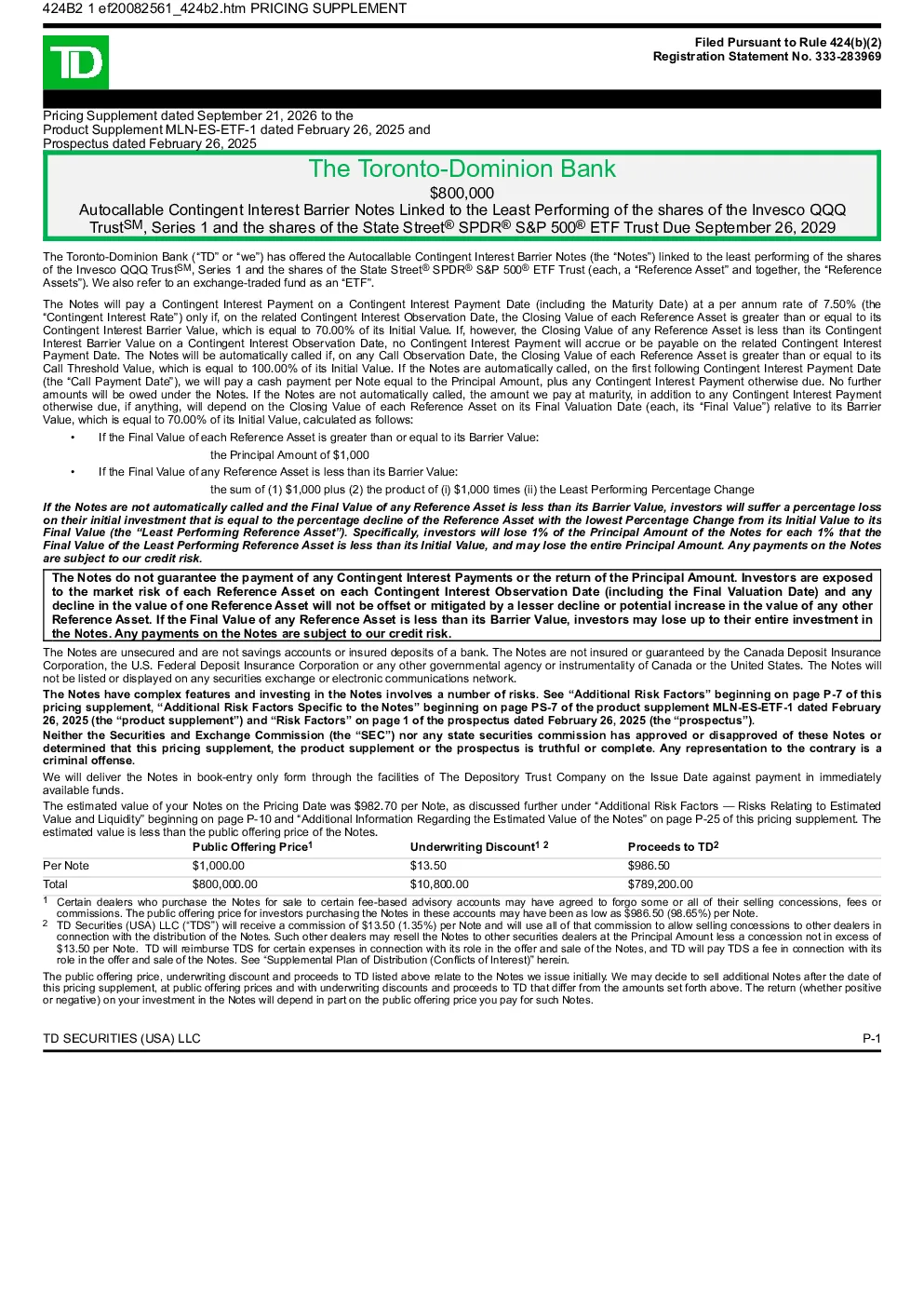
The Toronto-Dominion Bank (TD) has offered Autocallable Contingent Interest Barrier Notes linked to the least performing of the shares of the Invesco QQQ TrustSM, Series 1 and the shares of the State Street®SPDR®S&P 500®ETF Trust, due to mature on September 26, 2029. The Notes will pay a 7.50% per annum Contingent Interest Rate if, on the related Contingent Interest Observation Date, the Closing Value of each Reference Asset is greater than or equal to its Contingent Interest Barrier Value (70.00% of its Initial Value). If the Closing Value of any Reference Asset is less than its Contingent Interest Barrier Value on a Contingent Interest Observation Date, no Contingent Interest Payment will accrue or be payable. The Notes will be automatically called if, on any Call Observation Date, the Closing Value of each Reference Asset is greater than or equal to its Call Threshold Value (100.00% of its Initial Value). If called, TD will pay a cash payment per Note equal to the Principal Amount ($1,000) plus any Contingent Interest Payment otherwise due. If not called, the amount payable at maturity will depend on the Final Value of each Reference Asset relative to its Barrier Value (70.00% of its Initial Value): $1,000 if greater than or equal to its Barrier Value, or a loss equal to the percentage decline of the Least Performing Reference Asset below its Initial Value.
Key Features and Risks:
- Return Characteristics: The Notes do not guarantee principal repayment or Contingent Interest Payments. Investors may lose up to their entire investment if the Final Value of any Reference Asset is less than its Barrier Value. The potential positive return is limited to Contingent Interest Payments, if any, regardless of any appreciation of the Reference Assets.
- Reference Asset Risks: Investors are exposed to the market risk of each Reference Asset on each Contingent Interest Observation Date. The Notes are linked to the least performing asset, increasing the risk of no payments and significant losses. The value of a Reference Asset may not track its Net Asset Value (NAV), and adjustments to a Reference Asset could adversely affect the Notes.
- Estimated Value and Liquidity: The estimated value of the Notes ($982.70) is less than the public offering price ($1,000), reflecting costs and expected profits. The estimated value is based on TD's internal funding rate and models, which may differ from other institutions. There may be little or no secondary market for the Notes, and prices, if any, will likely be less than the public offering price.
- Hedging Activities and Conflicts of Interest: Potential conflicts of interest exist between investors and the Calculation Agent, TD, and its affiliates due to hedging activities and business relationships with Reference Asset Constituent Issuers.
- Credit Risk: Investors are subject to TD's credit risk, and changes in TD's credit ratings or spreads may adversely affect the Notes' market value.
- Taxation: The U.S. tax treatment of the Notes is uncertain, with potential characterization as prepaid derivative contracts or constructive ownership transactions. Canadian tax considerations apply to non-resident holders, with potential withholding taxes on interest and dividends.
Examples:
- Example 1: If the Notes are automatically called, the total return is 1.875% ($1,018.75).
- Example 2: If the Closing Value of at least one Reference Asset is less than its Contingent Interest Barrier Value on each Contingent Interest Observation Date prior to the Final Valuation Date, but the Final Value of each Reference Asset is greater than or equal to its Barrier Value, the total return is 1.875% ($1,018.75).
- Example 3: If the Final Value of at least one Reference Asset is less than its Contingent Interest Barrier Value and Barrier Value, investors will suffer a 60.00% loss ($400).
Conclusion: The Notes offer potentially high returns but come with significant risks, including the possibility of losing the entire investment. Investors should carefully consider the risks and consult with their advisors before investing.