1H26快评:脱货加深;盈利压力还会持续
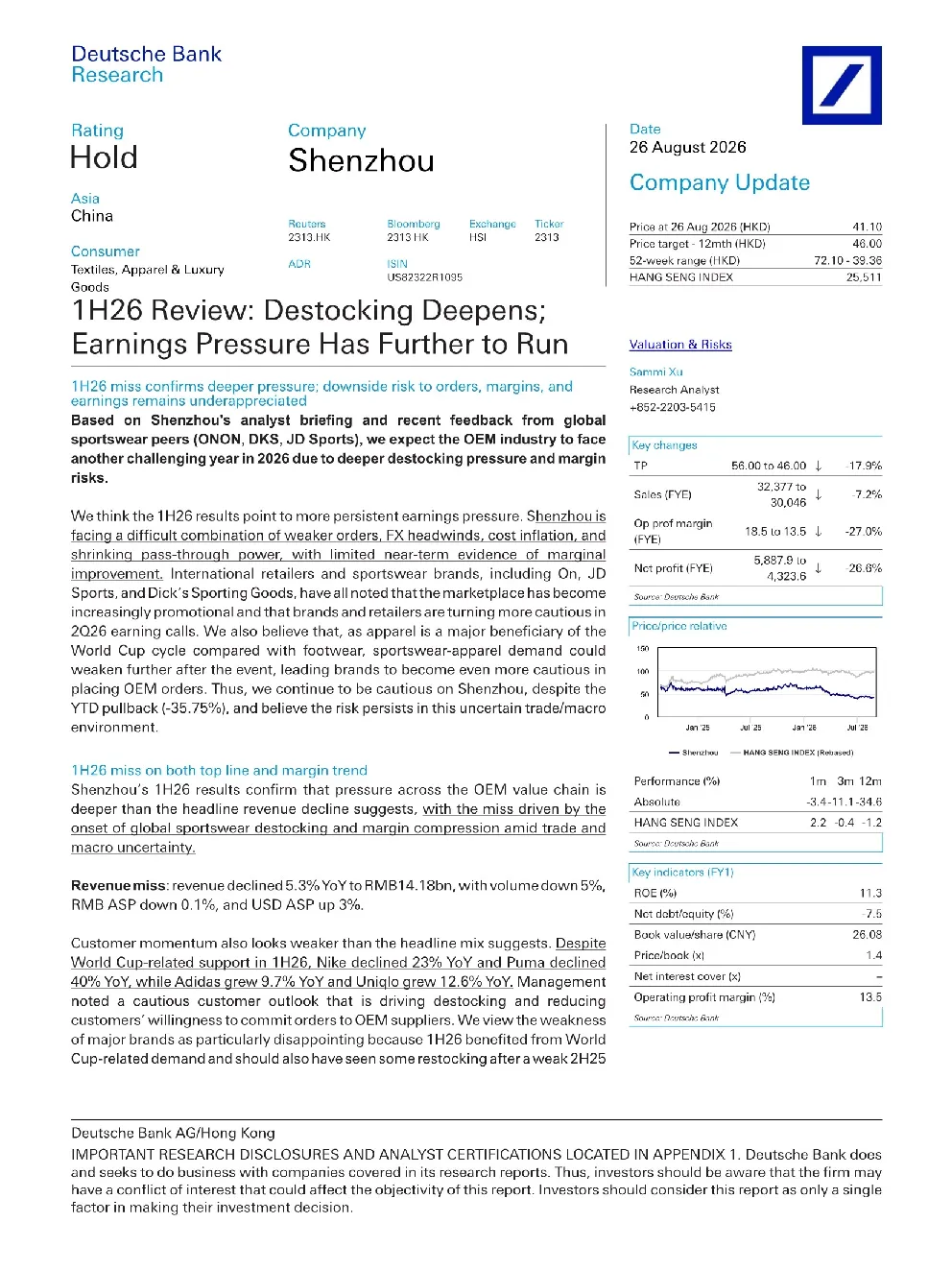
Company Update China 1H26 Review: Destocking Deepens;Earnings Pressure Has Further to Run SammiXu Research Analyst+852-2203-5415 earnings remainsunderappreciatedBased on Shenzhou's analyst briefing and recentfeedback fromglobal sportswearpeers(ONON,DKS,JDSports),weexpecttheOEMindustrytofaceanother challengingyearin 2026duetodeeperdestockingpressureand marginrisks. Wethink the1H26resultspointtomorepersistentearningspressure.Shenzhouisfacinga difficult combination ofweaker orders,FX headwinds,cost inflation,andshrinking pass-through power, with limited near-term evidence of marginalimprovement. International retailers and sportswear brands, including On,JDSports,andDick's SportingGoods,haveallnotedthatthemarketplacehasbecomeincreasingly promotionaland that brands and retailers are turning more cautious in2Q26 earning calls. We also believe that, as apparel is a major beneficiary of theWorld Cup cycle compared withfootwear,sportswear-apparel demand couldweakenfurtherafterthe event, leading brands to become evenmorecautious inplacing OEM orders.Thus,we continueto be cautious on Shenzhou,despite theYTDpullback(-35.75%),and believethe riskpersists inthisuncertain trade/macroenvironment. 1H26missonbothtoplineandmargintrendShenzhou's1H26results confirmthatpressure acrosstheOEMvalue chain is deeper than the headline revenue decline suggests,with the miss driven by theonset of global sportsweardestocking and margin compression amid trade andmacro uncertainty. Revenuemiss:revenuedeclined5.3%YoYtoRMB14.18bn,withvolumedown5%,RMBASP down0.1%,and USD ASPup3%. Customer momentum also looks weakerthan the headline mix suggests. DespiteWorld Cup-related support in 1H26, Nike declined 23% YoY and Puma declined40%YoY,whileAdidasgrew9.7%YoYand Uniglogrew12.6%YoY.Managementnoted a cautious customer outlook that is driving destocking and reducingcustomerswillingnesstocommitorderstoOEMsuppliers.Weviewtheweaknessofmajorbrandsasparticularlydisappointingbecause1H26benefitedfromWorldCup-relateddemandandshouldalsohaveseensomerestockingafteraweak2H25 Textiles, Apparel & Luxury GoodsShenzhou insufficient to offset pressure fromthecore sportswear customerbase,whichrepresentsover80%ofShenzhou'sdemand. tradeandmacrouncertainty.Grossprofit declined21.2%YoYtoRMB3.20bn,andgrossmargin contracted 4.5ppYoYto22.6%from27.1% in1H25,reflecting RMBappreciation,rising labour costs, higher synthetic-fibre raw material costs due totheIranwar,andtariff sharingstarting in2H26 amid UStrade-warpressure.Basedon management's breakdown,labour costs accounted for around1.5pp of themargin decline,RMB appreciation contributed 1.3pp,raw material costscontributed 1.3pp, and the remaining 0.4pp was mainly related to tariff sharing.This margin bridge suggests that Shenzhou has limited pass-through power inaweak demand environment, leavingmargins structurallyvulnerable. Net profit fell sharply: 1H26 net profit fell 40.0% YoY to RMB1.90bn, significantlyworse than the top-line decline. Excluding government subsidies, FX-relatedlosses, and disposal gains, DB-adjusted net profit declined 20% YoY.The 6% taxratein 1H26 was abnormallylow versus the normal 12-13%level; excludingthis taxbenefit,operating profit declined51%YoY,while coreoperating profitfell30%YoY,highlighting much weaker underlying profitability. 5%dividend yield:Shenzhoumaintained a 60.4%payout ratio (vs.56%in 2025)The current share price indicates a dividend yield over 5%, which should offerdownside support.We think if Shenzhou's management is able to lift the dividendpayout ratio (towards 80% or above), high dividend yield could become a verymiss. 2H26outlook:headwindspersistdespitealowbaseFor2H26,weforecastrevenuetodecline1%YoY(volumn-1%,RMBASP0%,USD ASP+3%), implying a 3%decline forthefull year.We expect Uniqlo orders to holdupbetterthanthoseofotherkeycustomers,growing12.5%YoY, supported byglobal consumption trade-down in a K-shaped economy.However, this is unlikelyto offset broaderweakness at Nike (-17%YoY)and Puma (-40%YoY),aswell aspotentially slower growth at Adidas (+4.5%YoY)after World Cup-relateddemandfades. Onmargins,we expectpressuretopersistrather than tonormalizequickly (i.e.above25%GPM).For2H26,our model forecasts a gross margin of 23.9%,compared with 22.6%in1H26 and25.6% in 2H25.Shenzhou maynegotiate ASPadjustmentswithcustomerstopassthroughpartofthecommodity-costincrease,butthemagnituderemainsuncertain given OEMs'weakening bargainingpowerandcustomersowndemandpressure.Labourcostinflationisalsolikelytoremainsticky across both China and overseas factories, with China affected by highersocial security costs and Vietnam facing an approximately 9% wage increase.Managementalsonotedthatmorecomplicatedproductscouldresultinadditionalmanufacturing costs,addinganotherlayerof downsiderisk tomargins. On abnormal tax rate:the 6% tax rate in 1H26 also provided a major butunsustainableboosttoreportednetprofit.Asthetaxratenormalizestoaround12-13%,this temporarybenefit should unwind,creating an