印度电子行业合同制造业的兴起
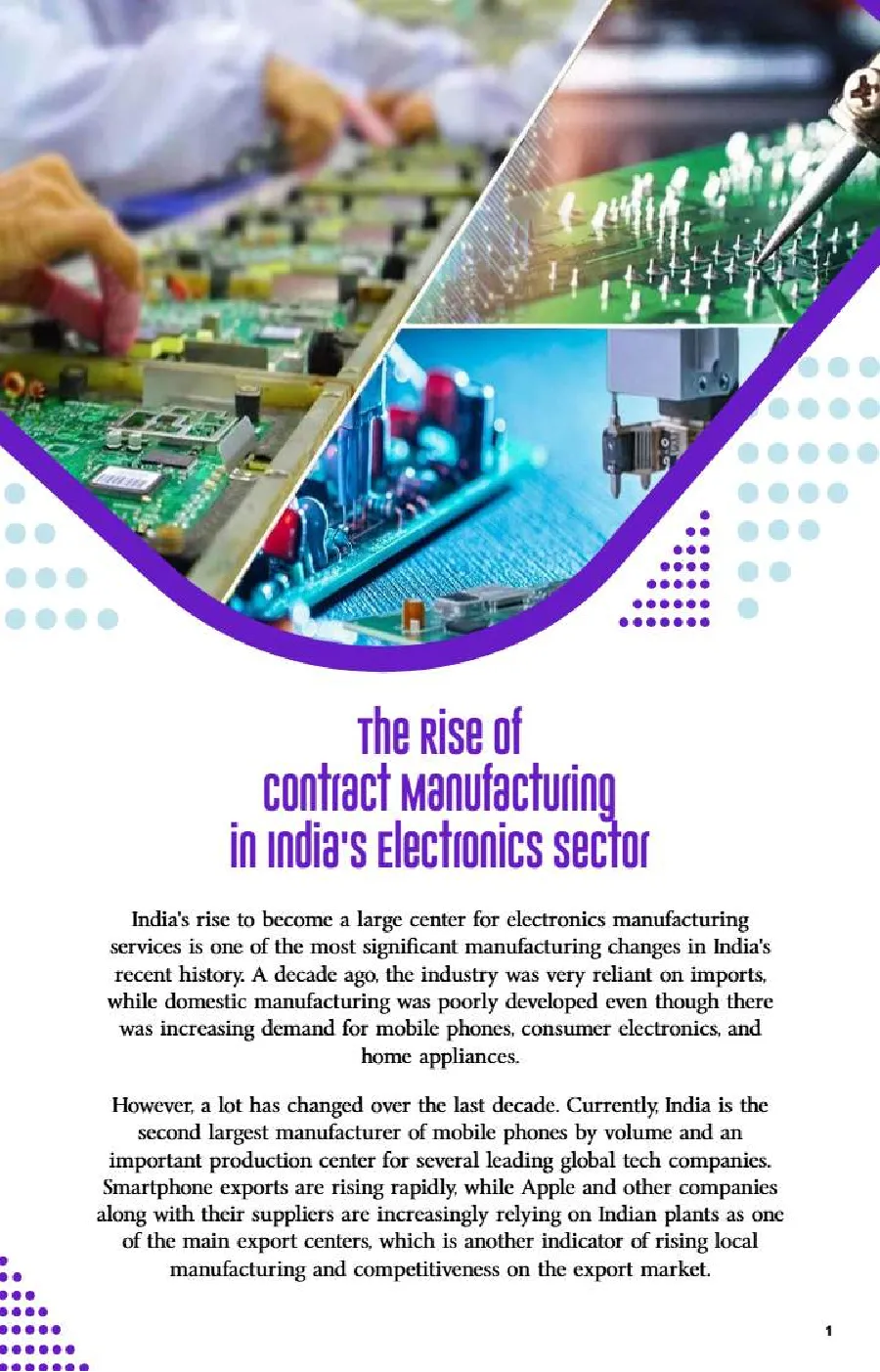
India's rise to become a large centerfor electronicsmanufacturingservices is one of the most significant manufacturing changes in India'srecent history. A decade ago, the industry was very reliant on importswhile domestic manufacturing was poorly developed even though therewas increasing demand for mobile phones, consumer electronics, andhome appliances. However, a lot has changed over the last decade. Currently, India is thesecond largest manufacturer of mobilephones by volume and animportant production center for several leading global tech companies.Smartphone exports are rising rapidly, while Apple and other companiesalong with their suppliers are increasingly relying on Indian plants as oneof the main export centers, which is another indicator of rising localmanufacturing and competitiveness on the export market. Such development is possible throughvarious measures including PLI Scheme,SPECS, EMC 2.0, India SemiconductorMission, and ElectronicsComponentsManufacturing Scheme (ECMS) alongwith the changing geopolitical situationand increased popularity of China+1strategy.Theresult ofall thesemeasures isthat theEMS industrybecameone of thefastest growing parts of the industrialeconomy of India. ambition to build the ecosystem forsemiconductors resulted in thedominance of Taiwan, South Korea.Singapore and subsequently China as thedominantglobalmanufacturingcenters. The increasing use of mobile connectionsand consumption of consumerelectronics over the2000s increasedIndia's reliance on electronic productimports.Thegovernment announced NPE2012 - the first national policy fordeveloping the sector into globallycompetitiveElectronicSystemDesignandManufacturing sector aiming to achieveturnover of electronics of Rs. 2964 lakhcrore (USs 400 billion) by 2020. However,India produced electronics worth onlyaround Rs. 5.4 lakh crore (USs 68 billion)in2019-20. The current paper analyses the evolutionof India's contract manufacturing sector,the policy measures behind it, the playersin the industry, the opportunities,challenges, and future of the industry. HISTORICAL BACKGROUND:FROMIMPORTDEPENDENCE TOMANUFACTURINGAMBITION Indeed, the momentum gatheredconsiderable impetus after 2014 due tothe flagship programs Make in India,Digital India,and Startup India,along withmeasures like M-SIPS and NPE 2019. As aresult, the manufacturing industry forelectronics in India grew from around Rs.1.9 lakh crore (USs 31 billion) in FY15 toRs. 11.3 lakh crore (USs 130 billion) inFY2S and ended up making India thesecond largest manufacturer of mobilephonesintheworld.o Over the last few decades, India'sdevelopment in the field of electronicsmanufacturinghas passed from decades-long reliance on imports to increasinglybold ambitionsto become a globalmanufacturing center.Although thecountry managed to develop a solidposition in software services and ITsphere over the 1990s and 2000s, thedevelopment of manufacturingcapabilities was weak, and the lack of Furthermore, leveraging these initiatives,theGovernmenttookpolicyactionslikePLI Scheme for Large Scale ElectronicsManufacturing, SPECS,and EMC 2.0,which were instrumental in attractingrenowned manufacturers like Foxconn,Pegatron,and Tata Electronics as well aspromoting domestic champions likeDixon Technologies, Syrma SGS,andKaynes Technology. and asset-light business models where thecompanies look for manufacturingpartners capable of offering scale.capability, and flexibility without anycapital investment Capital Efficiency and Asset-LightManufacturing One reason behind the relevance ofcontract manufacturing is the ability ofcontract manufacturers to leverage theirestablished processes in order to reducecosts through scale. They purchasecomponents inbulk and utiliseadvancedinfrastructureeffectively,thereby enablingthe firm to turn fixed costs intooperational costs andfocus on innovationandmarketexpansion. Currentlytheelectronicsindustryin Indiais evolving from an import-orientedmarketintoamoreholisticmanufacturerexporter with growing domestic demand,exports, and involvement in global valuechains. The trend is contributing to therise in the importanceof contractmanufacturing in India as a hub for globalelectronics manufacturing and supply Expertise and Technologies With modern electronics manufacturingrequiring special engineering capabilitiesand quality control, contractmanufacturers offer access to advancedtechnologies including high density SMTtechnology,automation of inspection,andX-ray testing. Moreover, Design forManufacturing (DFM) methods help toincrease production yield and efficiency WHYCONTRACTMANUFACTURING HAS BECOMESTRATEGIC FOR INDIA SELECTRONICSSECTOR As evident, one reason behind theimportance of contract manufacturing isthe evolution of the electronics industryworldwide towards innovation-oriented without any need for the brand to have volumes quickly and maintaining highthese capabilities in-house. quality. Faster Time-to-Market and ProductionFlexibility Streng