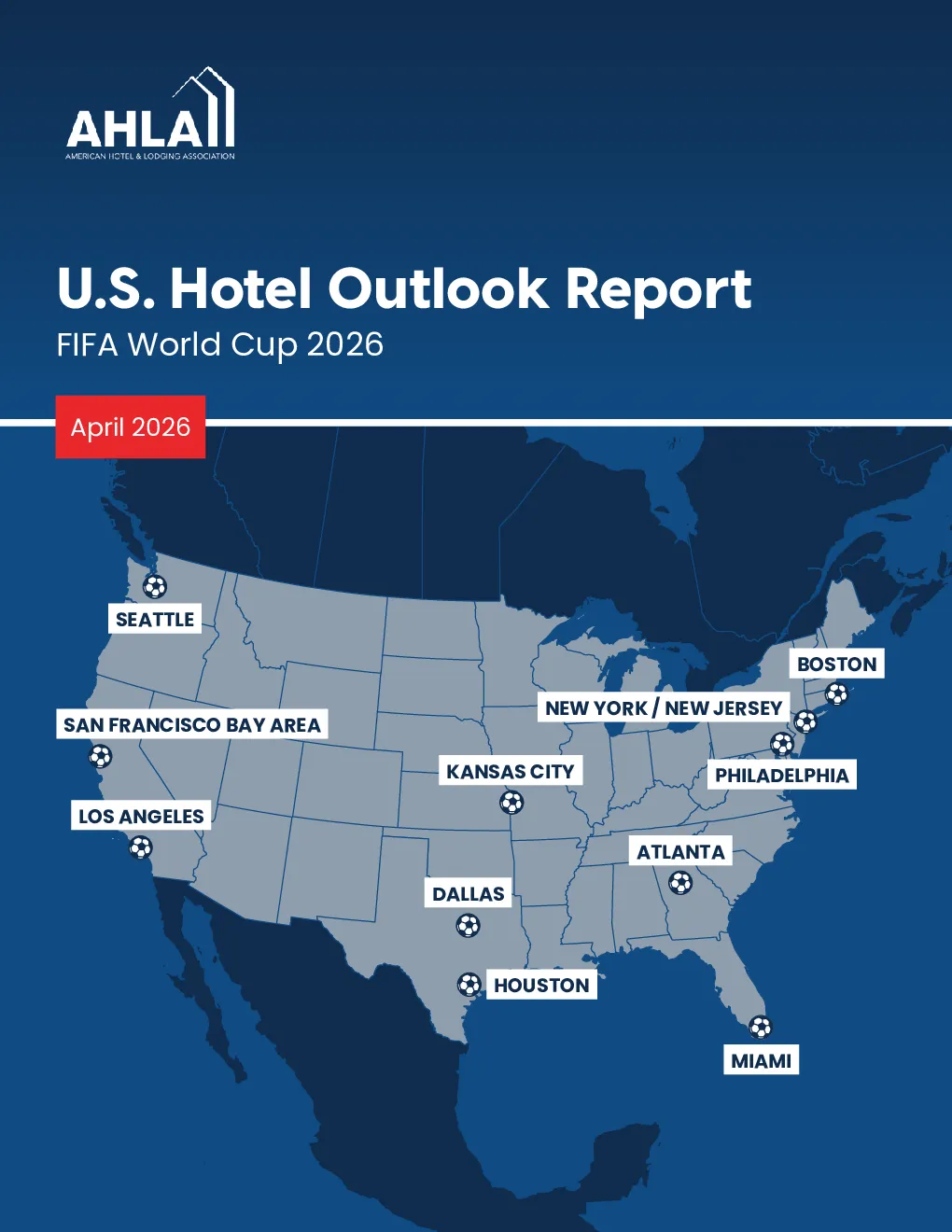
FIFA World Cup 2026 Executive Summary The hotel industry in the United States has spent years preparing for the 2026 FIFA World Cup, makingsignificant investments to ensure communities across the country are ready to welcome a global audience.Hotels have developed fan-focused activations, strengthened security and transportation coordination withfederal, state, and local partners, upgraded properties, and created tailored offerings. From multilingual services to international menus and culturally relevant programming, hotels are ready tomeet the needs of fans and provide a great experience for guests from around the world. With just two months until kickoff, however, indicatorssuggest the anticipated economic lift may fall short ofexpectations. Despite more thanfive milliontickets sold,this demand has not yet translated into strong hotelbookings. Forecasts show that domestic travelers areoutpacinginternational travelers – an imbalance thatthreatens the broader economic impact the World Cupwas expected to generate. Despite more than five milliontickets sold, this demand has not yettranslated into strong hotel bookings.Ticket Sales Source: FIFA To better understand these trends, AHLA commissioned a comprehensive analysis across all World Cuphost markets.The findings reveal several emerging challenges that require immediate attention: •Close to 80% of respondents say hotel bookings are tracking below initial forecasts.•Visa barriers and broader geopolitical concerns are significantly suppressing international demand,cited byclose to 70% of respondentsacross most markets. These factors consistently rank as the topconstraint on World Cup driven travel.•FIFA room block over commitment created an artificial early demand signal that has since unraveled,withroughly half of respondents in host marketsreporting material room block releases. Many hotelsindicate that early booking signals overstated true demand.•Only a limited subset of markets – those with strong baseline leisure demand or confirmed team basecamps – are seeing meaningful incremental uplift,representing close to 30% of overall respondents.•State and local policies are adding last-minute costs for travelers. Mounting Challenges Across World Cup Host Cities International Perceptionof Visa Delays New Taxesand Fees TSA Wait Times andFunding Uncertainty Increased Gas andJet Fuel Prices Room BlockCancellations AHLA Member Survey: Market Challenges An April 2026 AHLA member survey provides an early preview of World Cup hotel occupancy expectations.The data reveals widespread softness relative to initial expectations. Hotels in most markets report bookingpace falling below forecasts, with some even trailing typical June or July summer demand. Kansas Cityemerges as the most negatively impacted host market in the survey, with roughly85-90%of respondents reporting booking pace below expectations and trailing a typical June or July. Propertiesdescribe extensive FIFA room block cancellations, reaching70-95%of originally contracted inventory, whilemore than70% cite visa barriers and weak international demandas key drivers. Together, these factorshave left the market oversupplied, underperforming, and highly rate-sensitive relative to normal summerbenchmarks. Los Angelespresents a mixed picture, skewing below expectations for many properties. Roughly65-70%of respondents report booking pace below expectations, often in line with or lagging behind a typicalsummer. Approximately half of respondents cite visa barriers, high labor costs, and distance from venues asmeaningful constraints, alongside broader city policy challenges that continue to complicate operations.FIFA’s cancellation of thousands of downtown Los Angeles rooms reflects these pressures and underscoreshow World Cup-related performance is proving uneven and highly location-specific, varying significantly bysubmarket and proximity to match activity. In New York City, about two-thirds of respondents similarly report softer-than-expected bookings thatnonetheless track with normal summer demand. More than60%of New York City operators point tointernational travel barriers and geopolitical concerns influencing the soft bookings. In Dallas and Houston, roughly70%of respondents report booking pace below World Cup expectations,though still broadly in line with a typical June or July, pointing to limited incremental lift from thetournament. Other host markets, includingBoston, Philadelphia, San Francisco, and Seattle, show similarly limited WorldCup impact, with nearly80%of respondents reporting booking pace below expectations and behind atypical summer. Many respondents describe the tournament as a “non-event” in these cities, citing late FIFAroom releases and weak international fan travel as the dominant concerns across markets. Atlanta and Miamistand out as relatively bright spots among host cities. In Atlanta, approximately50%ofrespondents report booking pace in line with or ahead of expectati