频谱共享创新试验台第一阶段试验计划草案
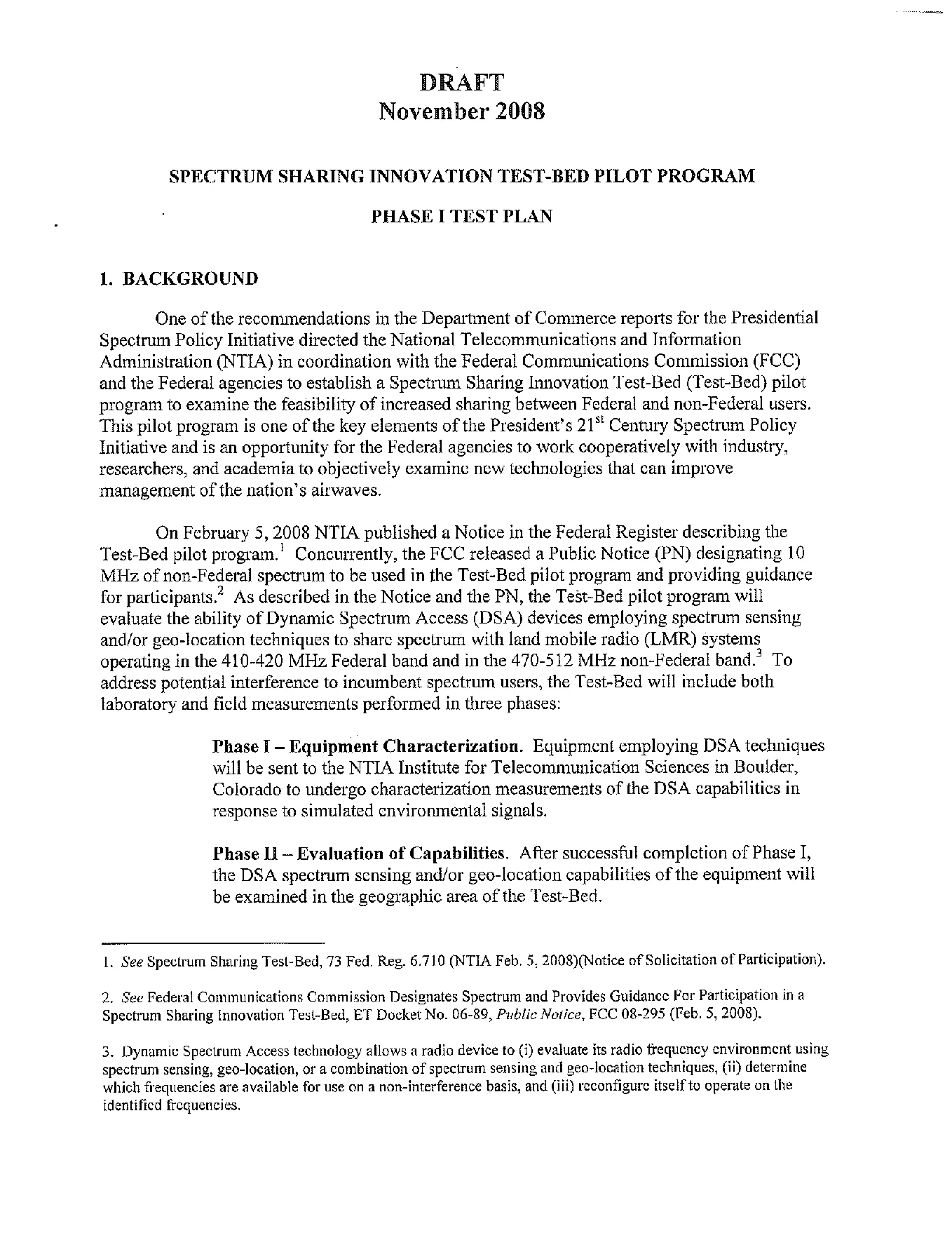
SPECTRUM SHARING INNOVATION TEST-BED PILOT PROGRAM PHASE I TEST PLAN 1. BACKGROUND One of the recommendations in the Department of Commerce reports for the PresidentialSpectrum Policy Initiative directed the National Telecommunications and InformationAdministration (NTIA) in coordination with the Federal Communications Commission (FCC)and the Federal agencies to establish a Spectrum Sharing Innovation Test-Bed (Test-Bed) pilotprogram to examine the feasibility of increased sharing between Federal and non-Federal users.This pilot program is one of the key elements of the President's 21st Century Spectrum Policyresearchers, and academia to objectively examine new technologies that can improvemanagement of the nation's airwaves. On February 5, 2008 NTIA published a Notice in the Federal Register describing theTest-Bed pilot program.I Concurrently, the FCC released a Public Notice (PN) designating 10MHz of non-Federal spectrum to be used in the Test-Bed pilot program and providing guidancefor participants. As described in the Notice and the PN, the Test-Bed pilot program willevaluate the ability of Dynamic Spectrum Access (DSA) devices employing spectrum sensingand/or geo-location techniques to share spectrum with land mobile radio (LMR) systemsoperating in the 410-420 MHz Federal band and in the 470-512 MHz non-Federal band.3 Toaddress potential interference to incumbent spectrum users, the Test-Bed will include bothlaboratory and field measurements performed in three phases: Phase I - Equipment Characterization. Equipment employing DSA techniqueswill be sent to the NTIA Institute for Telecommunication Sciences in Boulder,Colorado to undergo characterization measurements of the DSA capabilities inresponse to simulated environmental signals. Phase Il -- Evaluation of Capabilities. After successful completion of Phase I,the DSA spectrum sensing and/or geo-location capabilities of the equipment willbe examined in the geographic area of the Test-Bed. PhaseIlI-FieldOperation Evaluation.After successful completion of PhaseII the DSA equipment will be permitted to transmit in an actual radio frequencysignal environment. An automatic signal logging capability will be used duringoperation of the Test-Bed to help resolve interference events if they occur. Apoint-of-contact will also be established to stop Test-Bed operations ifinterference is reported. Eleven parties submitted solicitations of interest to participate in the Test-Bed pilotprogram. As a result of selection criteria specified in the February 2008 Federal Register Noticethe following parties were selected to participate in the Test-Bed pilot program: Adapt4 LLC,Adaptrum Inc., BAE Systems, Motorola Inc., Shared Spectrum Company, and VirginiaPolytechnic Institute and State University. Although there are television (TV) broadcast stations in the 470-512 MHz band, it is theintent to focus the Test-Bed pilot program on the ability of DSA devices to share spectrum withLMR systems. If participants are also interested in demonstrating compatibility with broadcastTV stations, it should be pointed out that the FCC has adopted a Notice of Proposed Rulemaking(NPRM) to investigate the use of white spaces in the TV band.3 As part of its evaluationprocess, the FCC has tested prototype equipment to gain a better understanding of theequipment's capability. 2.OBJECTIVE This document describes the types and depth of testing that NTIA intends to conduct inPhase I to assess whether DSA devices can share the frequency spectrum with LMR systems inthe specified frequency bands. It should be noted that not all of the tests described in thisdocument are applicable to all DSA devices. Furthermore, additional tests may be performed toexamine any unexpected behavior of the DSA device. While the tests performed under Phase Iof the Test-Bed could eventually be used in the development of compliance measurementprocedures for devices employing DSA techniques, it should be recognized that additional testscould be necessary. 3. ACRONYMS AND ABBREVIATIONS ACPR: Adjacent Channel Power Ratio BER: Bit Error Rate DSA: Dynamic Spectrum Access DUT: Device Under Test EIRP: Equivalent Isotropically Radiated Power IF: Intermediate Frequency I/Q: In-Phase and Quadrature LMR: Land Mobile Radio P25: Project 258 RF: Radio Frequency RMS: Root Mean Square SINAD: Signal-plus-Noise-plus-Distortion-to-Noise-plus-Distortion ratio 4. DEFINITIONS Available LMR Channels: LMR channels unoccupied by LMR signals and are not Locked-OutLMR Channels. Detection Threshold: The level at which a receiver can detect the presence of a transmittedLMR signal within the LMR Channel bandwidth. DUT Channel: A segment of spectrum that can be used to carry DUT signals. The DUTChannel(s) are specified by its channelization. DUT Operating Channel: A collection of one or more DUT Channel(s) that are in use. TheDUT Operating Channel(s) encompasses a collection of the Available LMR Channels. Guard Channels: U