您的浏览器禁用了JavaScript(一种计算机语言,用以实现您与网页的交互),请解除该禁用,或者联系我们。 [OECD]:终身学习测量框架发展的概念基础 - 发现报告

终身学习测量框架发展的概念基础

文化传媒 2026-07-27 OECD 何杰斌
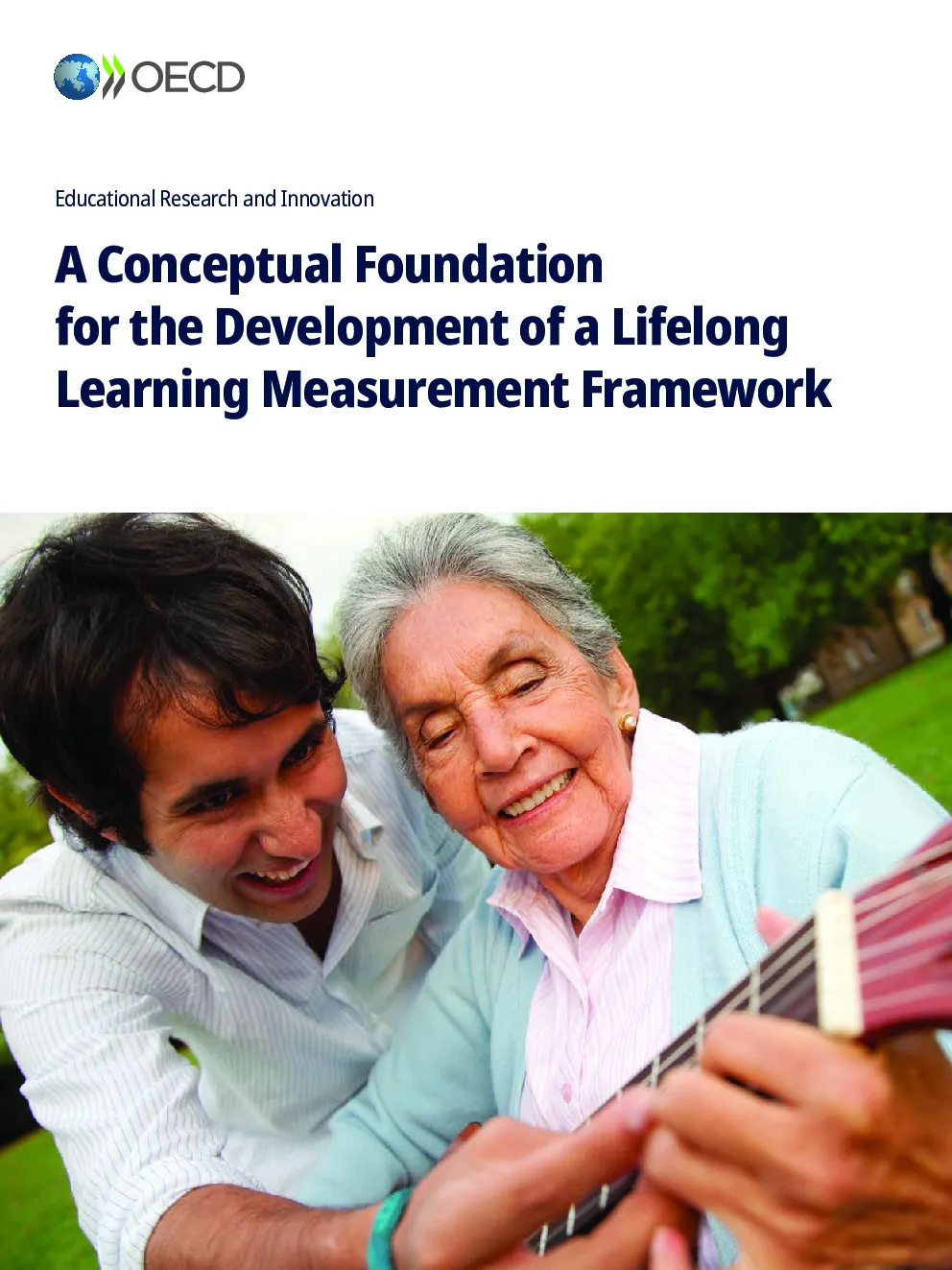
报告封面

A Conceptual Foundationfor the Development of a LifelongLearning Measurement Framework Educational Research and Innovation A Conceptual Foundationfor the Developmentof a Lifelong LearningMeasurement Framework This work is issued under the responsibility of the Secretary-General of the OECD, and does not necessarily reflect theofficial views of OECD Member countries. This document, as well as any data and map included herein, are without prejudice to the status of or sovereignty overany territory, to the delimitation of international frontiers and boundaries and to the name of any territory, city or area. OECD (2026),A Conceptual Foundation for the Development of a Lifelong Learning Measurement Framework, EducationalResearch and Innovation, OECD Publishing, Paris,https://doi.org/10.1787/27e5a619-en. ISBN 978-92-64-87701-6 (print)ISBN 978-92-64-94405-3 (PDF)ISBN 978-92-64-66732-7 (HTML) Educational Research and InnovationISSN 2076-9660 (print)ISSN 2076-9679 (online) Attribution 4.0 International (CC BY 4.0) This work is made available under the Creative Commons Attribution 4.0 International licence. By using this work, you accept to be bound by the terms of this licence(https://creativecommons.org/licenses/by/4.0/).Attribution– you must cite the work.Translations– you must cite the original work, identify changes to the original and add the following text:In the event of any discrepancy between the original work and thetranslation, only the text of the original work should be considered valid.Adaptations– you must cite the original work and add the following text:This is an adaptation of an original work by the OECD. The opinions expressed and arguments employed inthis adaptation should not be reported as representing the official views of the OECD or of its Member countries.Third-party material– the licence does not apply to third-party material in the work. If using such material, you are responsible for obtaining permission from the third party and forany claims of infringement.You must not use the OECD logo, visual identity or cover image without express permission or suggest the OECD endorses your use of the work.Any dispute arising under this licence shall be settled by arbitration in accordance with the Permanent Court of Arbitration (PCA) Arbitration Rules 2012. The seat of arbitration shallbe Paris (France). The number of arbitrators shall be one. Foreword Today's policy challenges–from AI-driven labour market change to demographic ageing and socialcohesion–depend on people's capacity to learn continuously. Yet our international data collections onlifelong learning still provide only fragmented snapshots. Educational surveys rarely follow learners acrossthe life course or connect with adult learning surveys. As for adult learning surveys, they concentrate oncertain age groups, particularly adults between 25 and 64, overlook learning before and after those years,rely largely on cross-sectional surveys, and privilege labour-market outcomes over broader benefits suchas health, civic participation and wellbeing. Most importantly, they struggle to capture where learningincreasingly takes place: in workplaces, families, communities and digital environments. The instinctive response is often to ask for better surveys or more indicators. That is necessary, butinsufficient. What is needed is a different conceptual lens. Rather than treating lifelong learning as anextension of formal education, we should start from the premise that learning occurs across the life courseand across many contexts, only some of which are institutionalised. Schools and universities remainimportant, but they are only one part of a much larger learning ecosystem. This is why the conceptual framework proposed in this report deserves attention even beyond its immediaterecommendations. It reframes lifelong learning around learning systems rather than education systems,and argues that measurement should follow this broader perspective. By organising analysis around theinteraction between the demand for learning, the supply of learning opportunities and the mechanisms thatcoordinate the two, it shifts the focus from educational participationand its learning outcomes tounderstanding how societies enable people to keep learning throughout their lives. Such a shift stretches beyond what current statistical systems can readily deliver. But that should not beseen as a weakness. Blue-sky thinking has an important role in public policy: conceptual frameworks oftenshape what becomes measurable tomorrow. International statistics have repeatedly evolved by firstredefining what matters before building the instruments to observe it. This report seeks to do the same forlifelong learning. It offers practical directions rather than a fixed blueprint. Extending surveys across the full life course,linking longitudinal datasets, integrating administrative records, developing portable learning records andexploiting new analytical techniques a