您的浏览器禁用了JavaScript(一种计算机语言,用以实现您与网页的交互),请解除该禁用,或者联系我们。 [美国银行]:电力检查:瓦特在用电网吗? - 发现报告

电力检查:瓦特在用电网吗?

公用事业 2025-07-01 美国银行 陈曦
报告封面

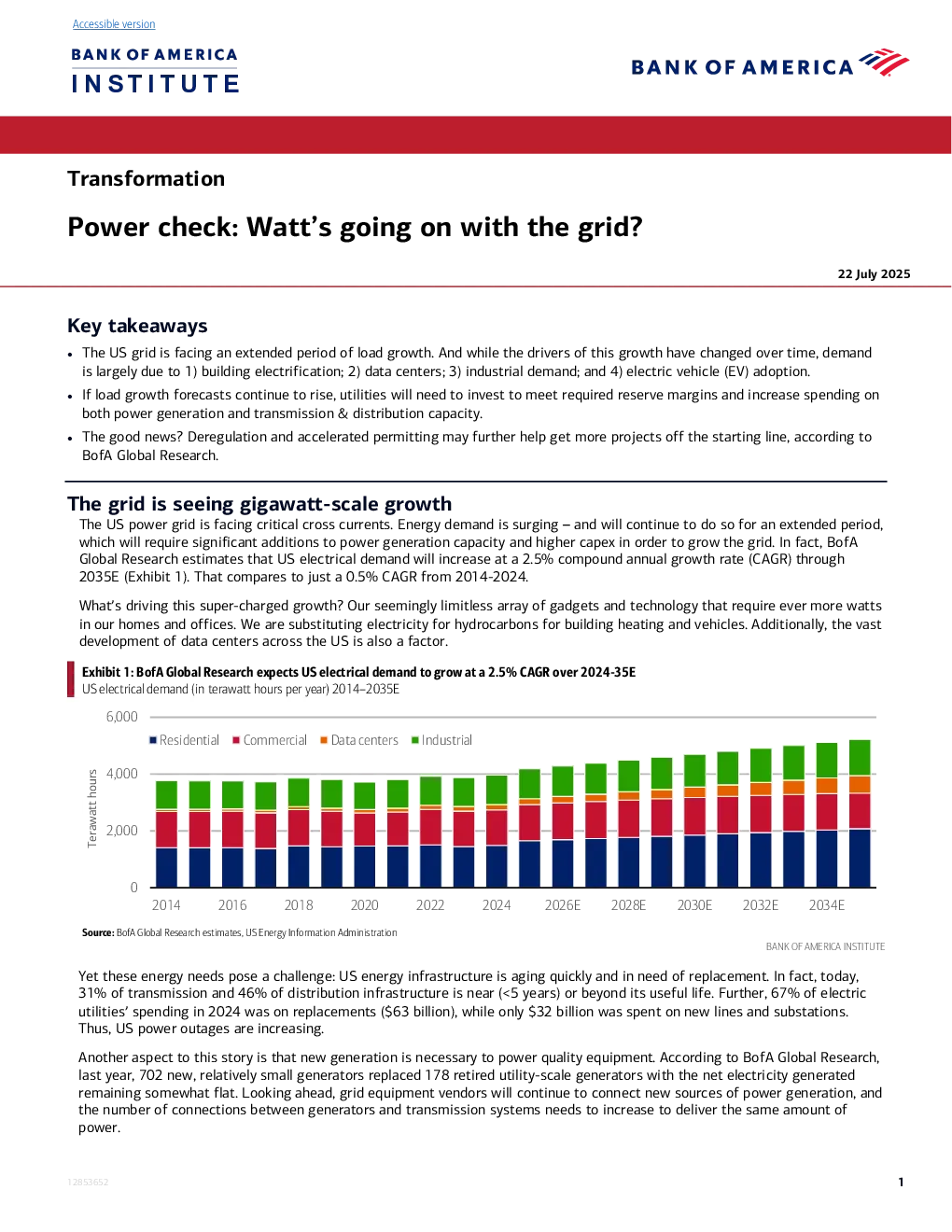
Power check: Watt’s going on with the grid? 22 July 2025 Key takeaways •The US grid is facing an extended period of load growth. And while the drivers of this growth have changed over time, demandis largely due to 1) building electrification; 2) data centers; 3) industrial demand; and 4) electric vehicle (EV) adoption. •If load growth forecasts continue to rise, utilities will need to invest to meet required reserve margins and increase spending onboth power generation and transmission & distribution capacity.•The good news? Deregulation and accelerated permitting may further help get more projects off the starting line, according toBofA Global Research. The grid is seeing gigawatt-scale growthThe US power grid is facing critical cross currents. Energy demand is surging–and will continue to do so for an extended period, which will require significant additions to power generation capacity and higher capex in order to grow the grid. In fact, BofAGlobal Research estimates that US electrical demand will increase at a 2.5% compound annual growth rate (CAGR) through2035E (Exhibit 1). That compares to just a 0.5% CAGR from 2014-2024. What’s driving this super-charged growth? Our seemingly limitless array of gadgets and technology that require ever more wattsin our homes and offices. We are substituting electricity for hydrocarbons for building heating and vehicles. Additionally, the vastdevelopment of data centers across the US is also a factor. US electrical demand (in terawatt hours per year) 2014–2035E Yet these energy needs pose a challenge: US energy infrastructure is aging quickly and in need of replacement. In fact, today,31% of transmission and 46% of distribution infrastructure is near (<5 years) or beyond its useful life. Further, 67% of electricutilities’spending in 2024 was on replacements ($63 billion), while only $32 billion was spent on new lines and substations.Thus, US power outages are increasing. Another aspect to this story is that new generation is necessary to power quality equipment. According to BofA Global Research,last year, 702 new, relatively small generators replaced 178 retired utility-scale generators with the net electricity generatedremaining somewhat flat. Looking ahead, grid equipment vendors will continue to connect new sources of power generation, andthe number of connections between generators and transmission systems needs to increase to deliver the same amount ofpower. The grid in a snapshotBut before we get too far in, let’s ground ourselves first (see what we did there?). Asked simply: What is the grid? The US electrical grid (Exhibit 2) has ~7,000 power plants with capacity of at least one MW (megawatt). These are connected tostep-up transformers to increase the voltage for transmission. Transmission takes place over 642,000 miles of high-voltage lines(i.e., over 34 kilovolts, or kV). Then, before electricity is distributed to consumers, these high-voltage transmission lines gothrough step-down transformers. The US grid has over 201,050 distribution circuits, which run from substations to end usersthrough 6.3 million miles of distribution lines. There are also residential transformers with 120-240 voltage, which is typical forsingle-family homes. The US grid delivers over 3,800 terawatt hours of electricity to 162 million customers annually. Residential customers use 37%of total generation, with commercial and industrial customers using 36% and 26% of generation, respectively. Stylized diagram of an electrical grid What has changed in 2025?•National energy emergency.As part of his“Day One”executive orders, President Donald Trump declared a national energy emergency on 1/20/2025. The order aims to create affordable, abundant energy, and streamline energyinfrastructure permits and regulation. According to BofA Global Research, deregulation (e.g., fast-track approval forelectrical equipment on federal lands) may help to accelerate the US grid build out. •Downshift in some renewable power plans…The Trump Administration is pursuing an“all of the above”strategy forpower generation, with a particular focus on cost efficiency and reliability. Given this focus, it is unsurprising that somehigher cost renewable offerings, such as offshore wind, have come under more scrutiny. •…but traditional power generation gearing up.Power sources that can be adjusted as needed (aka dispatchablepower generation), particularly natural gas power, are enjoying increased demand. This is true both for traditional utilitiesand independent power producers aligned with data center development. BofA Global Research views broaderderegulation efforts at the Environmental Protection Agency, Department of Energy, and Department of the Interior ashelping to accelerate traditional power projects. •Biden era funding is still flowing.The Grid Deployment Office, created under the Biden administration, is beingmaintained by the Trump administration. This agency awarded $14.5 billion in grants o