您的浏览器禁用了JavaScript(一种计算机语言,用以实现您与网页的交互),请解除该禁用,或者联系我们。 [美国银行]:未来之路:自动驾驶汽车的未来 - 发现报告

未来之路:自动驾驶汽车的未来

交运设备 2025-09-01 美国银行 张曼迪
报告封面

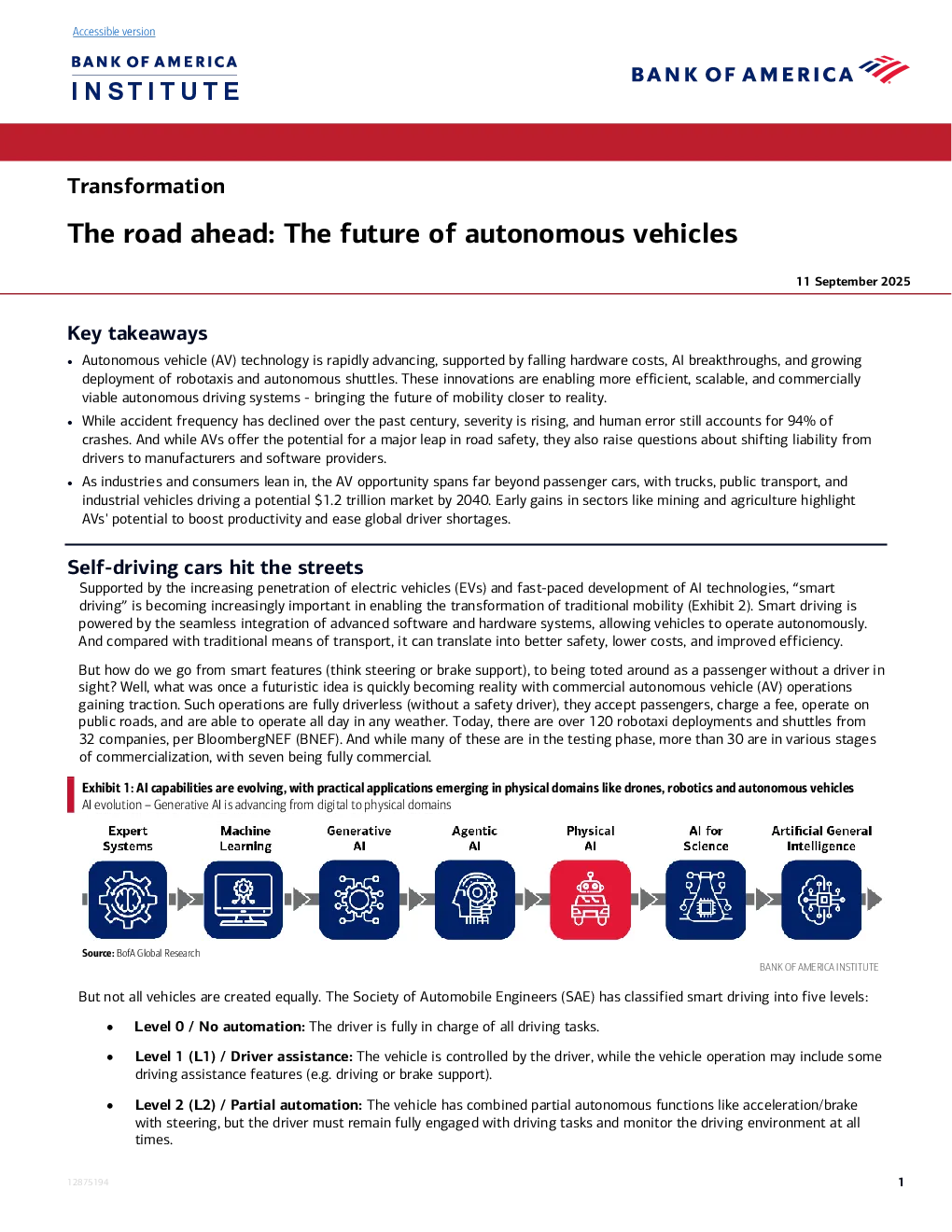
The road ahead: The future of autonomous vehicles 11September2025 Key takeaways •Autonomous vehicle (AV) technology is rapidly advancing, supported by falling hardware costs, AI breakthroughs, and growingdeployment of robotaxis and autonomous shuttles. These innovations are enabling more efficient, scalable, and commerciallyviable autonomous driving systems - bringing the future of mobility closer to reality. •While accident frequency has declined over the past century, severity is rising, and human error still accounts for 94% ofcrashes. And while AVs offer the potential for a major leap in road safety, they also raise questions about shifting liability fromdrivers to manufacturers and software providers. •As industries and consumers lean in, the AV opportunity spans far beyond passenger cars, with trucks, public transport, andindustrial vehicles driving a potential $1.2 trillion market by 2040. Early gains in sectors like mining and agriculture highlightAVs' potential to boost productivity and ease global driver shortages. Self-driving cars hit the streetsSupported by the increasing penetration of electric vehicles (EVs) and fast-paced development of AI technologies,“smart driving”is becoming increasingly important in enabling the transformation of traditional mobility (Exhibit 2). Smart driving ispowered by the seamless integration of advanced software and hardware systems, allowing vehicles to operate autonomously.And compared with traditional means of transport, it can translate into better safety, lower costs, and improved efficiency. But how do we go from smart features (think steering or brake support), to being toted around as a passenger without a driver insight? Well, what was once a futuristic idea is quickly becoming reality with commercial autonomous vehicle (AV) operationsgaining traction. Such operations are fully driverless (without a safety driver), they accept passengers, charge a fee, operate onpublic roads, and are able to operate all day in any weather. Today, there are over 120 robotaxi deployments and shuttles from32 companies, per BloombergNEF (BNEF). And while many of these are in the testing phase, more than 30 are in various stagesof commercialization, with seven being fully commercial. Exhibit1:AI capabilities are evolving, with practical applications emerging in physical domains like drones, robotics and autonomous vehiclesAI evolution–Generative AI is advancing from digital to physical domains But not all vehicles are created equally. The Society of Automobile Engineers (SAE) has classified smart driving into five levels: •Level 0 / No automation:The driver is fully in charge of all driving tasks.•Level 1 (L1) / Driver assistance:The vehicle is controlled by the driver, while the vehicle operation may include somedriving assistance features (e.g. driving or brake support).•Level 2 (L2) / Partial automation:The vehicle has combined partial autonomous functions like acceleration/brakewith steering, but the driver must remain fully engaged with driving tasks and monitor the driving environment at alltimes. •Level 3 (L3) / Conditional automation:Driver is necessary and must be ready to take control of the vehicle at alltimes with notice, while driver is not required to monitor the environment. •Level 4 (L4) / High automation:The vehicle is capable of performing all driving functions under certain conditions.The driver may have the option to control the vehicle. •Level 5 (L5) / Full automation:The vehicle is capable of performing all driving functions under all conditions. Thedriver may/may not have the option to take control of the vehicle. Falling tech costs could unlock the futureBut why is now the time for AVs? For one, tech costs are falling. Vehicles with sufficient sensor and compute capabilities required for AV operations remain expensive but are getting cheaper with scale. In fact, hardware costs of robotaxis in Chinahave fallen by more than 50% compared to previous AV models. And removing the cost of the driver cuts the cost per mile by52%, per BofA Global Research, which can unlock more addressable markets. BofA Global Research also notes that a fleet of one million AVs could unlock up to $50 billion revenue-generating miles, whichsuggests that achieving driver-out commercial operations would create significant economic potential, even with a relativelysmall fleet (compared to the 1.4 billion cars on the road globally). What else impacts commercialization? Beyond cost-effective technology, other factors are critical to successful AV commercialization including safety, utilization andfleet management. The variable demand in ride hailing services could leave 95% of the fleet lying idle in off-peak trough periods,such as overnight. This would severely hamper utilization and potentially lead to higher empty miles, as AVs are reallocatedbetween paid rides. Furthermore, the past decade has seen the rise of“asset-light”mobility service aggregators, driven by