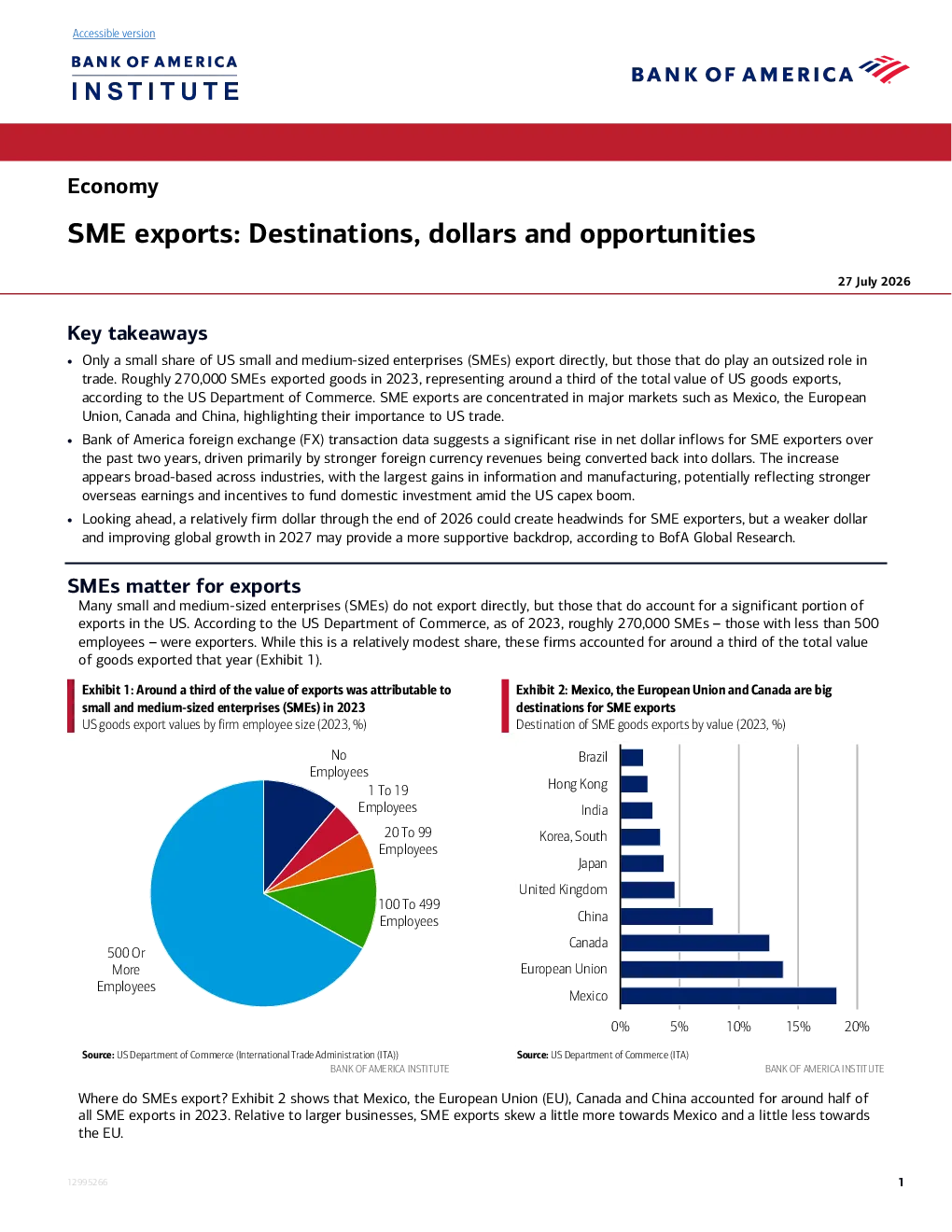
SME exports: Destinations, dollars and opportunities 27 July 2026 Key takeaways •Only a small share of US small and medium-sized enterprises (SMEs) export directly, but those that do play an outsized role intrade. Roughly 270,000 SMEs exported goods in 2023, representing around a third of the total value of US goods exports,according to the US Department of Commerce. SME exports are concentrated in major markets such as Mexico, the EuropeanUnion, Canada and China, highlighting their importance to US trade. •Bank of America foreign exchange (FX) transaction data suggests a significant rise in net dollar inflows for SME exporters overthe past two years, driven primarily by stronger foreign currency revenues being converted back into dollars. The increaseappears broad-based across industries, with the largest gains in information and manufacturing, potentially reflecting strongeroverseas earnings and incentives to fund domestic investment amid the US capex boom. •Looking ahead, a relatively firm dollar through the end of 2026 could create headwinds for SME exporters, but a weaker dollarand improving global growth in 2027 may provide a more supportive backdrop, according to BofA Global Research. SMEs matter for exportsMany small and medium-sized enterprises (SMEs) do not export directly, but those that do account for a significant portion of exports in the US. According to the US Department of Commerce, as of 2023, roughly 270,000 SMEs–those with less than 500employees–were exporters. While this is a relatively modest share, these firms accounted for around a third of the total valueof goods exported that year (Exhibit 1). Exhibit1:Around a third of the value of exportswas attributable tosmall and medium-sized enterprises (SMEs) in 2023US goods export values by firm employee size (2023, %) Destination of SME goods exports by value (2023, %) Where do SMEs export?Exhibit 2shows that Mexico, the European Union (EU), Canada and China accounted for around half ofall SME exports in 2023. Relative to larger businesses, SME exports skew a little more towards Mexico and a little less towardsthe EU. SMEs made hay with a weaker dollarHow have SME exporters fared in recent years? To answer this question, we can analyze Bank of America transactional foreign exchange (FX) data for small and business banking clients (i.e. clients with annual revenues up to $50 million). See Methodologyfor more information. Exhibit 3 shows that, according to this data, SMEs have seen a rising net inflow of dollars from FXtransactions, with a significant jump over 2025-26. On the other hand, dollar outflows have been fairly stable, with the dollarinflow driving the net position (Exhibit 3). Why are inflows rising? One explanation may be that exporter SMEs have enjoyed solid profitability in foreign markets over thepast few years, after a more difficult period during the pandemic and immediately afterwards. As a result, they have beenconverting these rising foreign currency profits back into dollars, driving the dollar inflow higher. Dollar inflows and outflows due to SME FX transactions, according to Bank of America FX transactional data (monthly, index 2019 = 100) But the US dollar also weakened in 2025, meaning that SMEs’foreign currency revenues may have been translating into higherdollar values without much shift in underlying profits. Looking at the data, while the US dollar index (DXY) dropped back over2025 (Exhibit 4), the link between SME dollar inflows and the DXY over time does not appear very close. So, in our view, this isnot the whole story. Exhibit4:Net flows were rising over a weaker period for theUSdollar Exhibit5: Information and manufacturingindustrieshave seenlarge rises in inflowsChange in dollar inflow by industry, July 2023-June 2024 to July 2025-June Dollar net inflow due to SME FX transactions according to Bank ofAmerica FX transactional data and the DXY index (monthly, index 2019 =100) 2026 (%) When we look across industries, we find a fairly broad-based increase in dollar inflows for these exporting SMEs over the pasttwo years, with the information sector showing the largest rise relative to 2023/24, followed by manufacturing (Exhibit 5). Theseexport-oriented SMEs appear to be an exception to the broader small business landscape, with most small firms remainingcautious about capital spending. But the rise in manufacturing FX inflows appears consistent with the recent increase in smallmanufacturing firms’profitability growth (read more on this in theJune Small Business Checkpoint). Alongside profitability, an additional incentive to boost inflows for these sectors could be the US domestic capex boom. In otherwords, SMEs with foreign currency earnings may have been incentivized to bring these dollars“home”to invest in, for example,activity related to data center build-outs and the return of manufacturing capacity to the US. Export destination is not the same as currency exposure for SMEsWhat currenc