2026世界人工智能大会(WAIC):坚定但更务实,数据与半导体成焦点
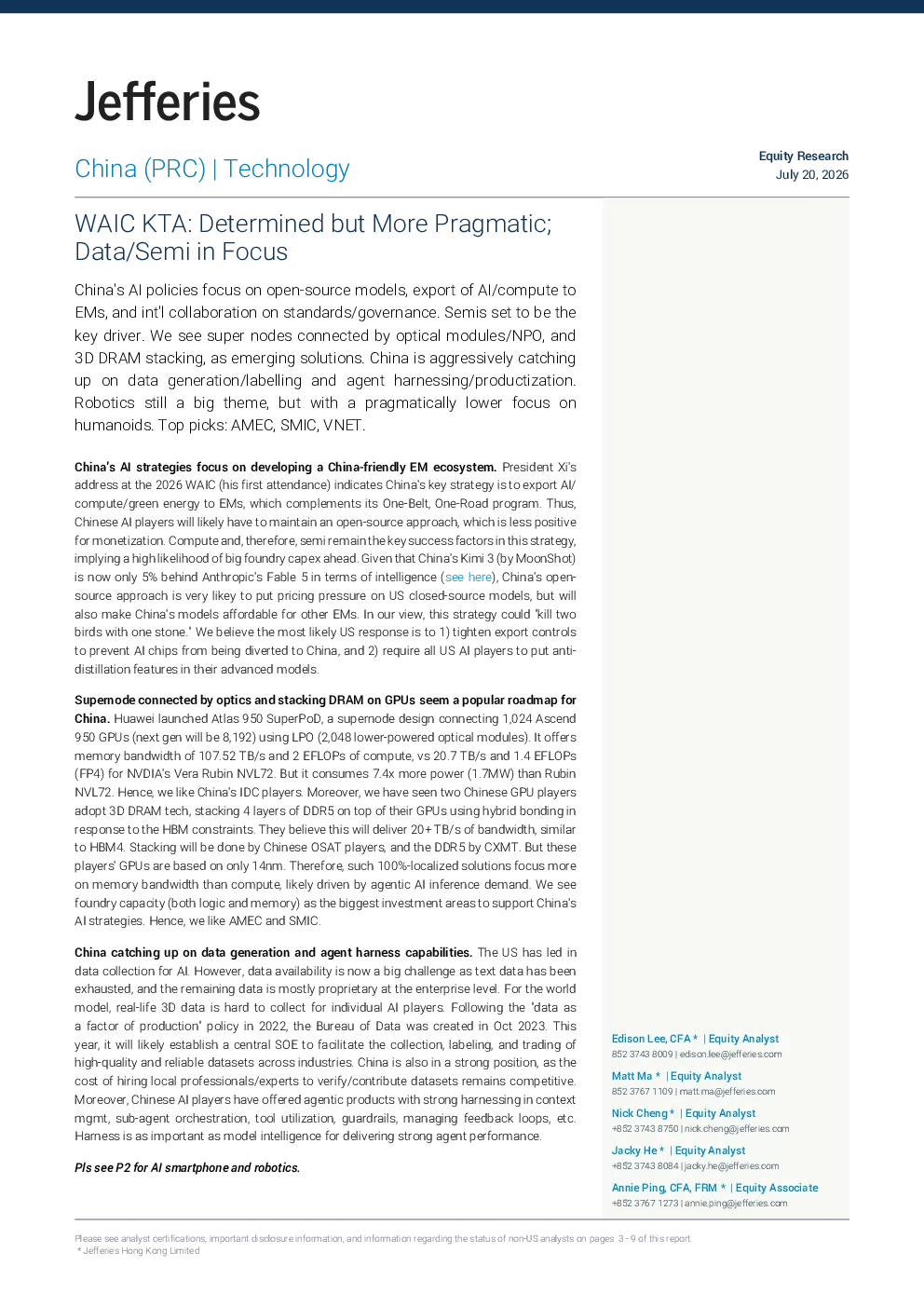
中国(中华人民共和国)| 科技 WAIC KTA:决心更务实;聚焦数据/半导 中国的AI政策重点在于开源模型、向新兴市场出口AI/计算技术,以及在国际标准/治理方面的合作。半导体将成为关键驱动力。我们看到了通过光模块/NPO互联的超节点,以及3D DRAM堆叠等新兴解决方案。中国在数据生成/标注和智能体应用/产品化方面正积极追赶。机器人技术仍是重要主题,但对人形机器人的关注则采取了务实的较低重点。首选:AMEC、SMIC、VNET。 中国的AI战略专注于构建对中国友好的EM生态系统。习近平主席在2026年世界人工智能大会(其首次出席)上的讲话表明,中国的核心战略是向EM国家出口AI/计算/绿色能源,这与其“一带一路”倡议相辅相成。因此,中国的AI参与者可能需要坚持开源方式,这对商业化而言不太有利。计算能力以及由此带来的半导体仍然是该战略的关键成功因素,这意味着未来大型晶圆厂资本支出很可能大幅增加。鉴于中国的“米家3”(由MoonShot开发)在智能水平上目前仅落后于Anthropic的“法伯5”5%(详情请见此处),中国的开源方式很可能给美国的闭源模型带来定价压力,但也将使中国的模型对其他EM国家更具价格优势。在我们看来,这一战略可谓“一石二鸟”。我们认为,美国最可能的回应是:1) 严格出口管制,防止AI芯片被转移至中国;2) 要求所有美国AI参与者在其先进模型中加入反蒸馏功能。 通过光模块互连和GPU堆叠DRAM似乎是中国的一个热门发展路线。华为推出了Atlas 950 SuperPoD,这是一种超节点设计,通过LPO(使用2,048个低功耗光模块)连接了1,024个Ascend 950 GPU(下一代将增至8,192)。它提供107.52 TB/s的内存带宽和2 EFLOPs的计算能力,而NVIDIA的Vera Rubin NVL72则为20.7 TB/s和1.4 EFLOPs(FP4)。但它的功耗比Rubin NVL72高出7.4倍(达到1.7MW)。因此,我们看好中国的IDC运营商。此外,我们已看到两家中国GPU厂商采用3D DRAM技术,通过混合键合在其GPU顶部堆叠4层DDR5,以应对HBM的限制。他们认为这将提供20+ TB/s的带宽,类似于HBM4。堆叠工作将由中国的OSAT厂商完成,DDR5则由CXMT提供。但这些厂商的GPU仅基于14nm工艺。因此,这种100%本土化的解决方案更侧重于内存带宽而非计算能力,这可能是受自主AI推理需求驱动。我们将晶圆代工产能(包括逻辑和存储)视为支持中国AI战略的最大投资领域。因此,我们看好AMEC和SMIC。 中国在数据生成和智能体运用能力上正在迎头赶上。美国在人工智能的数据收集方面一直领先。然而,数据可用性现在是一个重大挑战,因为文本数据已经枯竭,而剩余的数据大多在企业层面是专有的。对于世界模型而言,真实世界的3D数据对各个人工智能参与者来说很难收集。根据2022年“数据作为生产要素”的政策,数据局于2023年10月成立。今年,它可能会建立一家中央国有企业,以促进跨行业高质量和可靠数据集的收集、标注和交易。中国也处于有利地位,因为雇佣当地专业人员/专家来验证/贡献数据集的成本仍然具有竞争力。此外,中国的人工智能参与者已经提供了具有强大上下文管理、子智能体编排、工具利用、护栏、管理反馈循环等功能的智能体产品。运用能力与模型智能一样重要,对于提供强大的智能体性能至关重要。 852 3743 8009 | edison.lee@jefferies.com李登森,CFA* | 股票分析师 852 3767 1109 | matt.ma@jefferies.com马特·马 * | 股票分析师 +852 3743 8084 | jacky.he@jefferies.com杰克·何 * | 股权分析师 请参见P2页,了解AI智能手机和机器人技术。 +852 3767 1273 | annie.ping@jefferies.com安妮·平,CFA,FRM* | 股权分析师 人工智能手机仍然是一个巨大的挑战。一家中国人工智能公司展示了一款由其手机版大语言模型(1亿-10亿数据参数)驱动、而非传统操作系统(但内核仍是安卓)、并由ODM代工的自研人工智能手机。我们认为OpenAI可能也想做类似的事情。但我们认为其体验与云服务相比区分度不够。该生态系统也可能受限,因为主要互联网公司可能会出于安全原因或保护自身生态而封锁其API。硬件供应链中的议价能力不足以及高内存价格是额外的挑战。 机器人领域仍有许多参与者,但淡化人形机器人是一个现实策略。机器人占据了WAIC展会约25%的展位空间,比去年更大,因此仍然是中国非常重要的AI主题。然而,我们观察到人形机器人的演示和展览出现了显著下滑。现在重点是轮式机器人,它们成本更低、更容易商业化。我们认为这意味着机器人领域的参与者变得更加务实,表明该领域风险较低。我们判断人形机器人可能还需要5年,鉴于计算能力(尤其对中国而言)、内存(昂贵)、过热、灵巧手(功率半导体和电机的微型化)以及减速器等面临的挑战。我们认为轮式机器人生产挑战要小得多,在成本上具有竞争力,并且更容易商业化。 公司估值/风险 先进微加工设备有限公司 中国 我们415.00人民币的PT是基于80x/58x 2026E/27E P/E得出的。主要风险包括:1) 美国商务部进一步实施制裁;2) 客户产能扩张不及预期;3)中国以外的新客户获取不及预期;4) 新工具开发不及预期。 英伟达公司 目标价位:300美元意味着相对于我们2028财年每股收益14.14美元,有21倍的市盈率。 Risks: •英特尔、AMD以及超大规模企业内部设计的ASIC正带来新兴的竞争威胁,抢占市场份额并对ASP施加压力。 • 汽车平台的增长速度低于预期。• 从企业和超大规模企业那里放缓数据中心资本支出。 半导体制造国际公司 我們對港股的目標價基於2026年預期市價淨值比的4.0倍,而我們對A股的目標價基於2026年預期市價淨值比的7.0倍。主要風險包括:1)如果美國繼續向美國SPE公司發放牌照,以供其向中芯國際供應成熟節點設備以應對全球芯片短缺,則供應鏈風險將放慢;2)由5G、物聯網、CIS等驅動的成熟節點需求好於預期,導致ASP進一步提升。 VNET集团 我們的價格目標基於SOTP。我們價格目標的風險包括:需求增長不及預期、未能從政府獲得足夠的電力配置,以及由於競爭加劇導致價格不及預 分析师认证: 我,爱迪生·李,特许金融分析师(CFA),证明本研究报告中所表达的所有观点均准确反映了我对相关证券(或公司)的个人看法。我还证明,我的任何薪酬部分,现在或将来,均未直接或间接地与本研究报告中表达的具体建议或观点相关。 我,Matt Ma,特此证明本研究报告中所表达的所有观点均准确反映了我对相关证券(或相关公司)的个人看法。我还特此证明,我的任何薪酬部分,现在或将来,均未直接或间接地与本研究报告中表达的具体建议或观点相关。 本人 Nick Cheng 声明,本研究报告中所表达的所有观点均准确反映本人对相关证券及相关公司的个人看法。本人还声明,本人的任何薪酬与本研究报告中表达的特定建议或观点无直接或间接关联。 我,何嘉怡,特此证明,本研究报告中所表达的所有观点均准确反映了我对相关证券(或相关公司)的个人看法。我还特此证明,我的任何薪酬部分,现在或将来,均未直接或间接地与本研究报告中表达的具体建议或观点相关。 非美国分析师注册:爱迪生·李(CFA)受雇于Jefferies Hong Kong Limited,Jefferies LLC的非美国附属机构,其并非FINRA注册/合格的证券分析师。该分析师可能不是Jefferies LLC(FINRA会员机构)的关联人士,因此可能不受FINRA规则2241的约束,也不受与研究分析师持有的证券相关的与标的公司沟通、公开露面等方面的限制。 非美国分析师注册:Matt Ma受雇于Jefferies Hong Kong Limited,Jefferies LLC的非美国附属机构,其并非FINRA注册/合格的证券分析师。该分析师可能并非Jefferies LLC(FINRA会员机构)的关联人士,因此可能不受FINRA规则2241的约束,也不受与研究分析师所持证券相关的与标的公司沟通、公开露面等方面的限制。 非美国分析师注册:Nick Cheng受雇于Jefferies Hong Kong Limited,Jefferies LLC的非美国附属机构,其并非FINRA注册/合格的证券分析师。该分析师可能不是Jefferies LLC(FINRA会员机构)的关联人士,因此可能不受FINRA规则2241的约束,也不受与研究分析师持有的证券相关的与标的公司沟通、公开露面等方面的限制。 非美国分析师注册:杰弗里·香港有限公司的Jacky He受雇于Jefferies LLC的非美国附属机构,未在美国金融业监管局(FINRA)注册或具备研究分析师资格。该分析师可能不是Jefferies LLC(FINRA会员机构)的关联人士,因此可能不受FINRA规则2241以及研究分析师与目标公司沟通、公开露面和交易其持有证券的限制。 非美国分析师注册:安妮·平(CFA、FRM)受雇于Jefferies Hong Kong Limited,Jefferies LLC的非美国附属机构,其未在FINRA注册或具备研究分析师资格。该分析师可能不是Jefferies LLC(FINRA会员机构)的关联人士,因此可能... 不受 FINRA 规则 2241 的约束,也不受与特定公司沟通、公开露面以及所持证券交易的限制研究员 与所有Jefferies员工一样,负责本报告所述金融工具覆盖的分析师的部分薪酬基于公司整体业绩,包括投资银行业务收入。我们力求根据适当情况更新我们的研究,但各种法规可能阻止我们这样做。除了定期发布的某些行业报告外,大部分报告将根据分析师的判断,在适当的时候以不定期间隔发布。 投资建议记录 《MAR》第三条第(1)款e项和第七条推荐已发布 推荐已分发 July 19, 2026 12:34 P.M.July 19, 2026 12:34 P.M. 杰弗里斯评级说明 买入 - 指我们预期在12个月内提供总回报(价格上涨加上收益)15%或更多的证券。持有 - 描述我们预期在12个月内提供总回报(价格上涨加上收益)为正15%或负10%的证券。表现不佳 - 描述我们预期在12个月内提供总回报(价格上涨加上收益)为负10%或更低的证券。 NR - 投资评级和目标价已被临时暂停。此类暂停符合相关法规和/或Jefferies政策。 CS - 覆盖暂停。Jefferies已暂停对该公司的覆盖。NC - 不涵盖。Jefferies 不覆盖该公司。监控股 - 指其公司基本面和财务状况正在被监控的证券,且不提供任何财务预测或对公司投资价值的意见。受限 - 描述在摩根士丹利参与某些交易的情况下,由于公司政策或适用的证券法规禁止某些类型的沟通(包括投资建议),因此禁止向某些发行人提供沟通服务的情形。 评估方法 杰弗里斯(Jefferies)分配评级的方法可能包括:市值、到期日、成长/价值、波动率以及未来12个月的预期总回报。目标价格基于多种方法,可能包括但不限于以下分析:市场风险分析、增长率、收入流、折现现金流(DCF)、EBITDA、每股收益(EPS)、现金流(CF)、自由现金流(FCF)、EV/EBITDA、市盈率(P/E)、PE/增长率、P/CF、P/FCF、溢价(折价)/平均组EV/EBITDA、溢价(折价)/平均组市盈率、分部估值法、净资产价值、股息回报以及未来12个月的净资产收益率(ROE)。 杰弗里斯特许经营精选 杰富瑞精选股包括我们股权分析师在12个月内提出的最佳股票建议中的选股。选股基于基本面分析,并可能考虑分析师信心