您的浏览器禁用了JavaScript(一种计算机语言,用以实现您与网页的交互),请解除该禁用,或者联系我们。 [世界银行]:将农业公共支出重新用于孟加拉国农业食品系统的高质量增长和就业 - 发现报告

将农业公共支出重新用于孟加拉国农业食品系统的高质量增长和就业

农林牧渔 2026-07-06 世界银行
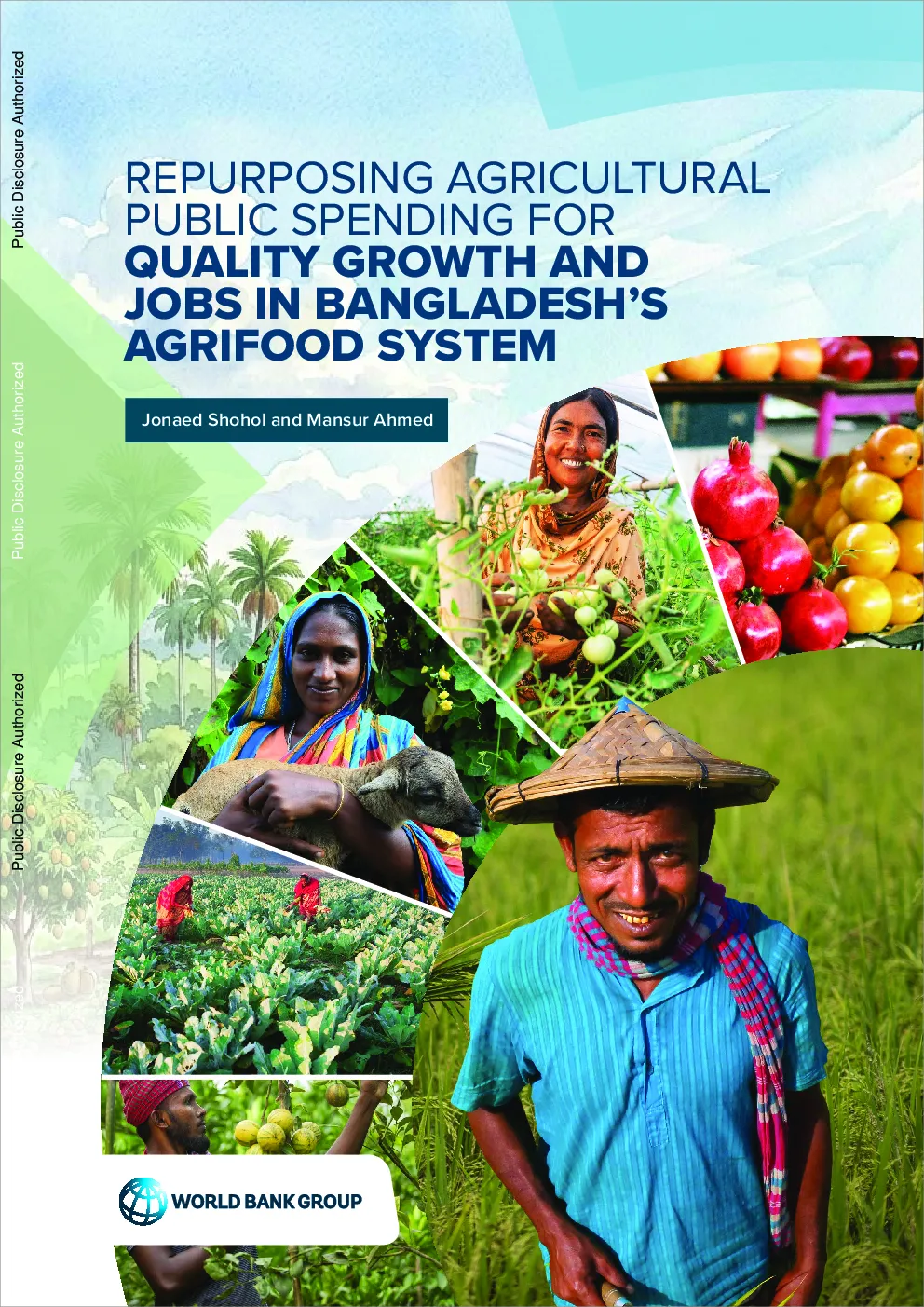
报告封面

Jonaed Shohol and Mansur Ahmed © 2026 The World Bank1818 H Street NW, Washington, DC 20433, USATelephone: 202-473-1000; Internet: www.worldbank.org World Bank BangladeshPlot E 32, Sher-e-Bangla Nagar, Agargaon, Dhaka 1207, BangladeshTelephone: (880-2) 5566-7777; Email: bangladeshinfo@worldbank.org Some rights reserved This work is a product of the staff of The World Bank with external contributions. The findings, interpretations, andconclusions expressed in this work do not necessarily reflect the views of The World Bank, its Board of Executive Directors,or the governments they represent. The World Bank does not guarantee the accuracy, completeness, or currency of the data included in this work and does notassume responsibility for any errors, omissions, or discrepancies in the information, or liability with respect to the use of orfailure to use the information, methods, processes, or conclusions set forth. The boundaries, colors, denominations, and otherinformation shown on any map in this work do not imply any judgment on the part of The World Bank concerning the legalstatus of any territory or the endorsement or acceptance of such boundaries. Nothing herein shall constitute or be construed or considered to be a limitation upon or waiver of the privileges andimmunities of The World Bank, all of which are specifically reserved. Rights and Permissions The material in this work is subject to copyright. Because The World Bank encourages dissemination of its knowledge, thiswork may be reproduced, in whole or in part, for non-commercial purposes as long as full attribution to this work is given. Attribution—Please cite the work as follows: Jonaed Shohol and Mansur Ahmed. 2026. Repurposing Agricultural PublicSpending for Quality Growth and Jobs in Bangladesh’s Agrifood System. Washington, DC: World Bank. Translations—If you create a translation of this work, please add the following disclaimer along with the attribution: Thistranslation was not created by The World Bank and should not be considered an official World Bank translation. The WorldBank shall not be liable for any content or error in this translation. Adaptations—If you create an adaptation of this work, please add the following disclaimer along with the attribution: Thisis an adaptation of an original work by The World Bank. Views and opinions expressed in the adaptation are the soleresponsibility of the author or authors of the adaptation and are not endorsed by The World Bank. Third-party content—The World Bank does not necessarily own each component of the content contained within the work.The World Bank therefore does not warrant that the use of any third-party-owned individual component or part contained inthe work will not infringe on the rights of those third parties. The risk of claims resulting from such infringement rests solelywith you. If you wish to reuse a component of the work, it is your responsibility to determine whether permission is neededfor that reuse and to obtain permission from the copyright owner. Examples of components can include, but are not limited to,tables, figures, images, maps, illustrations, and photographs. Any queries on rights and licenses, including subsidiary rights, should be addressed to World Bank Publications, The WorldBank Group, 1818 H Street NW, Washington, DC 20433, USA; fax: 202-522-2625; e-mail: pubrights@worldbank.org. Cover photo:© Mahfuz Hasan Bhuiyan, Habibul Haque/Drik, Shehab Uddin, Flore de Préneuf/World Bank. REPURPOSING AGRICULTURALPUBLIC SPENDING FORQUALITY GROWTH ANDJOBS IN BANGLADESH’SAGRIFOOD SYSTEM Jonaed Shohol and Mansur Ahmed CONTENTS FOREWORDvi ACKNOWLEDGMENTSvii ABBREVIATIONSviii EXECUTIVE SUMMARYx OVERVIEW2I. I.1.Objectives and Scope of the ReportI.2.Methods and Data55 A REVIEW OF PUBLIC EXPENDITURE ON FOOD ANDAGRICULTURE10 II.1.Budgetary Framework of Bangladesh10 II.2.Trends and Composition of Public Expenditure on Food andAgriculture II.3.Fiscal Management and Operational Efficiency of Public Expenditure20 II.4.Policy Coherence Analysis of Agricultural Public Expenditures23 A DEEP DIVE INTO THE FERTILIZER SUBSIDY PROGRAM28 III.1.Overview and Evolution of Fertilizer Policies28 III.2.Operating Mechanisms of Fertilizer Distribution and Management30 III.3.Distributional Impact and Outcomes of Fertilizer Subsidies32 POLICY RECOMMENDATIONS40 REFERENCES44 ANNEXES 46 Annex 1:Institutional Landscape of Food and AgricultureSpending in Bangladesh46 Annex 2:MAFAP Indicators of Public Expenditure on Food andAgriculture47 Annex 3:Spatial Distribution of Agricultural Spending andOutcomes Annex 4:Annual Timeline for Fertilizer Demand Estimation andProcurement52 Annex 5:Fertilizer Use Efficiency: Technical and AllocativeEfficiency Models Annex 6:Determinants of Fertilizer Overuse: LogisticRegression Results56 Annex 7:Key Assumptions for Estimating Ex-Ante CarbonBalance58 FIGURES FIGURE I-1: Trend in Annual Growth RatesFIGURE I-2: Drivers of Agricultur