您的浏览器禁用了JavaScript(一种计算机语言,用以实现您与网页的交互),请解除该禁用,或者联系我们。 [ITIF]:中国蓬勃发展的生物制药竞争力需要美国的回应 - 发现报告

中国蓬勃发展的生物制药竞争力需要美国的回应

医药生物 2026-06-29 ITIF 杨框子
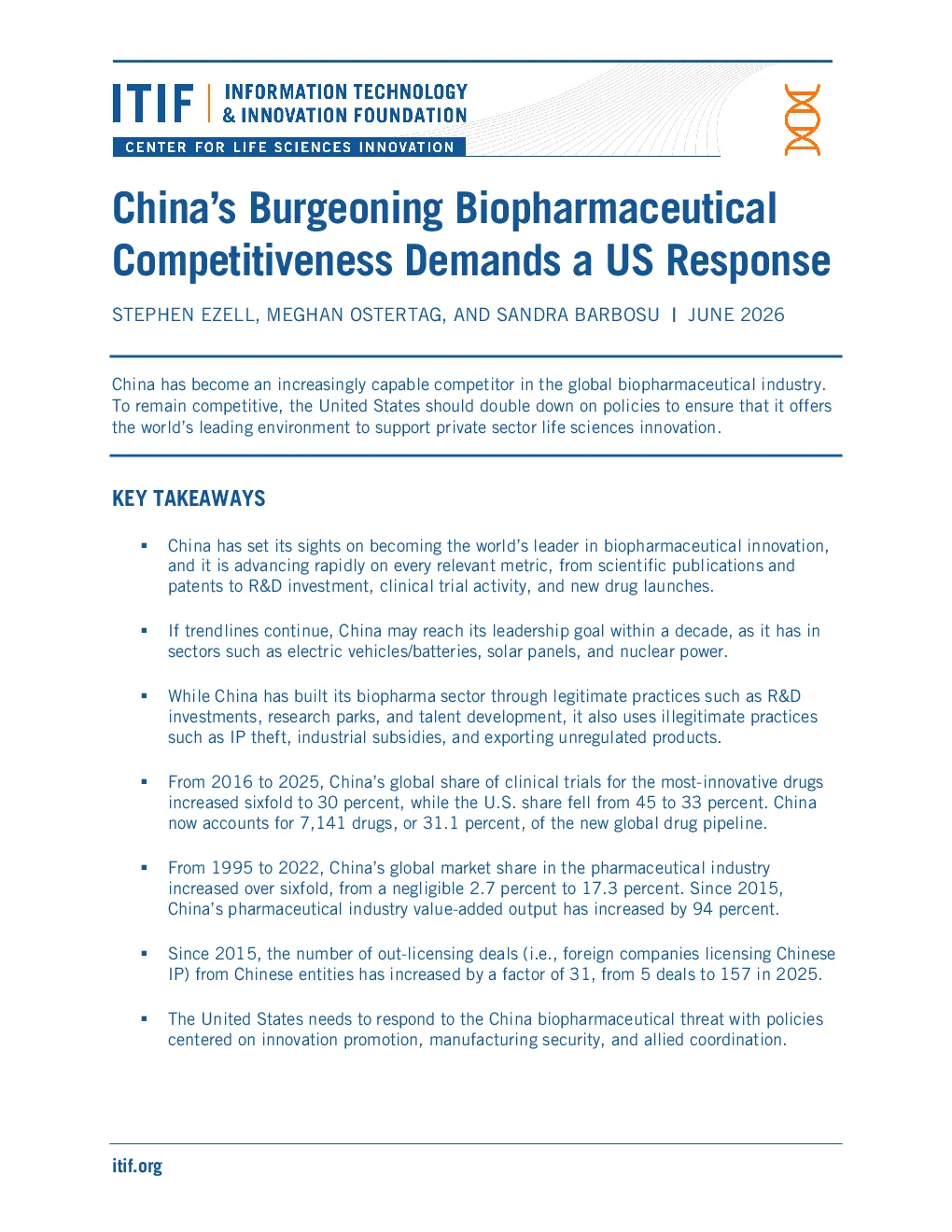
报告封面

STEPHEN EZELL, MEGHAN OSTERTAG, AND SANDRA BARBOSU|JUNE 2026 China has become an increasingly capable competitor in the global biopharmaceutical industry.To remain competitive, the United States should double down on policies to ensure that it offers KEY TAKEAWAYS China has set its sights on becoming the world’s leader in biopharmaceutical innovation,and it is advancing rapidly on every relevant metric, from scientific publications and If trendlines continue, China may reach its leadership goal within a decade, as it has insectors such as electric vehicles/batteries, solar panels, and nuclear power. While China has built its biopharma sector through legitimate practices such as R&Dinvestments, research parks, and talent development, it also uses illegitimate practices From 2016 to 2025, China’s global share of clinical trials for the most-innovative drugsincreased sixfold to 30 percent, while the U.S. share fell from 45 to 33 percent. China From 1995 to 2022, China’s global market share in the pharmaceutical industryincreased over sixfold, from a negligible 2.7 percent to 17.3 percent. Since 2015, Since 2015, the number of out-licensing deals (i.e., foreign companies licensing ChineseIP) from Chinese entities has increased by a factor of 31, from 5 deals to 157 in 2025. The United States needs to respond to the China biopharmaceutical threat with policiescentered on innovation promotion, manufacturing security, and allied coordination. CONTENTS Key Takeaways ................................................................................................................. 1Introduction ..................................................................................................................... 3China’s Biopharmaceutical Ecosystem................................................................................. 5Legitimate Practices ...................................................................................................... 5Illegitimate Practices ..................................................................................................... 7China’s Growing Biopharmaceutical Competitiveness ............................................................ 9Patents and Scholarly Publications .................................................................................. 9Research and Development........................................................................................... 11International Competitiveness Comparisons .................................................................... 14Clinical Trials and Drug Development............................................................................. 18Out-Licensing Deals..................................................................................................... 21Emerging Therapies ..................................................................................................... 22Policy Recommendations................................................................................................. 29Ensuring U.S. Innovation Leadership ............................................................................. 30 INTRODUCTIONChina has set its sights on becoming the world’s leader in biopharmaceutical innovation. While such a goal might seem fanciful to some, the reality is China has set similar goals—and achieved them—in industries ranging from electric vehicles (EVs)/batteries and solar panels to nuclearpower and telecommunications networking equipment.1In recent years, China has developed acomprehensive national strategy to strengthen its biopharmaceutical innovation capacity, whichfeatures a wide range of policy instruments, including subsidies, financial incentives, high-tech China has set its sights on becoming the world’s leader in biopharmaceutical innovation. China began to seriously target the biopharmaceutical sector as early as 2007, when the ChineseCommunist Party (CCP) announced plans to “set up high-tech industrial bases for biotechnology.”3In 2011, as part of its 12th Five-Year Plan (2011–2015), China designatedbiotechnology as a “strategic emerging industry” and also introduced a coordinated national strategy to accelerate biotech innovation and competitiveness.4Under its 14th Five-Year Plan(2021–2025), China committed to increasing research and development (R&D) investment by In 2021 alone, China’s basic science research investment rose by 10.6 percent—part of adeliberate push to build long-term scientific capacity. That same year, Beijing also launched newnational laboratories and innovation centers in strategic fields such as artificial intelligence (AI), In 2022, China for the first time issued a five-year plan specifically for the bioeconomy,articulating broad goals for 2025 in biopharma, bio-agriculture, bio-manufacturing, and bio-security. This Bioeconomy Development Plan established biomedicine as a strategic pillar alongside agriculture and biomanufacturing, targe