中国工业政策被忽视的领域:食品供应链
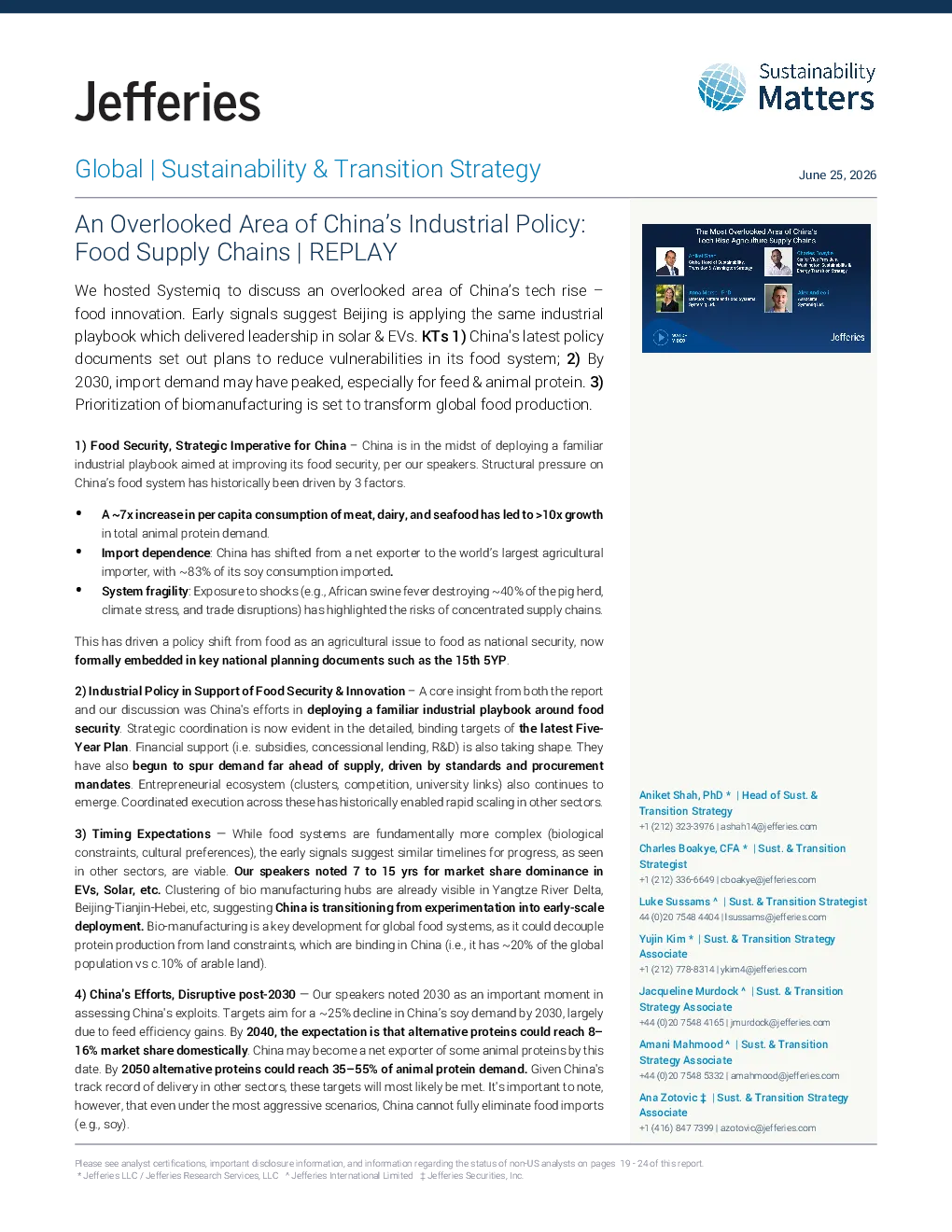
Global | Sustainability & Transition Strategy June 25, 2026 An Overlooked Area of China’s Industrial Policy:Food Supply Chains | REPLAY We hosted Systemiq to discuss an overlooked area of China’s tech rise –food innovation. Early signals suggest Beijing is applying the same industrialplaybook which delivered leadership in solar & EVs.KTs1)China's latest policydocuments set out plans to reduce vulnerabilities in its food system;2)By 1) Food Security, Strategic Imperative for China– China is in the midst of deploying a familiarindustrial playbook aimed at improving its food security, per our speakers. Structural pressure on in total animal protein demand.• importer, with ~83% of its soy consumption imported.• climate stress, and trade disruptions) has highlighted the risks of concentrated supply chains. This has driven a policy shift from food as an agricultural issue to food as national security, now 2) Industrial Policy in Support of Food Security & Innovation– A core insight from both the reportand our discussion was China's efforts indeploying a familiar industrial playbook around foodsecurity. Strategic coordination is now evident in the detailed, binding targets ofthe latest Five-Year Plan. Financial support (i.e. subsidies, concessional lending, R&D) is also taking shape. They Aniket Shah, PhD * | Head of Sust. &Transition Strategy +1 (212) 323-3976 | ashah14@jefferies.com 3) Timing Expectations— While food systems are fundamentally more complex (biologicalconstraints, cultural preferences), the early signals suggest similar timelines for progress, as seenin other sectors, are viable.Our speakers noted 7 to 15 yrs for market share dominance inEVs, Solar, etc.Clustering of bio manufacturing hubs are already visible in Yangtze River Delta,Beijing-Tianjin-Hebei, etc, suggestingChina is transitioning from experimentation into early-scale Charles Boakye, CFA * | Sust. & TransitionStrategist +1 (212) 336-6649 | cboakye@jefferies.com Luke Sussams ^ | Sust. & Transition Strategist44 (0)20 7548 4404 | lsussams@jefferies.com Yujin Kim * | Sust. & Transition StrategyAssociate Jacqueline Murdock ^ | Sust. & TransitionStrategy Associate+44 (0)20 7548 4165 | jmurdock@jefferies.com 4) China's Efforts, Disruptive post-2030— Our speakers noted 2030 as an important moment inassessing China's exploits. Targets aim for a ~25% decline in China’s soy demand by 2030, largelydue to feed efficiency gains. By2040, the expectation is that alternative proteins could reach 8–16% market share domestically. China may become a net exporter of some animal proteins by this Amani Mahmood ^ | Sust. & TransitionStrategy Associate+44 (0)20 7548 5332 | amahmood@jefferies.com Ana Zotovic ‡ | Sust. & Transition StrategyAssociate+1 (416) 847 7399 | azotovic@jefferies.com 5) Investment Implications—1)China could emerge as a global leader in a new proteinecosystem by 2030's;2)Growth areas include feed efficiency tech, biomanufacturing infrastructure China’s foodfuture How China’s food-security strategy could reshapeglobal agricultural commodity supply chains 22June 2026 Presentedby China is increasingly reliant on imports for key food and feedcommodities Increasing Import Reliance Rising Demand Share of soy used in China that’s domestically produced Non-exhaustive China’s leadershipis focused onfoodas a nationalsecurity priority 15thFive-Year Plan (2026) China's national strategic blueprint, it nowincorporates emerging technologies such assynthetic biology and new protein sources within abroader strategy to diversify China’s food supply andstrengthen conventional agricultural production Number One Document (2026) The Party's first agricultural policy statement of the15th FYP period, explicitly naming biomanufacturing asa key technological priority for China's food system Plan for Accelerating the Constructionof China into an AgriculturalPowerhouse (2024-2035)“A world power must first strengthen its agriculture,and only when agriculture is strong can a country bea world power” National Food Security Law (2023)Aims to ensure security in staple grains for food useand instructs authorities to ensure the food supplyremains firmly in the PRC’s own hands Prior experience shows that China can quickly and radicallytransform industries that it designates as strategic priorities China uses a 5-part playbook to transform industries; we are seeingearly signals in multiple parts of the food system Strategic & Coordinated Vision •Five-year plans direct industrial andeconomic transformation through bindingtargets that cascade national to local levels•Central coordination with local competition•Explicit industrial targeting with stateowned enterprises Policy & RegulatorySupport Financial Support Induced Demand •Access to low interest loansthrough state banks•Subsidies (national and local)•R&D funding •Solar: renewable energy mandatesat local and national levels•EV: purchaseincentives and fleetgoals at national and lo