艾伯维公司(ABBV)收购Apogee Therapeutics(APGE):高度去风险的特应性皮炎扩张助力
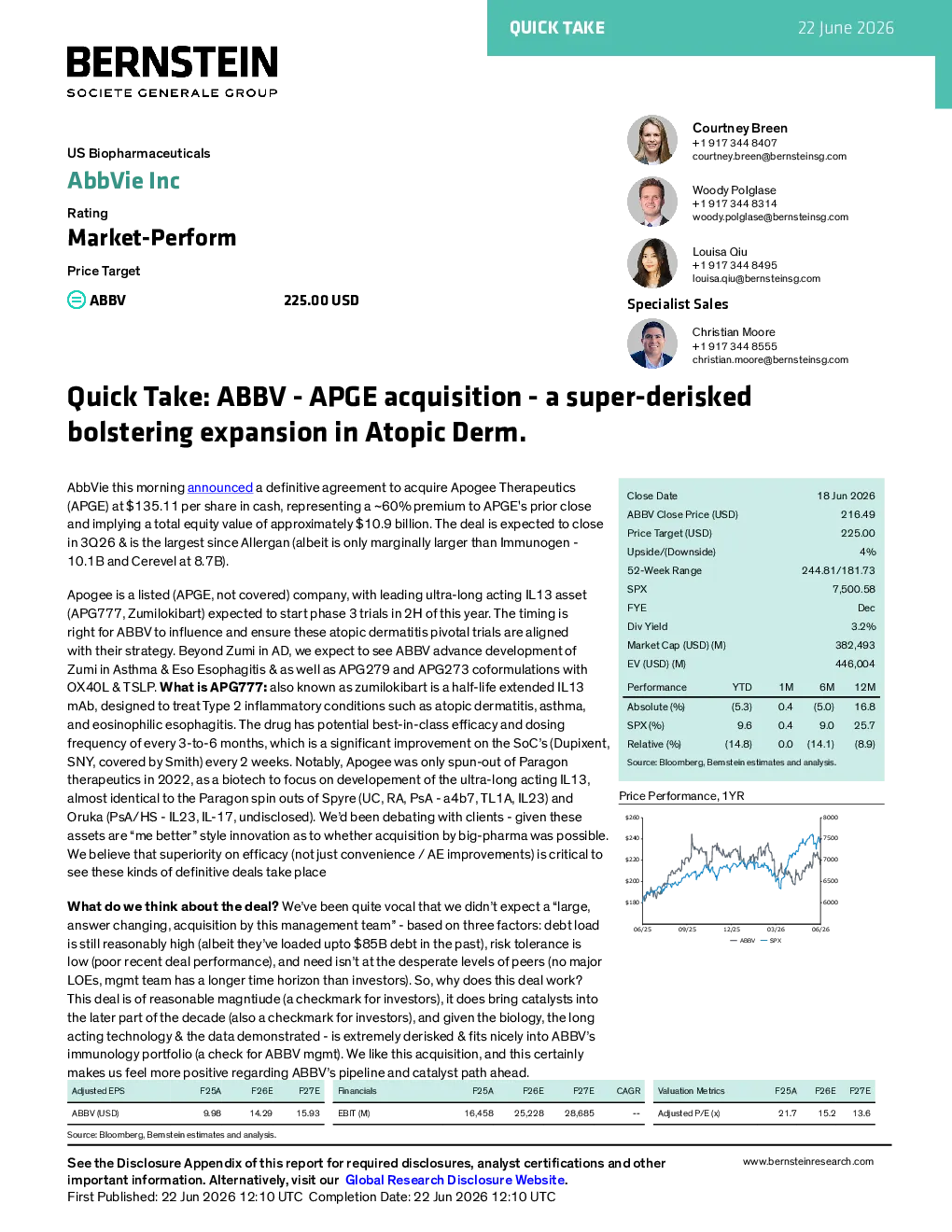
Woody Polglase+1 917 344 8314woody.polglase@bernsteinsg.com RatingMarket-Perform Louisa Qiu+1 917 344 8495louisa.qiu@bernsteinsg.com Price Target 225.00 USD ABBV Specialist Sales Christian Moore+1 917 344 8555christian.moore@bernsteinsg.com Quick Take: ABBV - APGE acquisition - a super-deriskedbolstering expansion in Atopic Derm. AbbVie this morning announced a definitive agreement to acquire Apogee Therapeutics(APGE) at $135.11 per share in cash, representing a ~60% premium to APGE's prior closeand implying a total equity value of approximately $10.9 billion. The deal is expected to closein 3Q26 & is the largest since Allergan (albeit is only marginally larger than Immunogen -10.1B and Cerevel at 8.7B). Apogee is a listed (APGE, not covered) company, with leading ultra-long acting IL13 asset(APG777, Zumilokibart) expected to start phase 3 trials in 2H of this year. The timing isright for ABBV to influence and ensure these atopic dermatitis pivotal trials are alignedwith their strategy. Beyond Zumi in AD, we expect to see ABBV advance development ofZumi in Asthma & Eso Esophagitis & as well as APG279 and APG273 coformulations withOX40L & TSLP.What is APG777:also known as zumilokibart is a half-life extended IL13mAb, designed to treat Type 2 inflammatory conditions such as atopic dermatitis, asthma,and eosinophilic esophagitis. The drug has potential best-in-class efficacy and dosingfrequency of every 3-to-6 months, which is a significant improvement on the SoC’s (Dupixent,SNY, covered by Smith) every 2 weeks. Notably, Apogee was only spun-out of Paragontherapeutics in 2022, as a biotech to focus on developement of the ultra-long acting IL13,almost identical to the Paragon spin outs of Spyre (UC, RA, PsA - a4b7, TL1A, IL23) andOruka (PsA/HS - IL23, IL-17, undisclosed). We’d been debating with clients - given theseassets are “me better” style innovation as to whether acquisition by big-pharma was possible.We believe that superiority on efficacy (not just convenience / AE improvements) is critical tosee these kinds of definitive deals take place What do we think about the deal?We’ve been quite vocal that we didn’t expect a “large,answer changing, acquisition by this management team” - based on three factors: debt loadis still reasonably high (albeit they’ve loaded upto $85B debt in the past), risk tolerance islow (poor recent deal performance), and need isn’t at the desperate levels of peers (no majorLOEs, mgmt team has a longer time horizon than investors). So, why does this deal work?This deal is of reasonable magntiude (a checkmark for investors), it does bring catalysts intothe later part of the decade (also a checkmark for investors), and given the biology, the longacting technology & the data demonstrated - is extremely derisked & fits nicely into ABBV’simmunology portfolio (a check for ABBV mgmt). We like this acquisition, and this certainlymakes us feel more positive regarding ABBV’s pipeline and catalyst path ahead. OVERVIEW Apogee Therapeutics is a clinical-stage biotechnology company that advances its pipeline utilizing a development strategy of"derisked science," targeting well-established, clinically-validated biological mechanisms rather than pursuing high-risk novelpathways. By applying advanced antibody engineering techniques, such as YTE or LS amino acid modifications that optimizeneonatal Fc receptor (FcRn) binding and maximize antibody recycling, the company designs novel biologics with significantlyextended half-lives. This engineering approach delivers candidates optimized for half-life extension, improved formulation, andhigh-yield, high-titer manufacturing to reduce injection frequency and lower cost of goods sold (COGS) at launch. Ultimately, thecompany leverages a "pipeline-in-a-product" approach, seeking to validate doses in primary indications like atopic dermatitis orasthma and then expand directly into other attractive indications such as COPD or eosinophilic esophagitis (EoE). The lead candidate in Apogee's pipeline iszumilokibart (APG777), a subcutaneous monoclonal antibody targeting IL-13that exhibits equivalent potency to lebrikizumab (Ebglyss) and dupilumab (DUPIXENT) but features an exceptionally long half-life of approximately 75 to 77 days. This extended half-life supports a maintenance dosing schedule of every 3 to 6 months(representing just 2 to 4 injections per year compared to 13 to 26 injections under current treatment paradigms) and is beingdeveloped for moderate-to-severe atopic dermatitis (AD), asthma, and EoE. In May 2026, Apogee reported positive 16-week data from Part B of its Phase 2 APEX clinical trial of zumilokibart in moderate-to-severe AD, meeting all primary andsecondary endpoints with65.90% of mid-dose patients achieving EASI-75.Beyond monotherapy, Apogee is developingAPG279, a potential first-in-classfixed-dose coformulationof zumilokibart and APG990 (an anti-OX40L antibody with anapproximately 60-day half-life), which is designed to provid