中国经济:需求端进一步恶化
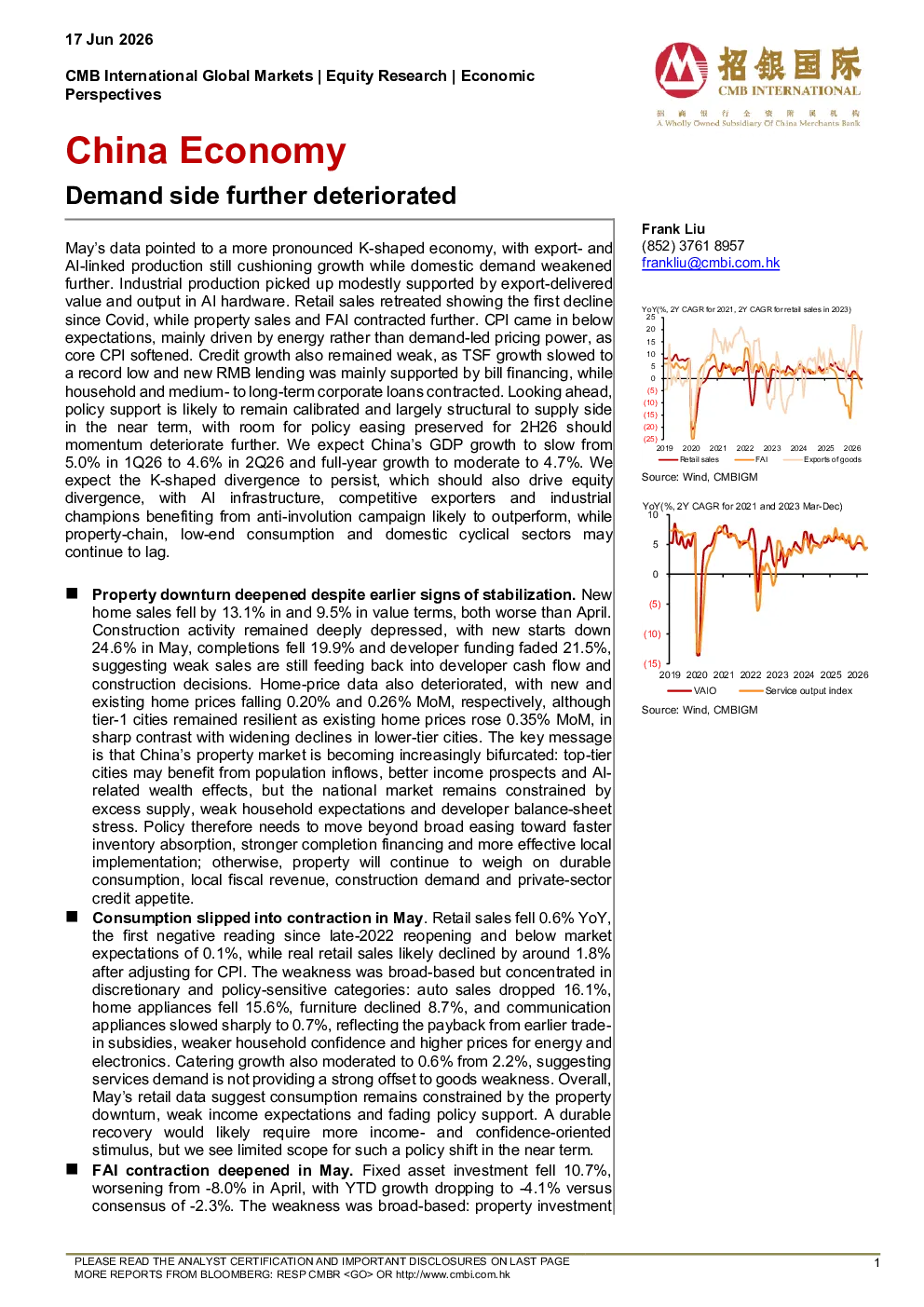
Demand side further deteriorated Frank Liu(852) 3761 8957frankliu@cmbi.com.hk May’sdata pointed to a more pronounced K-shaped economy, with export-andAI-linked production still cushioning growth while domestic demand weakenedfurther. Industrial productionpicked upmodestly supported by export-deliveredvalue and output in AI hardware. Retail salesretreated showing thefirst declinesinceCovid,while property sales and FAI contracted further. CPI came in belowexpectations, mainly driven by energy rather than demand-led pricing power, ascore CPI softened. Credit growth also remained weak, as TSF growth slowed toa record low and new RMB lending wasmainlysupportedby bill financing, whilehousehold and medium-to long-term corporate loans contracted. Looking ahead,policy support is likely to remain calibrated and largely structural to supply sidein the near term,with room for policy easing preserved for 2H26 shouldmomentum deteriorate further. We expectChina’sGDP growth to slow from Source:Wind, CMBIGM ◼Property downturn deepened despite earlier signs of stabilization.Newhome sales fell by 13.1% in and 9.5% in value terms, both worse than April.Construction activity remained deeply depressed, with new starts down24.6%in May, completionsfell19.9% and developer fundingfaded21.5%,suggesting weak sales are still feeding back into developer cash flow andconstruction decisions. Home-price data also deteriorated, with new andexisting home prices falling 0.20% and 0.26% MoM, respectively, althoughtier-1 cities remained resilient as existing home prices rose 0.35% MoM, insharp contrast with widening declines in lower-tier cities. The key messageis that China’s property market is becoming increasingly bifurcated: top-tier Source:Wind, CMBIGM ◼Consumption slipped into contraction in May. Retail sales fell 0.6% YoY,the first negative reading since late-2022 reopening and below marketexpectations of 0.1%, while real retail sales likely declined by around 1.8%after adjusting for CPI. The weakness was broad-based but concentrated indiscretionary and policy-sensitive categories: auto sales dropped 16.1%,home appliances fell 15.6%, furniture declined 8.7%, and communicationappliances slowed sharply to 0.7%, reflecting the payback from earlier trade-in subsidies, weaker household confidence and higher prices for energy andelectronics. Catering growth also moderated to 0.6% from 2.2%, suggesting FAI contraction deepened in May.Fixed asset investment fell 10.7%,worsening from-8.0% in April, with YTD growth dropping to-4.1% versus remained the largest drag at-24.3%, infrastructure investment unexpectedlyplunged to-10.8% from-3.7%, while manufacturing investment stayed incontraction at-4.2%, showing limited support from strong exports. Withinmanufacturing, auto investment remained weak at-7.9% and electricalmachinery investment fell back into contraction at-2.3%, likely reflecting thecontinued impact of anti-involution policies in EVs, batteries and solar, whiletransport equipment was the main bright spot, rising 21.4% onresilient ◼Manufacturing output recovered mildly but remained uneven.Industrialproduction rose to 4.5% YoY in May from 4.1% in April, beating marketexpectations of 4.4%. The rebound was supported by export-delivered value,which stayed elevated at 10.1%, and AI-related production, with integratedcircuit output rising 22.9%. However, the recovery was narrow: construction-linked materials remained weak, with crude steel and cement output down2.7% and 8.1%, while autos, PCs and smartphones contracted by 3.2%, May’sinflation data pointed to softening domestic demand.CPI stayedflat at 1.2% YoY in May, below market expectations of 1.3–1.4%, as theheadline was supported mainly by energy prices, while food remained aseparate drag, with food CPI at-1.7% and pork prices down 16.1%. CoreCPI edged down to 1.1% YoY from1.2%, with services CPI also moderatingto0.8%,suggesting underlying consumer demand and pricing powerremained soft. Durable goods remained tepid as autos and home appliancescontinued to drop despite some support from consumer electronics. By ◼Credit data reinforced the weakdemand picture.New TSF dropped11.5% to RMB2.03trn in May,below consensus of RMB2.32trn. Governmentnet financing further dropped 16.1% to RMB1.2trn, indicating weakeningfiscal support. Outstanding TSF growth slowed to a record-lowof7.7% YoY;new RMB loans dropped 16.1%toRMB520bn, above market expectationsofRMB450bn.More importantly,loan composition remained poor,ashousehold loans contracted by RMB141bn in both short-term and medium-to long-term loans.The medium-to long-term corporate loans fell to- ◼The recovery remains increasingly K-shaped.On the positive side,export-oriented production and selected AI-linked sectors are still providinga floor to activity. However, the weaker side of the economy is broadening:retail sales fell into contraction, property investment and sales deterioratedfurther,infrastructure investment weakened sharply,and cr