您的浏览器禁用了JavaScript(一种计算机语言,用以实现您与网页的交互),请解除该禁用,或者联系我们。 [世界银行]:增强电池储能系统的安全性:全球经验教训和最佳实践 - 发现报告

增强电池储能系统的安全性:全球经验教训和最佳实践

电气设备 2026-06-16 世界银行 苏吃吃
报告封面

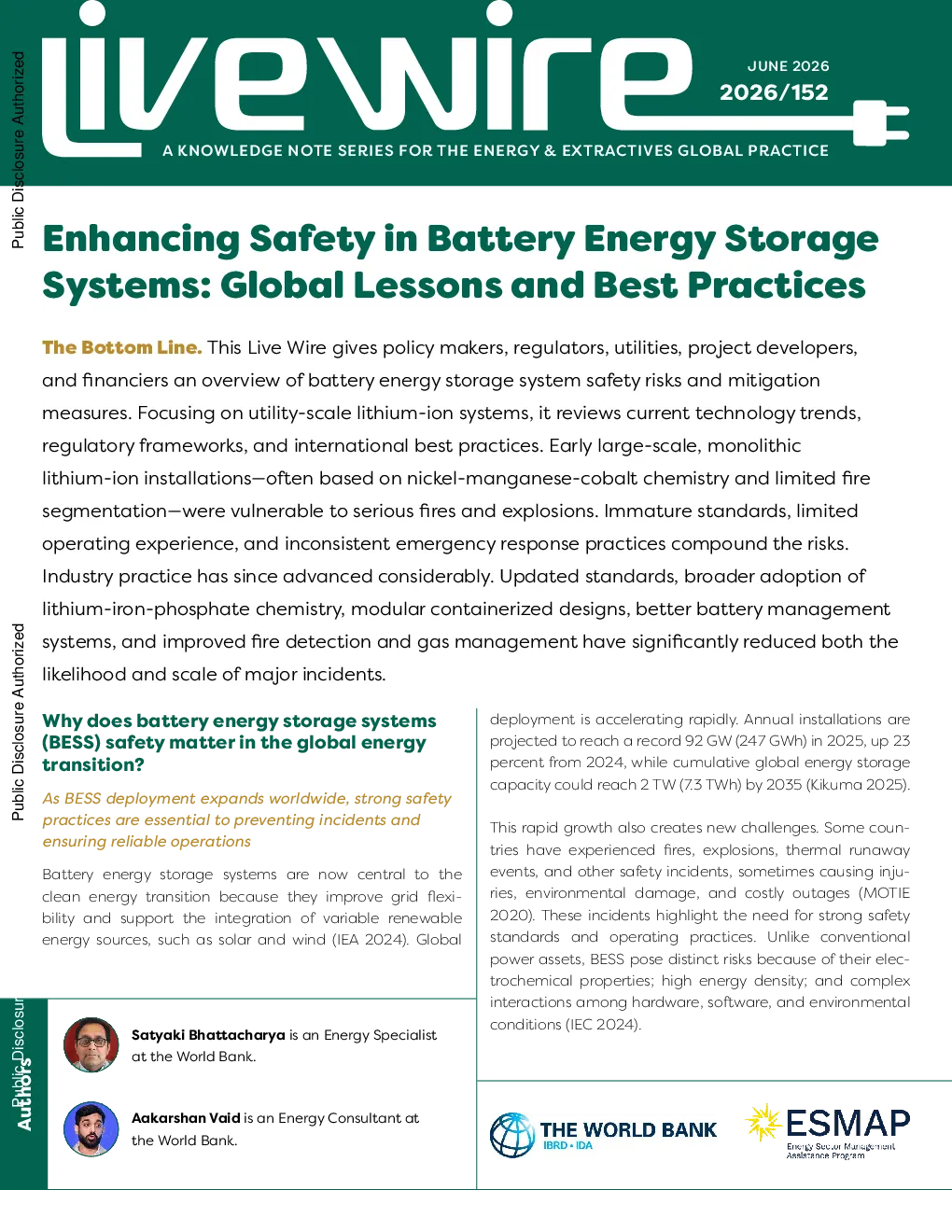
Enhancing Safety in Battery Energy StoragePublic Disclosure Authorized The Bottom Line.This Live Wire gives policy makers, regulators, utilities, project developers,and financiers an overview of battery energy storage system safety risks and mitigationmeasures. Focusing on utility-scale lithium-ion systems, it reviews current technology trends,regulatory frameworks, and international best practices. Early large-scale, monolithic deployment is accelerating rapidly. Annual installations areprojected to reach a record 92 GW (247 GWh) in 2025, up 23percent from 2024, while cumulative global energy storage Why does battery energy storage systems(BESS) safety matter in the global energy As BESS deployment expands worldwide, strong safetypractices are essential to preventing incidents andPublic Disclosure Authorized This rapid growth also creates new challenges. Some coun-tries have experienced fires, explosions, thermal runawayevents, and other safety incidents, sometimes causing inju- ries, environmental damage, and costly outages (MOTIE2020). These incidents highlight the need for strong safetystandardsand operating practices.Unlike conventional Satyaki Bhattacharyais an Energy Specialistat the World Bank. Aakarshan Vaidis an Energy Consultant atthe World Bank. demonstrateboth the consequences of immature prac-tices and the value of regulatory learning. For example, theRepublic of Korea’s investigation into a series of BESS firesbetween 2017 and 2019 prompted major reforms in manu- Weak safety measures can have seriousconsequences. Fires in enclosed battery Weak safety measures can have serious consequences. Firesin enclosed battery containers can escalate rapidly, releasingtoxic gases and triggering explosions. Emergency responseis often complicated by the lack of standardized firefight-ing protocols for lithium-ion systems (NFPA 2026). Recentupdates to international fire classification standards also Although incident data from the late 2010s remain useful forunderstanding failure modes, the safety risk profile of modernBESS installations has changed materially. Since 2022, mostnew utility-scale projects have favored lithium-iron-phos-phate (LFP) chemistry because of its greater thermal stabilityand lower oxygen release during failure events, along withimproved battery management and monitoring systems. As countries scale up BESS deployment, safety must remaina nonnegotiable priority (figure 1). Early adoption markets Regulatoryand standards gaps create additional vul-nerabilities. Global standards such as IEC 62933-5-2, UL9540/9540A,and National Fire Protection Association(NFPA) 855 provide essential guidance but do not yet fullyaddresslong-duration storage technologies,second-life What are the primary safety risks and failuredrivers in battery energy storage systems? Technical failures, environmental stress, operationalgaps, and outdated standards have resulted in safety Battery energy storage systems face a wide range of riskdrivers across design, installation, and operation. Technicalfactors are among the most significant contributors. Thermalrunaway—triggered by overcharging, manufacturing defects, Taken together, these factors show that BESS incidents rarelystem from a single failure. Instead, they reflect interactingvulnerabilities across technology, environment, operations, Environmental conditions can amplify these risks. Outdooror coastal installations may be exposed to humidity, salt,dust, and intrusion by insects or small animals, all of which How can countries strengthen safetystandards and operational practices? can cause corrosion, insulation breakdown, or short circuits.Several incidents have demonstrated how inadequate ven- Clear, context-specific standards backed by strongoperational practices are essential Governments and regulators can improve safety by adopt-ing comprehensive frameworks that cover manufacturing,system integration, installation, commissioning, operation,and end-of-life management. International references suchas IEC 62933, UL 9540/9540A, and NFPA 855 provide a O&Epractices are also critical to preventing failures.Commissioning errors, poor sensor calibration, inadequatethermal imaging or protective-device testing, and irregularinspections can undermine system performance. As batteries Developersand system integrators can improve safetythrough robust engineering design and quality assurance. Keymeasures include adequate separation distances, fire-ratedenclosures, effective thermal management, and integrated Operators should maintain rigorous O&M programs focusedon continuous monitoring of temperature, voltage, current,state of charge, and state of health. Regular inspections,ventilation system maintenance, sensor recalibration, and information and hazard documentation also supports safer, Together,these actions demonstrate that strengtheningBESS safety depends on coordinated efforts by policy mak-ers, manufacturers, developers, operators, and eme