关注OpenAI(英)2026 Guānzhù OpenAI (Yīng) 2026
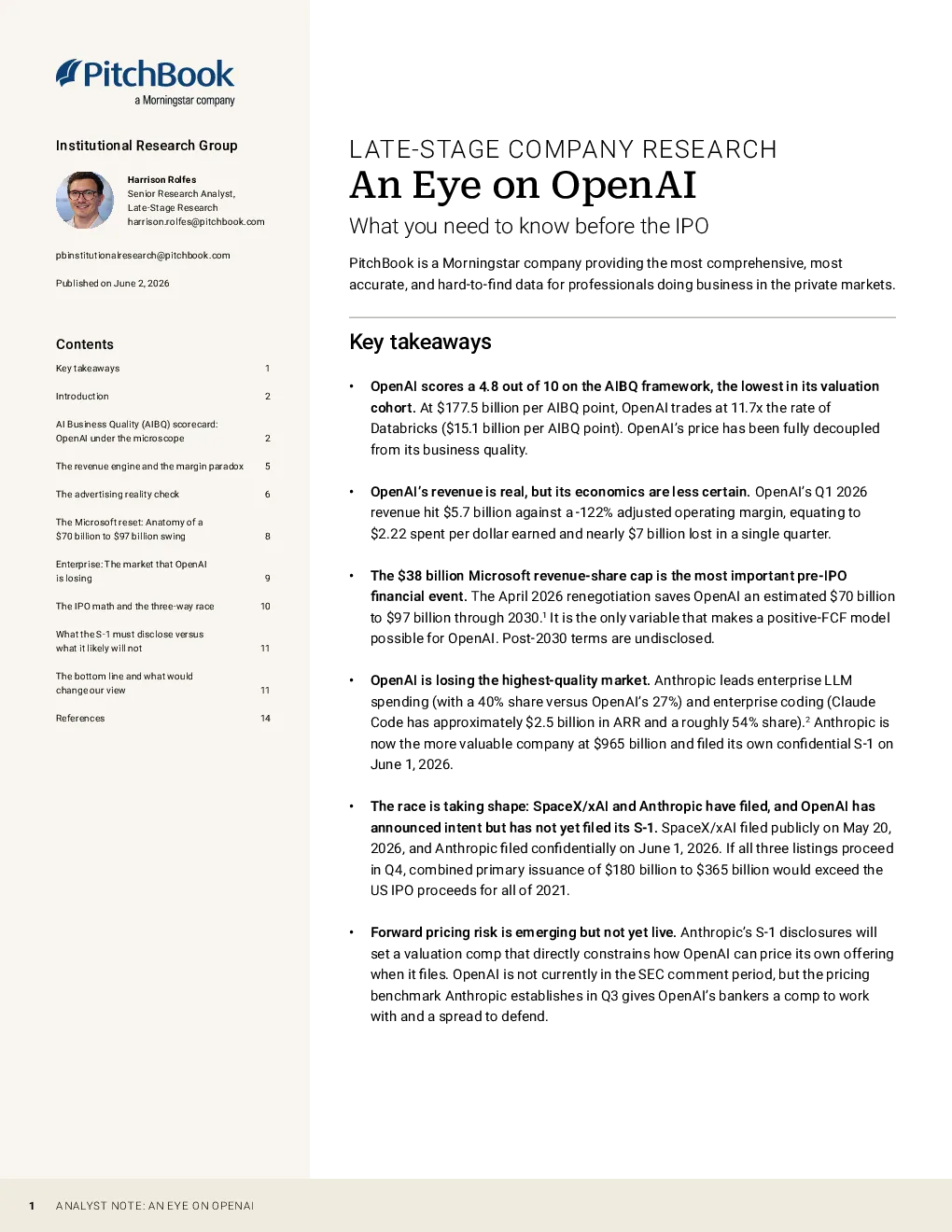
Institutional Research Group Harrison RolfesSenior Research Analyst,Late-Stage Research What you need to know before the IPO pbinstitutionalresearch@pitchbook.com PitchBook is a Morningstar company providing the most comprehensive, mostaccurate, and hard-to-find data for professionals doing business in the private markets. Published on June 2, 2026 Key takeaways •OpenAI scores a 4.8 out of 10 on the AIBQ framework, the lowest in its valuationcohort.At $177.5 billion per AIBQ point, OpenAI trades at 11.7x the rate ofDatabricks ($15.1 billion per AIBQ point). OpenAI’s price has been fully decoupled •OpenAI’s revenue is real, but its economics are less certain.OpenAI’s Q1 2026revenue hit $5.7 billion against a -122% adjusted operating margin, equating to$2.22 spent per dollar earned and nearly $7 billion lost in a single quarter. •The $38 billion Microsoft revenue-share cap is the most important pre-IPOfinancial event.The April 2026 renegotiation saves OpenAI an estimated $70 billionto $97 billion through 2030.1It is the only variable that makes a positive-FCF model •OpenAI is losing the highest-quality market.Anthropic leads enterprise LLMspending (with a 40% share versus OpenAI’s 27%) and enterprise coding (ClaudeCode has approximately $2.5 billion in ARR and a roughly 54% share).2Anthropic isnow the more valuable company at $965 billion and filed its own confidential S-1 on •The race is taking shape: SpaceX/xAI and Anthropic have filed, and OpenAI hasannounced intent but has not yet filed its S-1.SpaceX/xAI filed publicly on May 20,2026, and Anthropic filed confidentially on June 1, 2026. If all three listings proceed •Forward pricing risk is emerging but not yet live.Anthropic’s S-1 disclosures willset a valuation comp that directly constrains how OpenAI can price its own offeringwhen it files. OpenAI is not currently in the SEC comment period, but the pricingbenchmark Anthropic establishes in Q3 gives OpenAI’s bankers a comp to work Introduction OpenAI’s $852 billion valuation rests on a single structural assumption: that thecompany reaches free cash flow (FCF) break-even before its infrastructure obligationspeak. The numbers show it cannot get there without the $38 billion Microsoft revenue- OpenAI plans to confidentially file its S-1 with the US Securities and ExchangeCommission (SEC), with Goldman Sachs and Morgan Stanley leading the processtoward a Q4 2026 listing near $1 trillion.3On May 28, 2026, Anthropic closed a $65 OpenAI is not going public as the undisputed AI leader but as the second-most-valuable AI startup in what may become a three-way IPO race if it files as announced,behind a competitor projecting its first profitable quarter. AI Business Quality (AIBQ) scorecard: OpenAI The AIBQ framework scores frontier AI companies across five weighted dimensions:capital efficiency (20%), revenue quality (25%), compute independence (15%),governance optionality (20%), and moat durability (20%). OpenAI scores 4.8 out of10, placing it fourth among the Frontier Five. At an $852 billion valuation, it trades •Capital efficiency (score: 4):OpenAI has raised $185.9 billion to produce $25 billionto $33 billion in annual recurring revenue (ARR).6This equates to a 0.16x capitalefficiency ratio, improving from 0.11x in March but still third lowest in the Frontier •Revenue quality (score: 5):OpenAI’s enterprise retention of 88% is competitivebut below the over 120% net revenue retention (NRR) that public software-as-a-service investors treat as a quality benchmark.7Churn at 41% means nearly half •Compute independence (score: 5):OpenAI’s total infrastructure obligations standat approximately $1.2 trillion across Microsoft Azure, Oracle/Stargate, Broadcom,NVIDIA, AMD, Amazon Web Services (AWS), and CoreWeave.9Committed computeramps to $15 billion in 2026, $35 billion in 2027, and $80 billion in 2028, exceedingprojected revenue by 2028, when the $80 billion committed compute rampsurpasses the roughly $62 billion revenue projection, and consuming a structurally •Governance optionality (score: 4):The OpenAI Foundation's warrant share countis undisclosed, which means investors cannot model dilution. CEO Sam Altmanholds no disclosed equity, sits as sole executive director on both boards, and issubject to an active congressional inquiry. The November 2023 board crisis was •Moat durability (score: 6):OpenAI’s 905 million weekly active users (WAU), 92%Fortune 500 penetration, and 15 billion tokens per minute are strong numbers.But ChatGPT's share of AI web traffic fell from 86.7% to 64.5% in 12 months.10Enterprise market share flipped from being OpenAI-led to Anthropic-led. The Valuation per AIBQ point versus AIBQ score by company OpenAI is the outlier:highest price per unitof quality, bottom-halfAIBQ score OpenAI versus Anthropic capital efficiency ratio The capital efficiency crossover: Anthropic now generates approximately 2x to 3x the ARR per dollar raised that OpenAI does The revenue engine