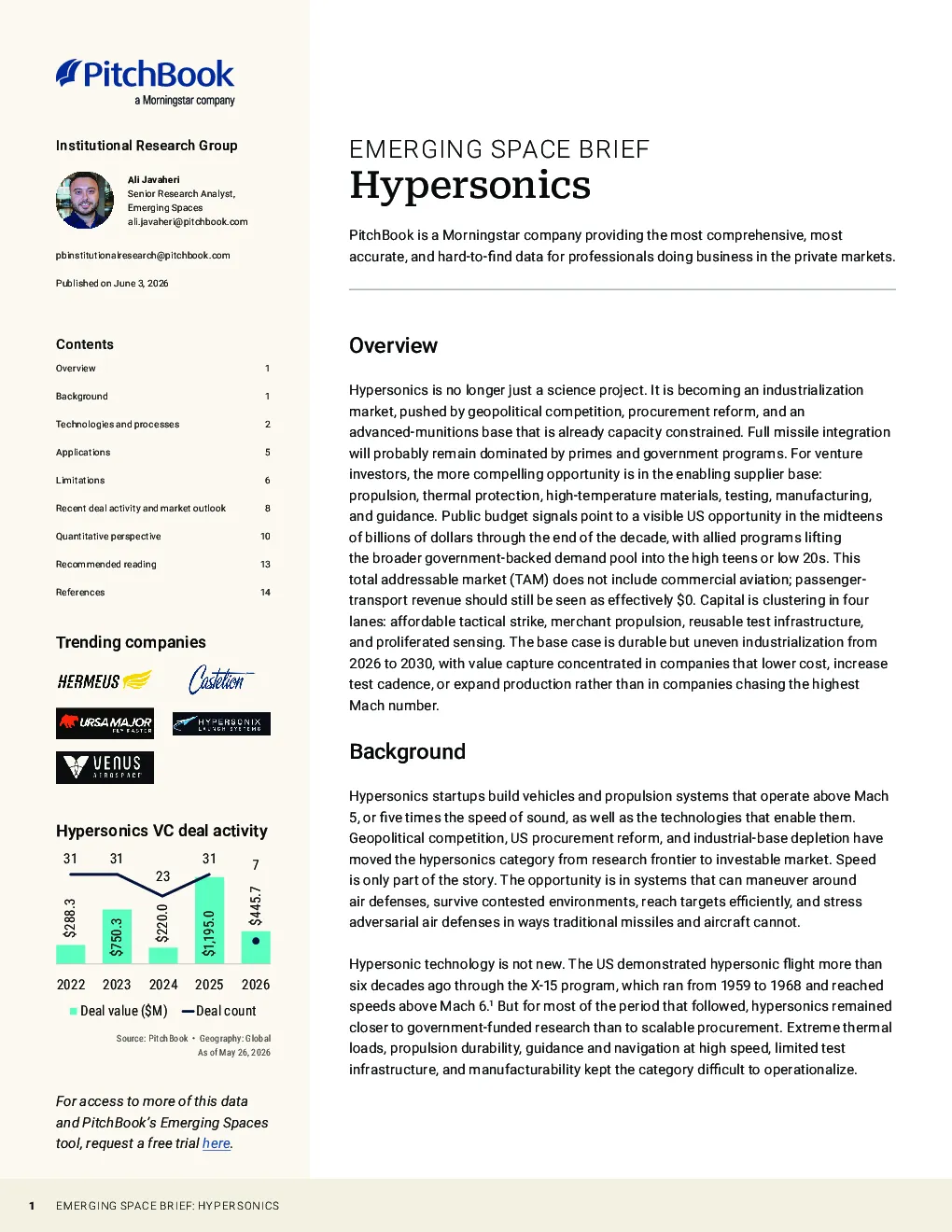
EMERGING SPACE BRIEFHypersonics Institutional Research Group Ali JavaheriSenior Research Analyst,Emerging Spacesali.javaheri@pitchbook.com PitchBook is a Morningstar company providing the most comprehensive, mostaccurate, and hard-to-find data for professionals doing business in the private markets. pbinstitutionalresearch@pitchbook.com Published on June 3, 2026 Overview Contents Hypersonics is no longer just a science project. It is becoming an industrializationmarket, pushed by geopolitical competition, procurement reform, and anadvanced-munitions base that is already capacity constrained. Full missile integrationwill probably remain dominated by primes and government programs. For ventureinvestors, the more compelling opportunity is in the enabling supplier base:propulsion, thermal protection, high-temperature materials, testing, manufacturing,and guidance. Public budget signals point to a visible US opportunity in the midteensof billions of dollars through the end of the decade, with allied programs liftingthe broader government-backed demand pool into the high teens or low 20s. Thistotal addressable market (TAM) does not include commercial aviation; passenger-transport revenue should still be seen as effectively $0. Capital is clustering in fourlanes: affordable tactical strike, merchant propulsion, reusable test infrastructure,and proliferated sensing. The base case is durable but uneven industrialization from2026 to 2030, with value capture concentrated in companies that lower cost, increasetest cadence, or expand production rather than in companies chasing the highestMach number. Background Hypersonics startups build vehicles and propulsion systems that operate above Mach5, or five times the speed of sound, as well as the technologies that enable them.Geopolitical competition, US procurement reform, and industrial-base depletion havemoved the hypersonics category from research frontier to investable market. Speedis only part of the story. The opportunity is in systems that can maneuver aroundair defenses, survive contested environments, reach targets efficiently, and stressadversarial air defenses in ways traditional missiles and aircraft cannot. Hypersonic technology is not new. The US demonstrated hypersonic flight more thansix decades ago through the X-15 program, which ran from 1959 to 1968 and reachedspeeds above Mach 6.1But for most of the period that followed, hypersonics remainedcloser to government-funded research than to scalable procurement. Extreme thermalloads, propulsion durability, guidance and navigation at high speed, limited testinfrastructure, and manufacturability kept the category difficult to operationalize. For access to more of this dataand PitchBook’s Emerging Spacestool, request a free trialhere. That began to change as China and Russia developed hypersonic andhypersonic-adjacent weapons. China’s DF-ZF glide vehicle and reported 2021fractional orbital glide test raised concerns that US missile-warning and air-defensearchitectures could be stressed by maneuverable systems flying nontraditionaltrajectories at high speed.2Russia’s Avangard glide vehicle and Kinzhal, Tsirkon, andOreshnik missiles reinforced the view that hypersonics had moved from laboratoryresearch to operational signaling. US thinking shifted accordingly: Hypersonics wasno longer about matching adversary speed but about preserving deterrence, strikecredibility, and defensive resilience. US demand is now formalizing around programs of record, including Dark Eagle,Conventional Prompt Strike (CPS), Hypersonic Attack Cruise Missile (HACM), the GlidePhase Interceptor, and remaining Air-Launched Rapid Response Weapon (ARRW)procurement activity. These programs are still prime led, but they create pull-throughdemand for propulsion, thermal protection, materials, testing, manufacturing,and guidance. Acquisition reform, Australia-UK-US (AUKUS) collaboration, andUkraine-driven munitions bottlenecks are widening the startup opportunity. Themarket opportunity for venture investors is less about creating the next prime forhypersonic missiles and more about backing the suppliers that enable the category toscale: the components, materials, manufacturing capacity, testing infrastructure, andguidance layers that make operational deployment economically viable. Technologies and processes Hypersonics is more of a stack than a single category; its three layers range fromoffensive vehicles through manufacturing, and each has its own market dynamics.The US Department of Defense (DOD) has shifted its framing from hypersonicdemonstration to “scaled hypersonics”: fielding hypersonic weapons with speed,precision, and survivability at a mass scale. The market opportunity sits within thelayers that enable this. Testing is one of the biggest bottlenecks in hypersonics. Ground facilities (includingwind tunnels, shock tunnels, arc jets, propulsion stands, materials testing, andhardware-in-the-loop simulation) recreate piece