人形机器人:科学家、发明家、工程师和园丁的行业定位解析
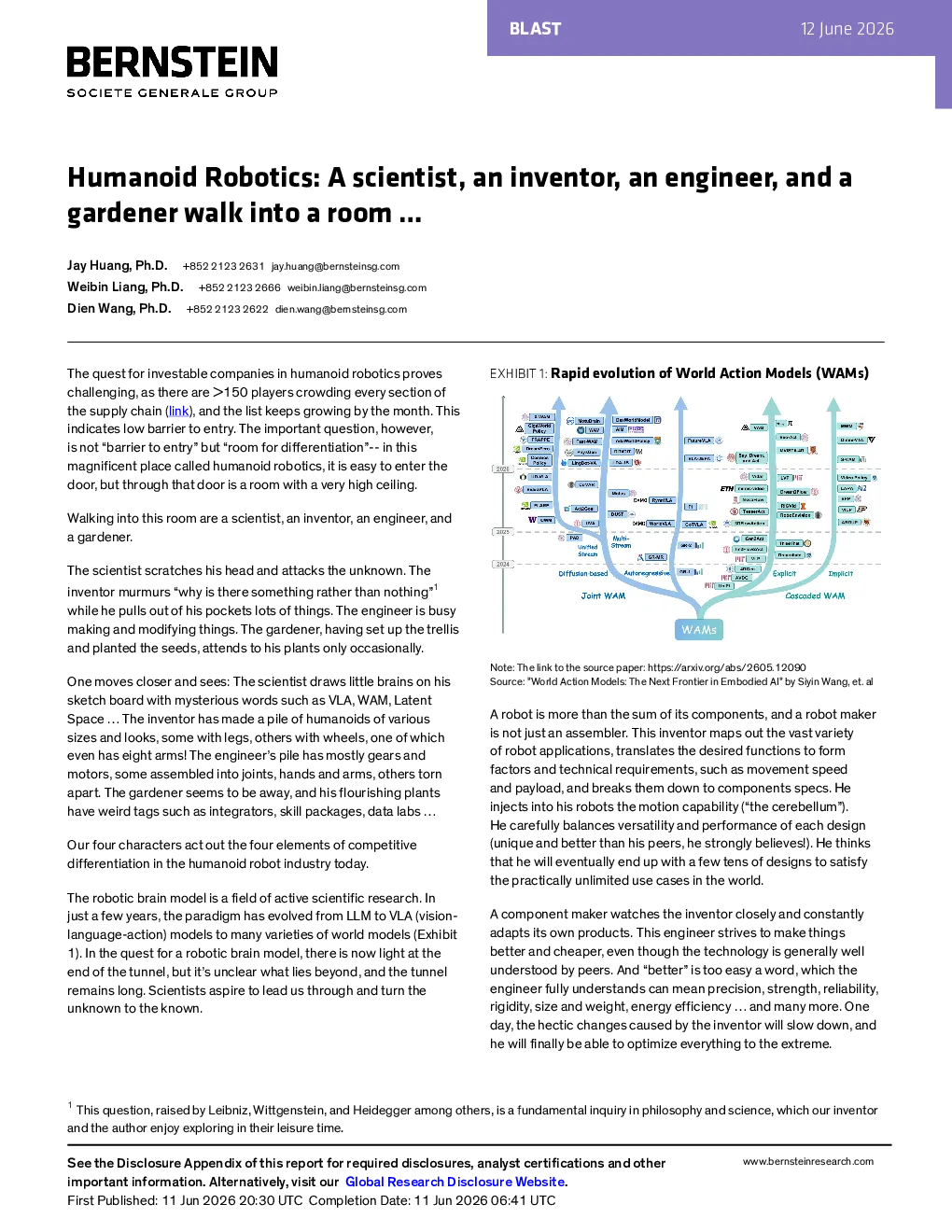
Jay Huang, Ph.D.+852 2123 2631jay.huang@bernsteinsg.comWeibin Liang, Ph.D.+852 2123 2666weibin.liang@bernsteinsg.comDien Wang, Ph.D.+852 2123 2622dien.wang@bernsteinsg.com The quest for investable companies in humanoid robotics proveschallenging, as there are >150 players crowding every section ofthe supply chain (link), and the list keeps growing by the month. Thisindicates low barrier to entry. The important question, however,is not “barrier to entry” but “room for differentiation”-- in thismagnificent place called humanoid robotics, it is easy to enter thedoor, but through that door is a room with a very high ceiling. Walking into this room are a scientist, an inventor, an engineer, anda gardener. The scientist scratches his head and attacks the unknown. Theinventor murmurs “why is there something rather than nothing”1while he pulls out of his pockets lots of things. The engineer is busymaking and modifying things. The gardener, having set up the trellisand planted the seeds, attends to his plants only occasionally. One moves closer and sees: The scientist draws little brains on hissketch board with mysterious words such as VLA, WAM, LatentSpace … The inventor has made a pile of humanoids of varioussizes and looks, some with legs, others with wheels, one of whicheven has eight arms! The engineer’s pile has mostly gears andmotors, some assembled into joints, hands and arms, others tornapart. The gardener seems to be away, and his flourishing plantshave weird tags such as integrators, skill packages, data labs … A robot is more than the sum of its components, and a robot makeris not just an assembler. This inventor maps out the vast varietyof robot applications, translates the desired functions to formfactors and technical requirements, such as movement speedand payload, and breaks them down to components specs. Heinjects into his robots the motion capability (“the cerebellum”).He carefully balances versatility and performance of each design(unique and better than his peers, he strongly believes!). He thinksthat he will eventually end up with a few tens of designs to satisfythe practically unlimited use cases in the world. Our four characters act out the four elements of competitivedifferentiation in the humanoid robot industry today. The robotic brain model is a field of active scientific research. Injust a few years, the paradigm has evolved from LLM to VLA (vision-language-action) models to many varieties of world models (Exhibit1). In the quest for a robotic brain model, there is now light at theend of the tunnel, but it’s unclear what lies beyond, and the tunnelremains long. Scientists aspire to lead us through and turn theunknown to the known. A component maker watches the inventor closely and constantlyadapts its own products. This engineer strives to make thingsbetter and cheaper, even though the technology is generally wellunderstood by peers. And “better” is too easy a word, which theengineer fully understands can mean precision, strength, reliability,rigidity, size and weight, energy efficiency … and many more. Oneday, the hectic changes caused by the inventor will slow down, andhe will finally be able to optimize everything to the extreme. The final element of differentiation is to become the “owner” ofthe ecosystem (Exhibit 3). A variety of additional players join forceto unlock the industry’s potential. They develop new robotic skillsets, collect data and do training, build accessories, and deploy forusers. To be the gardener at the center of the ecosystem is to bethe center of gravity of these players. He waits for his plants to bearfruits robot makers also start to emerge at the center of the ecosystem(link). He is an inventor also wearing the hats of the scientist and theengineer, and gardening is his weekend job. One exits the room of humanoid robotics, and in this magichouse he finds many more rooms with our four friends (Exhibit2). Scientists are more likely present in the newer rooms, such asthose tagged “Quantum Computing” and “Fusion Energy”. In otherrooms, scientists made their marks and have left; inventors andengineers are the busiest. In some ancient rooms, engineers aloneremain working. In the room tagged “Industrial Robotics”, FANUC,the inventor, has a very large pile of things and is right now tendingthe garden with his friends Nvidia (link) and Google (link). In another,Keyence is an inventor with a towering presence (Exhibit 4). Hispile has over 6,000 items, and he keeps pulling new stuff from hispockets at amazing speed (link). Our fable of the industry is clearly simplified, while the reality isentangled. A robot maker, being the inventor, also needs to be agood engineer. A component maker, from time to time, inventsnew products. It is fair to ask whether robot OEMs or componentsuppliers are the better segment to invest in. Good investmentopportunities arise in both, but structurally, we think robot OEMscommands multiple elements to differentiate, instead of be